
Wheel Stud Thread Pitch: Reading M14x1.5 and Its Cousins
Threads that are close are more dangerous than threads that do not fit. Here is how a designation is structured and how to identify yours with a gauge.

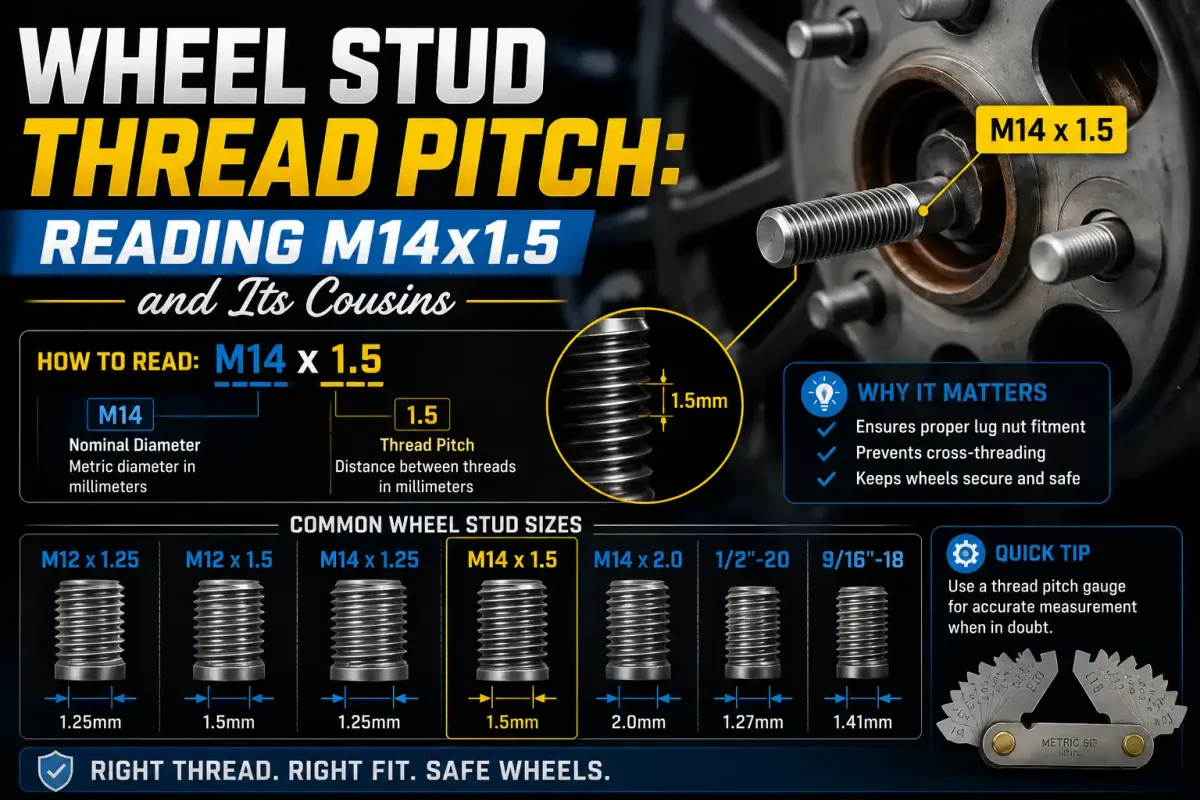
Short answer: the dangerous case is not a nut that will not fit, it is a nut that nearly fits. A thread specification close to but not identical to your studs will start, will run down, will feel like it is working, and will destroy the stud thread as it goes. A nut that plainly does not fit stops you. A nut that nearly fits does not.
That is why identifying the thread properly matters more than it seems to. This page covers how a designation is structured and how to establish yours with a gauge rather than by feel.
How a metric thread designation is structured
A metric thread designation such as M14x1.5 has three parts.
M means metric.
14 is the nominal major diameter in millimeters, which is approximately the outside diameter of the thread on the stud.
1.5 is the pitch in millimeters, the distance from one thread crest to the next.
The pitch is where the near-misses live. Two studs of the same nominal diameter with different pitches are physically similar enough that a nut will engage, and different enough that the engagement destroys the threads. Diameter differences are usually obvious; pitch differences are not.
How an imperial thread designation is structured
An imperial designation is written differently and expresses the same two properties.
The first part is the nominal diameter in inches, often as a fraction. The second is the threads per inch, which is the inverse of pitch: where metric states the distance between threads, imperial states how many fit in an inch.
This inversion is a real source of error. In metric, a larger second number means a coarser thread. In imperial, a larger second number means a finer thread. Someone comparing across the two systems without noticing the reversal reaches the wrong conclusion confidently.
The general lesson about numbers that have crossed a unit boundary applies here: why two websites give your car two different numbers.
Why nearly-matching threads are the real hazard
The mechanism is worth being explicit about.
When a nut with the wrong pitch is threaded onto a stud, the crests of one thread form bear on the flanks of the other rather than mating. Turning the nut forces those mismatched surfaces past each other, which deforms and shears material from the softer of the two.
What you feel while doing it is resistance, which is exactly what you feel when a correct fastener is being tightened. There is no distinct sensation that says "this is wrong" as opposed to "this is getting tight."
By the time the nut is fully down, the stud's thread may be substantially damaged. The joint can still register a torque reading, because the wrench is measuring resistance and there is plenty of resistance. What it is not measuring is whether that resistance came from clamping force or from destroying a thread.
Torque as a proxy for clamping force only holds when the joint is what the specification assumed: where your wheel torque spec actually lives.
Identifying your thread with a gauge rather than by feel
The correct tool is a thread pitch gauge, a set of leaves each cut to a specific pitch. You offer each leaf to the thread until one seats cleanly along its full length with no gaps.
Two points of method. Check the fit along the whole engaged length rather than at one point, since a close-but-wrong pitch will look correct across two or three threads and diverge over ten. And measure the diameter separately, because the gauge gives you pitch alone and the designation needs both.
What does not work is threading a nut on and judging by feel. That is the exact test the hazard defeats.
If you do not have a gauge, a tire and wheel professional does, and identifying a thread is a two-minute job for them.
Where the specification is recorded for your vehicle
Wheel fastener thread specifications are not usually in the owner's manual. They live in manufacturer service information, which is the tier above: owner's manual vs service manual vs repair database.
For aftermarket wheels and fasteners, the manufacturer of those parts specifies what they require, and they are the authority on their own products.
We do not publish thread specifications by vehicle. We cannot verify them across every model, year and market, and this is a fastener whose failure mode is a wheel coming off.
What a damaged stud thread means
A stud with damaged threads does not reliably develop clamping force, and a joint that does not clamp properly allows movement, which damages the seats and loosens the assembly further.
It is also not something to assess by eye with confidence, because the damage is inside the thread form.
If you suspect a stud has been cross-threaded or run with the wrong pitch, treat it as needing inspection rather than as something to torque up and watch. Studs are replaceable, and replacing one is a much smaller matter than the alternative.
When this becomes a professional's job
Three triggers, and any one of them is enough.
You cannot confidently identify the thread. Do not proceed on a hypothesis.
A nut has gone on unusually hard, or you have felt anything gritty. That is the symptom of the failure this page is about.
Studs are being replaced. Wheel stud replacement is a safety-relevant repair on an assembly that keeps the wheel attached to the vehicle, and it is not something this site will walk you through.
The rest of the fastener side of the joint, which fails in a similarly quiet way: lug seat types, and why the wrong nut fails. And the full pre-purchase checklist for used wheels: will these used wheels fit.
Frequently asked questions
What does M14x1.5 mean?
Metric thread, 14 millimeters nominal major diameter, 1.5 millimeters between thread crests. The second number is the pitch.
Why is a slightly wrong thread pitch dangerous?
Because it engages. The nut runs down while shearing material from the threads, and the resistance feels like normal tightening. A thread that plainly does not fit stops you; one that nearly fits does not.
How do I find my wheel stud thread pitch?
With a thread pitch gauge, checking the fit along the full engaged length, and measuring the diameter separately. Threading a nut on and judging by feel is exactly the test this hazard defeats.
Is metric or imperial finer at a higher number?
They run opposite ways. In metric a larger pitch number is coarser; in imperial a larger threads-per-inch number is finer. This reversal causes confident mistakes.
Can I reuse a stud that was cross-threaded?
Treat it as needing inspection by a professional. Thread damage is inside the form and hard to assess by eye, and a stud that does not clamp properly loosens the assembly.