Where Your Wheel Torque Spec Actually Lives
The index has no entry for lug nuts because it is filed under changing a tire. Here are the four places it hides and what to do when it is in none of them.

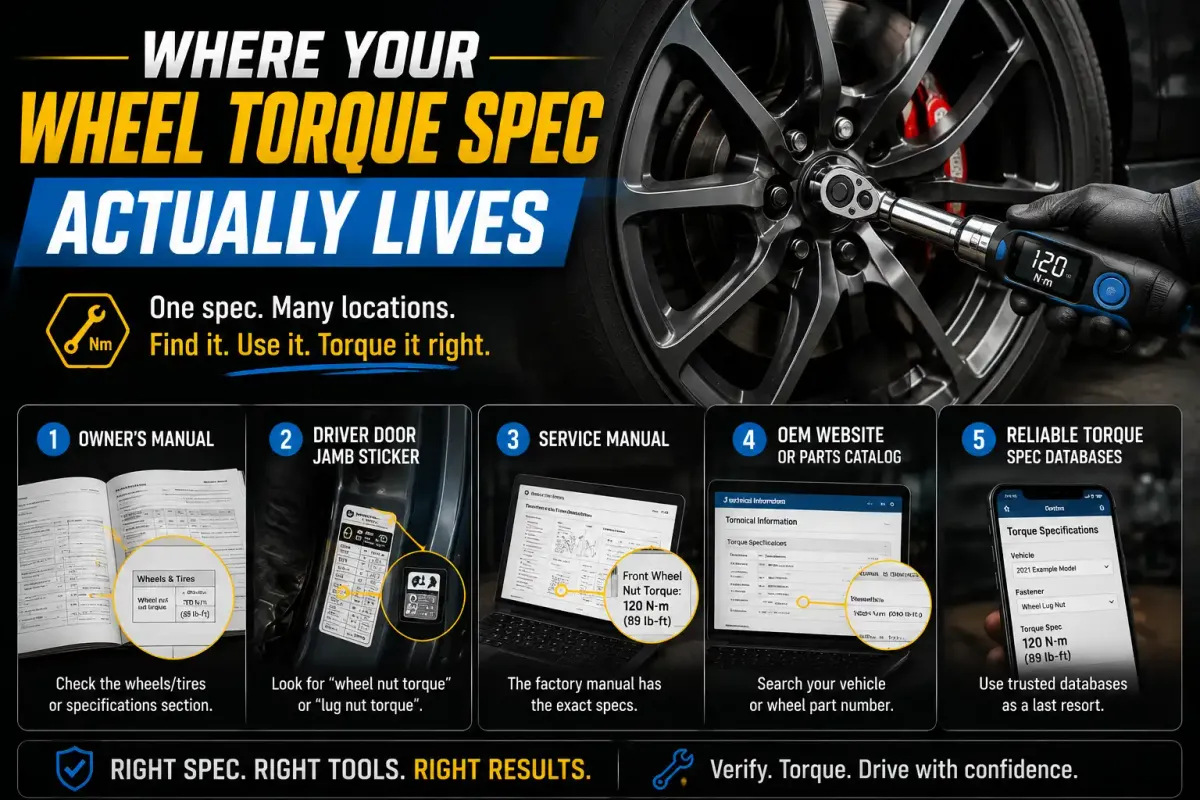
Short answer: it is usually filed under changing a tire rather than under specifications, which is why the index fails you. You looked in the right book and searched the right word. Owner's manuals frequently do not index this figure under torque, under lug or under wheel, and a reader who searches those terms concludes the manual does not have it when often it does.
This page covers the four places it hides, and what to do in the cases where the owner's manual genuinely does not carry it.
Why the index fails you
Owner's manual indexes are built around what an owner is doing, not around what an engineer would call the information.
A wheel torque figure is not filed as a specification because, from the manual author's point of view, it is not one. It is a step in a procedure: the procedure for changing a wheel at the roadside. So it appears inside that procedure, and the index entry is the procedure's name.
Search the manual's PDF for the unit rather than the word. Searching for the abbreviation of foot-pounds or of newton-metres will find the figure wherever it sits, including inside a numbered step where no index entry would ever point you.
Place one: the tire changing or spare wheel section
The most common location by a wide margin.
Look for the section covering roadside wheel changes, the spare wheel, or what to do with a flat. The figure typically appears as one line inside the sequence, after the instruction to lower the vehicle.
It is often accompanied by an instruction about tightening order, which is part of the same specification rather than an optional extra: torque sequence and why order matters.
Place two: a label with the jack or in the spare well
Some manufacturers print the figure on a label rather than only in the book.
Check the jack itself, the jack storage location, the spare wheel well, and the underside of the trunk floor panel. This is the same design logic as the tire placard in the door jamb: put the information where the person will be when they need it.
A label is also the version that survives a lost manual, which makes it worth photographing while you are down there.
Place three: manufacturer service information
Where the owner's manual has it, the manual is authoritative. Where it does not, the tier above does.
Manufacturer service information carries wheel torque with its conditions attached, including whether a different figure applies to different wheel types on the same vehicle. It resolves to your specific VIN, which a chart never can.
How to get into it as a private owner: owner's manual vs service manual vs repair database.
When the owner's manual genuinely does not carry it
It happens, and it is not a defect in your copy.
Before concluding that, check two things. That you have the manual for your market, since manuals from other markets are different documents and may be organized differently. And that you have the manual for your model year, since content moves between editions.
If you no longer have yours, most manufacturers host them free: where to get your owner's manual free.
If it truly is not there, go to manufacturer service information or ask a dealer service department. Do not substitute a general chart. This is a fastener whose failure mode is a wheel leaving a moving vehicle, and a figure from another vehicle is not a conservative approximation, it is a different specification.
Aftermarket wheels: whose figure applies now
If your wheels are not the ones the vehicle was built with, the vehicle manufacturer's figure was specified for a joint that no longer exists in that form.
The wheel manufacturer has a legitimate claim to specify for their own wheel, and there is real reasoning behind which one governs: aftermarket wheels, whose torque spec applies.
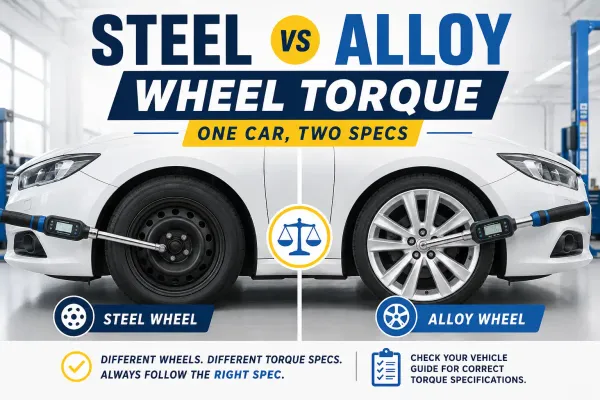
There is a related fork even on original wheels. A vehicle supplied with both steel and alloy wheels may carry two different figures, one per wheel type, and the seasonal swap is where that catches people: steel vs alloy wheel torque.
What to do with the figure once you have it
Having the number is not the whole job.
Check the units. Manuals and wrenches are not always in the same system, and the foot-pound to inch-pound confusion is an order-of-magnitude error rather than a small one.
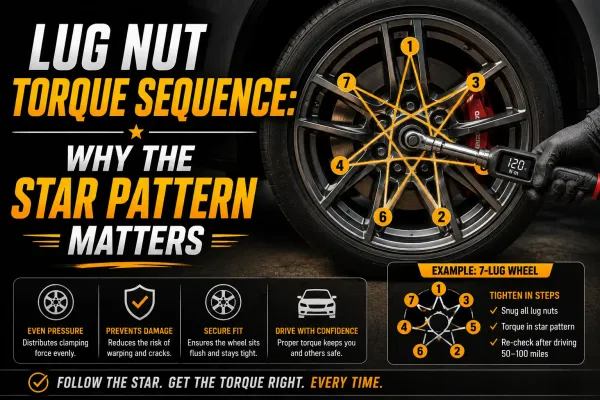
Apply it in the specified sequence, in more than one pass.
Apply it with a tool you can read, which is a skill rather than a given: click, beam and digital torque wrenches.
Note any re-torque instruction, from the manual or from whoever fitted the wheels.
Note the thread condition the figure assumes. A specification assumes a thread state, and adding anything to the threads changes what the number achieves.
The whole structure of a torque specification, and why the number alone is not it: how to find the torque spec for any fastener.
Frequently asked questions
Why is lug nut torque not in my manual's index?
Because it is filed inside the roadside wheel changing procedure rather than as a specification. Search the PDF for the unit abbreviation rather than for the word torque.
Where else does the figure appear?
Frequently on a label with the jack, in the spare wheel well, or on the underside of the trunk floor panel.
My manual really does not have it. What now?
Confirm you have the manual for your market and model year, then go to manufacturer service information or a dealer service department. Do not substitute a general chart.
Does the figure change with aftermarket wheels?
It can. The vehicle manufacturer specified for a joint that included their wheel, and the wheel manufacturer has a legitimate claim to specify for theirs.
Can one car have two wheel torque specs?
Yes. Vehicles supplied with both steel and alloy wheels may carry a different figure for each, which is where seasonal wheel swaps go wrong.