5 Lug Bolt Pattern Chart 2026: Complete mm to Inch Guide
Every common 5-lug bolt pattern in mm and inches, the stud spacing you can actually measure, and why 5x114.3 is not 5x115.

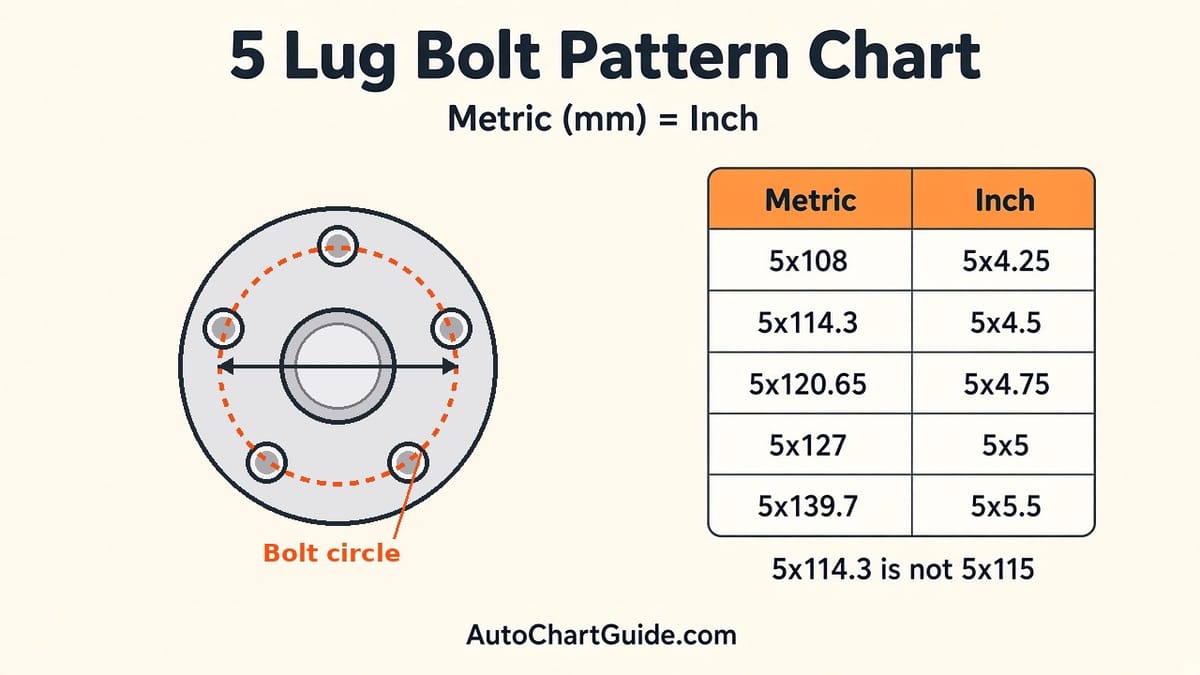
Short answer: A 5-lug bolt pattern is written as 5 x the diameter of the circle through the stud centers. The most common 5-lug patterns are 5x100, 5x10⁸, 5x112, 5x114.3 (5x4.5 in), 5x115, 5x120, 5x127 (5x5 in) and 5x139.7 (5x5.5 in). To convert between metric and inch, divide or multiply by 25.4. Four of those inch sizes are exact: 5x4.5 = 5x114.3, 5x4.75 = 5x120.65, 5x5 = 5x127 and 5x5.5 = 5x139.7. On a 5-lug hub there's no stud directly opposite another, so you can't read the circle diameter straight across. Measure the center-to-center distance between two neighboring studs and multiply by 1.7013. Look-alike patterns such as 5x114.3 and 5x115 are only 0.7 mm apart and are not interchangeable.
This chart was built from geometry, not copied from a fitment database. Every mm-to-inch conversion and every stud spacing below is calculated from the bolt-circle diameter, and the method is shown so you can check it. The vehicle examples are limited to ones we could confirm from manufacturer or genuine-parts listings, read on October 26, 2026. Always confirm your exact vehicle in the owner's manual, with a dealer, or by measuring before you buy wheels.
5 Lug Bolt Pattern Chart: Metric, Inch and Stud Spacing
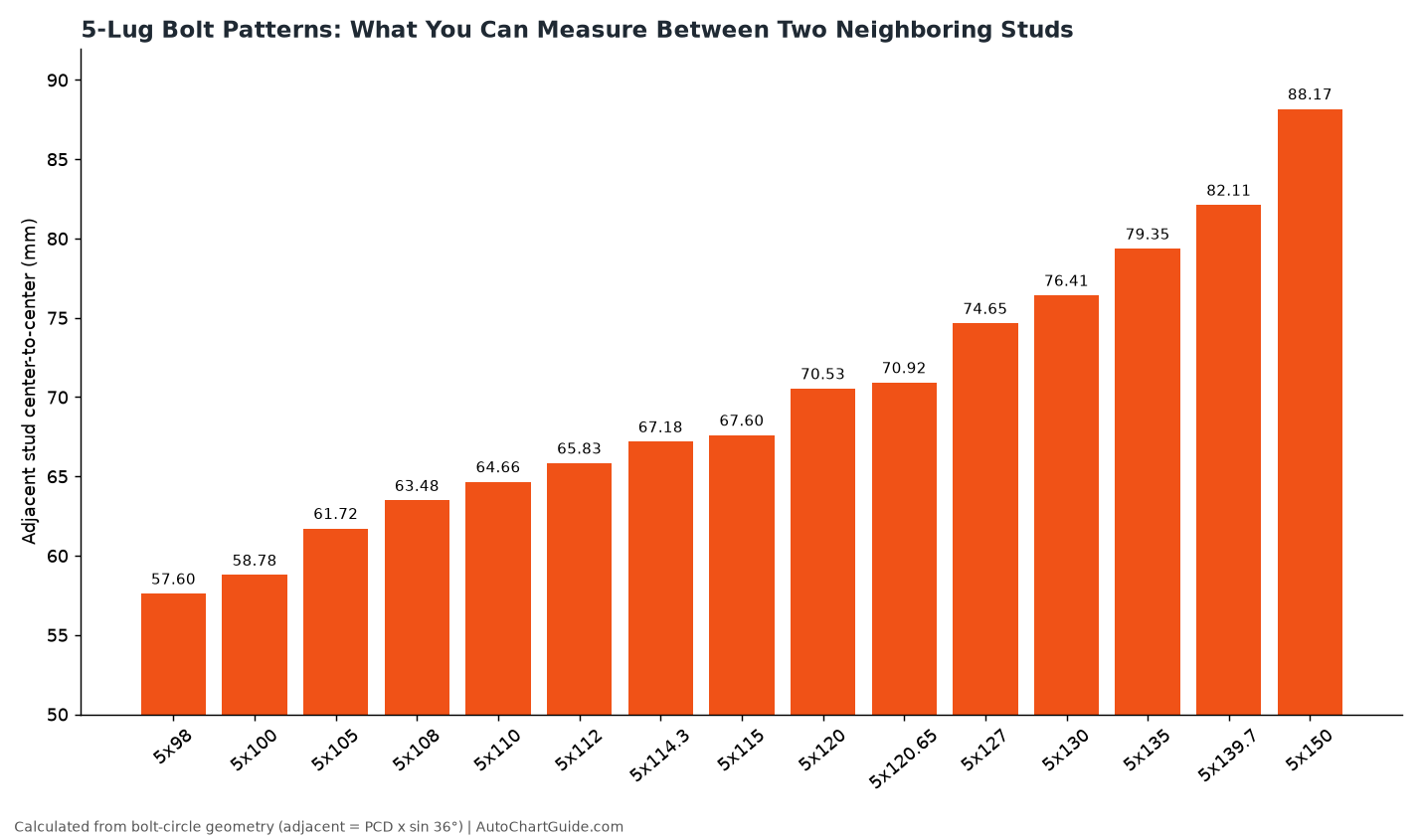
This is the full chart. The "adjacent stud" column is the measurement you can take with a ruler or caliper between two neighboring studs. The "skip one" column is the distance from one stud to the stud after next. Both are center to center.
| Pattern | Bolt circle (PCD) | Bolt circle in inches | Adjacent stud spacing | "Skip one" spacing |
|---|---|---|---|---|
| 5x98 | 98 mm | 3.8583 in | 57.60 mm (2.268 in) | 93.20 mm |
| 5x100 | 100 mm | 3.9370 in | 58.78 mm (2.314 in) | 95.11 mm |
| 5x10⁵ | 105 mm | 4.1339 in | 61.72 mm (2.430 in) | 99.86 mm |
| 5x10⁸ | 108 mm | 4.2520 in (5x4.25) | 63.48 mm (2.499 in) | 102.71 mm |
| 5x110 | 110 mm | 4.3307 in | 64.66 mm (2.546 in) | 104.62 mm |
| 5x112 | 112 mm | 4.4094 in | 65.83 mm (2.592 in) | 106.52 mm |
| 5x114.3 | 114.3 mm | 4.5000 in (5x4.5) | 67.18 mm (2.645 in) | 108.71 mm |
| 5x115 | 115 mm | 4.5276 in | 67.60 mm (2.661 in) | 109.37 mm |
| 5x120 | 120 mm | 4.7244 in | 70.53 mm (2.777 in) | 114.13 mm |
| 5x120.65 | 120.65 mm | 4.7500 in (5x4.75) | 70.92 mm (2.792 in) | 114.74 mm |
| 5x127 | 127 mm | 5.0000 in (5x5) | 74.65 mm (2.939 in) | 120.78 mm |
| 5x130 | 130 mm | 5.1181 in | 76.41 mm (3.008 in) | 123.64 mm |
| 5x135 | 135 mm | 5.3150 in (5x5.31) | 79.35 mm (3.124 in) | 128.39 mm |
| 5x139.7 | 139.7 mm | 5.5000 in (5x5.5) | 82.11 mm (3.233 in) | 132.86 mm |
| 5x150 | 150 mm | 5.9055 in | 88.17 mm (3.471 in) | 142.66 mm |
How to read it: if you measure 67.2 mm between two neighboring studs, your pattern is 5x114.3. If you measure about 74.6 mm, it's 5x127 (5x5 in). Because the look-alike patterns are so close together (see below), always take the measurement on more than one pair of studs and compare it with the chart. A difference of half a millimeter matters.
How a 5-Lug Bolt Pattern Is Written
The first number is the lug count and the second is the bolt-circle diameter, also called the pitch circle diameter (PCD). That's the diameter of an imaginary circle that passes through the center of every stud. In 5x114.3, there are five studs on a circle 114.3 mm across.
U.S. listings often use inches instead. 5x4.5 means five studs on a 4.5-inch circle. Because one inch is defined as exactly 25.4 mm, 4.5 in is exactly 114.3 mm, so 5x4.5 and 5x114.3 are the same pattern under two names. The same is true of 5x4.75 (120.65 mm), 5x5 (127 mm) and 5x5.5 (139.7 mm).
Not every common "inch" label is exact, though. 5x4.25 works out to 107.95 mm, while the metric pattern is usually called 5x10⁸. The 0.05 mm gap is far below what you could measure at home, and listings use the two names for the same pattern. 5x135, by contrast, has no neat inch equivalent. It's about 5x5.31 in, and you'll usually see it written in millimeters.
The bolt pattern has nothing to do with stud thread or lug nut size. A 5x114.3 hub can use M12x1.5, M14x1.5 or 1/2-20 studs depending on the vehicle. Our guide to wheel stud thread pitch covers that part of the fit.
Why You Multiply by 1.7013 on a 5-Lug Hub
On 4, 6 and 8-lug hubs, two studs sit directly opposite each other, so a ruler from one stud center to the opposite stud center reads the bolt-circle diameter directly. On a 5-lug hub, the studs are 72 degrees apart and none is directly opposite another. If you measure straight across from one stud, you land between two studs on the far side.
The geometry fixes that. Two neighboring studs and the hub center form a triangle, and the distance between neighboring studs equals the bolt-circle diameter x sin 36°, which is 0.5878 x the diameter. Turning that around:
- Bolt circle = adjacent stud spacing x 1.7013
- Bolt circle = "skip one" spacing x 1.0515 (from one stud to the one after next, 144 degrees apart, which is diameter x sin 72°)
Worked example: you measure 70.5 mm center to center between two neighboring studs. 70.5 x 1.7013 = 119.94 mm, so the pattern is 5x120. If you measure 70.9 mm instead, 70.9 x 1.7013 = 120.62 mm, which points to 5x120.65 (5x4.75 in). That 0.4 mm difference is why careful measuring matters. Our step-by-step guide on how to measure a bolt pattern walks through the tools and technique.
Measuring a 5-Lug Pattern Step by Step
- Use a caliper if you can. A tape measure is fine for telling 5x100 from 5x139.7, but not for telling 5x114.3 from 5x115.
- Measure center to center. Measuring the edge of one stud to the same edge of its neighbor gives the same result as center to center, because the studs are the same size. On a wheel, measure the lug holes the same way.
- Measure several pairs. Take adjacent spacing on at least three pairs and average them.
- Multiply by 1.7013 and find the nearest pattern in the chart.
- If the answer falls between two look-alikes, don't guess. Check the owner's manual, a dealer parts department or the original wheel's markings.
Look-Alike 5-Lug Patterns That Don't Interchange
Several 5-lug patterns are close enough that a wheel looks like it should go on. The table shows how far apart they really are, and the radial offset is how far each stud sits from the center of the other pattern's hole.
| Patterns | Bolt-circle difference | Radial stud offset | Adjacent-spacing difference |
|---|---|---|---|
| 5x120 vs 5x120.65 | 0.65 mm | 0.325 mm | 0.382 mm |
| 5x114.3 vs 5x115 | 0.70 mm | 0.350 mm | 0.411 mm |
| 5x98 vs 5x100 | 2.00 mm | 1.000 mm | 1.176 mm |
| 5x10⁸ vs 5x110 | 2.00 mm | 1.000 mm | 1.176 mm |
| 5x112 vs 5x114.3 | 2.30 mm | 1.150 mm | 1.352 mm |
| 5x127 vs 5x130 | 3.00 mm | 1.500 mm | 1.763 mm |
| 5x135 vs 5x139.7 | 4.70 mm | 2.350 mm | 2.763 mm |
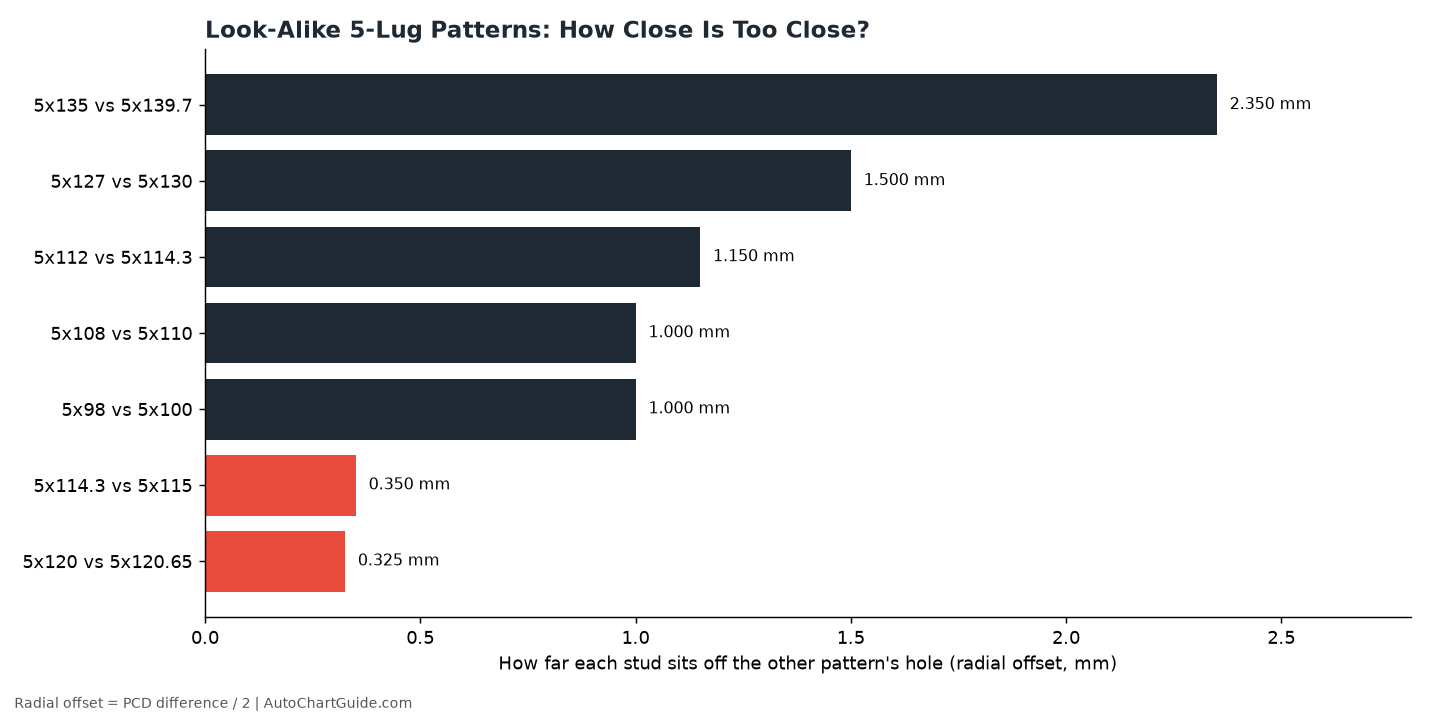
The two closest pairs are the most dangerous, because the studs may start into the holes. 5x114.3 and 5x115 differ by 0.7 mm in bolt circle, which puts each stud 0.35 mm off-center. 5x120 and 5x120.65 differ by 0.65 mm. With a conical lug seat, a nut that's off-center doesn't seat evenly, and the wheel ends up held by stud bending and partial seat contact instead of full clamping. That can let lug nuts loosen and, in the worst case, studs fail. A wider pair like 5x112 and 5x114.3 (2.3 mm) usually won't bolt on at all, which is safer because the mistake is obvious.
The rule is simple: a wheel must match the vehicle's bolt pattern exactly. If you need to run a different pattern, the usual route is a properly engineered adapter, but that changes offset and adds a joint that has to be torqued and checked. Our article on what wheel spacers change explains the trade-offs.
Verified Vehicle Examples
Vehicle bolt-pattern lists on the web are often copied from one site to another, and many mix generations or markets. We only list examples here that we could confirm in a manufacturer catalog or a genuine-parts listing for that vehicle.
| Vehicle | Pattern | Other published wheel details | Source |
|---|---|---|---|
| Jeep Wrangler JK (2007–2018), Wrangler JL (2018–2020) and Gladiator (2020) | 5x5 in (5x127) | 71.54 mm pilot bore on Jeep Performance Parts wheels | Mopar, Jeep Performance Parts Catalog |
| Ford Mustang: 2005–2017 V6, 2015–2023 EcoBoost, 2005–2023 GT | 5x4.5 in (5x114.3) | 70.6 mm center bore (Ford Performance wheel M-1007-M199B) | Ford Performance wheel M-1007-M199B (retailer listing) |
| Toyota Camry 2020–21 and 2025, Avalon TRD 2020, Avalon Nightshade 2021 | 5x114.3 | 60.1 mm center bore, +45 mm offset (genuine TRD wheel PT758-03200-02) | Genuine Toyota TRD wheel PT758-03200-02 (dealer parts listing) |
These examples show why the pattern alone doesn't settle fit. The Mustang and the Camry share 5x114.3, but their center bores are 70.6 mm and 60.1 mm. A Camry wheel won't slide over a Mustang hub, and a Mustang wheel on a Camry won't be hub-centered without a ring. The Ford listing also excludes some Mustangs, such as Shelby GT350 and GT500 models and cars with certain Brembo brake packages, because of brake clearance. Same pattern, different fit.
Patterns also change between generations. The Wrangler's 5x5 pattern applies to the JK and JL generations listed above, and older Wranglers aren't covered by that Mopar listing. If you're buying used wheels, match the generation, not just the model name.
Bolt Pattern Is Only One Part of Wheel Fit
Once the pattern matches, four more checks decide whether a wheel actually fits and is safe:
- Center bore. The wheel's center hole has to be at least as big as the hub pilot. If it's larger, a hub-centric ring keeps the wheel centered. Our guide to hub-centric vs lug-centric wheels explains when that matters.
- Lug seat type. Conical, ball (radius) and flat seats aren't interchangeable. The wrong seat type can't clamp the wheel properly even with the right pattern. See lug nut seat types.
- Offset and backspacing. These decide whether the wheel and tire clear the brakes, suspension and fenders.
- Load rating and brake clearance. The wheel has to carry the vehicle's load and clear the calipers, which is why the Ford wheel above excludes some brake packages.
Our checklist on whether wheels will fit your car covers all of these in order. After fitting any wheel, torque the lug nuts to the vehicle's specification in a star pattern and re-check them after the first short drive. Our guide to lug nut torque sequence shows the order for five lugs.
Where to Find Your Vehicle's Bolt Pattern
- Owner's manual or service information. Some manuals list the wheel and stud specifications. Many list only lug nut torque and thread size, so you may need another source for the pattern.
- A dealer parts department. With your VIN, a dealer can pull the original wheel part number, and the wheel listing usually states the pattern and center bore.
- Markings on the wheel. Many wheels are stamped on the back of a spoke or inside the barrel with size, offset and sometimes the bolt pattern.
- Measuring. Use the 1.7013 method above when nothing else is available, and confirm close calls with a second source.
For safety recalls involving wheels, studs or lug nuts, check your VIN on NHTSA's recall lookup. NHTSA's tire safety page also explains how wheel and tire choices affect safety.
Frequently Asked Questions
What is the most common 5-lug bolt pattern?
5x114.3 (5x4.5 in) is a very common pattern. Both the Ford Mustang and Toyota Camry examples in this article use it. We haven't found an official registry that counts patterns across all vehicles, so we don't publish a percentage. Confirm your own vehicle rather than assuming.
Is 5x114.3 the same as 5x4.5?
Yes. 4.5 inches x 25.4 = 114.3 mm exactly, so they are two names for the same pattern.
Is 5x114.3 the same as 5x115?
No. They differ by 0.7 mm in bolt-circle diameter, which puts each stud 0.35 mm off the center of the other pattern's hole. Don't mount one on the other.
Is 5x120 the same as 5x4.75?
No. 5x4.75 is 5x120.65, which is 0.65 mm larger than 5x120. They are close enough to confuse but are different patterns.
Is 5x5 the same as 5x5.5?
No. 5x5 is 5x127 and 5x5.5 is 5x139.7, a 12.7 mm difference. A wheel for one won't bolt onto the other.
How do I measure a 5-lug bolt pattern without special tools?
Measure center to center between two neighboring studs and multiply by 1.7013. A tape measure can separate patterns that are far apart. Use a caliper to tell close patterns apart.
Can I use a wheel with a slightly different bolt pattern?
No. Even when the studs appear to line up, the nuts can't seat evenly and the wheel can loosen. Use a wheel with the exact pattern, or a properly engineered adapter if you must change patterns.
Does the bolt pattern tell me the lug nut size?
No. Thread size and seat type are separate specifications. Two vehicles with the same pattern can need different lug nuts.
Sources
- Mopar, Jeep Performance Parts Catalog: Jeep Performance Parts wheel listings with 5 x 5 in bolt pattern and 71.54 mm pilot bore (read Oct 26, 2026).
- Ford Performance wheel M-1007-M199B (retailer listing): Ford Performance wheel M-1007-M199B listing with 5 x 114.3 mm (5 x 4.5 in) pattern, 70.6 mm center bore and vehicle fitment (read Oct 26, 2026).
- Genuine Toyota TRD wheel PT758-03200-02 (dealer parts listing): genuine Toyota TRD wheel PT758-03200-02 listing with 5x114.3 pattern, 60.1 mm center bore and +45 mm offset (read Oct 26, 2026).
- NHTSA's recall lookup
- tire safety page
- Calculations: conversions use 1 in = 25.4 mm exactly. Adjacent stud spacing = PCD x sin 36° and "skip one" spacing = PCD x sin 72°, computed in Python. The method is kept in our analysis file.