API SP vs SN: Manual Says One, Shelf Has the Other
Newer API S categories are generally intended to supersede older ones. Here is the principle, where it stops, and why your manual names an older letter.

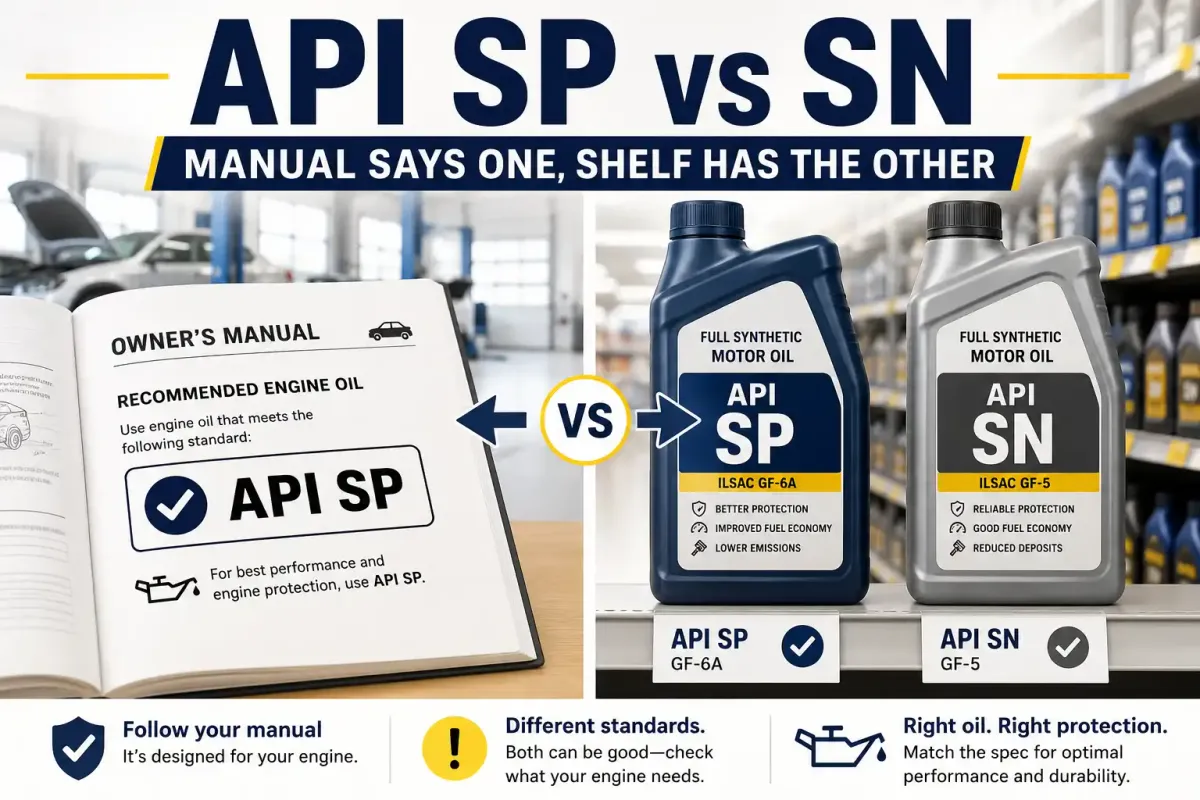
Short answer: newer API service categories in the S series are generally developed to supersede the ones before them, so a newer letter is normally intended to cover an older requirement. That is the principle behind why the shelf has moved on and your manual has not, and it is why this situation is common rather than alarming.
Written and verified 2026-09-11. API categories are updated periodically; the principles here are durable, but check the current position before relying on any specific category.
Two cautions before the detail. This is a principle rather than a guarantee, and there are places it does not hold. And an API category is only one of the systems on the bottle, so satisfying it does not finish the job.


As an Amazon Associate we earn from qualifying purchases.
What an API service category certifies
The American Petroleum Institute maintains service categories describing the performance level an engine oil meets, and it licenses products that qualify to display the certification mark.
That licensing is what gives the category weight. A product carrying the API donut with a given category has been licensed to do so. It is not a self-declaration in the way marketing language on the front of the bottle is: reading a motor oil label.
Categories are developed as engine technology and emissions requirements change, which is why the series has letters rather than stopping at one.
The S series and the C series are different things
Worth stating before anything else, because it is a genuine trap.
The S series covers oils for spark-ignition engines, which is most gasoline passenger vehicles.
The C series covers oils for compression-ignition engines, which is the diesel commercial side.
These are two parallel series, not one sequence. A C category is not a newer or better version of an S category, and a reader scanning a shelf for "the latest letter" can pick up a product from the wrong series entirely. Check which series your manual names.
Some products carry categories from both series, which is legitimate and means the product was licensed against both.


As an Amazon Associate we earn from qualifying purchases.
How the lettering progresses
Within the S series, the second letter advances as new categories are introduced, and interim categories are sometimes designated with an addition rather than a new letter.
The practical reading: a later letter is a later category. Products carrying older categories gradually leave the shelves as suppliers move to the current ones, which is exactly the situation that brought you here.
We are deliberately not printing a table of which letter arrived when. That is the kind of content that goes stale silently and that gets copied between sites until nobody knows its provenance. API publishes the current position itself, and that is the source to use.
The backward compatibility principle and where it stops
The general principle is that newer S categories are developed to be suitable where the categories they supersede were specified. That is why the industry can retire an old category without stranding every vehicle that names it.
Three places to be careful.
Where your manual names an OEM approval as well. An approval is the vehicle manufacturer's own specification and is not satisfied by any API category: OEM oil approvals and why they are not optional.
Where the vehicle is unusual. Older engines, engines with particular material or design characteristics, and anything with a manufacturer notice attached are cases to check rather than assume.
Where the ILSAC specification also matters, since ILSAC is a separate series with its own rules, including one place where two specifications are deliberately not interchangeable: ILSAC GF-6A vs GF-6B.
Why your manual names an older category
Because it was written when that category was current, and manuals are not revised as standards move.
This is not a defect in your manual and it does not mean the manufacturer has an opinion about newer categories. It means the document is a snapshot of what was current at the time the vehicle was built.
This is the same phenomenon that makes published specifications disagree with each other generally: sources capture a moment and the moment moves: why two websites give your car two different numbers.


As an Amazon Associate we earn from qualifying purchases.
The donut, and reading it correctly
The API certification mark is a circular symbol on the back of the bottle carrying three things: the SAE viscosity grade in the center, the API service category around the top, and any energy-conserving or resource-conserving designation around the bottom.
Read the category from the donut rather than from the front label. The front is marketing space and may summarize loosely; the donut is the certification mark and means what it says: what 5W-30 actually describes covers the grade in the middle.
When to check rather than assume
Three triggers for asking rather than reasoning it out.
Your manual names an OEM approval. Then the API category is not the binding requirement and the approval is.
Your vehicle is old enough that the gap is several categories. The principle is more comfortable across one step than across many.
You cannot find your manual's requirement at all, in which case establish that first: how to find every fluid spec your vehicle requires.
Where to ask: API publishes the current category position, and a dealer parts department can confirm what your specific VIN requires. We do not publish a compatibility matrix, because a matrix that goes stale is worse than no matrix and this is a subject where they go stale on a schedule.


As an Amazon Associate we earn from qualifying purchases.
Frequently asked questions
Is API SP OK where the manual says SN?
Newer S categories are generally developed to supersede older ones, so this is normally the intended path. Check whether your manual also names an OEM approval, which is a separate and stricter requirement.
Are API S and C categories related?
No. S covers spark-ignition engines and C covers compression-ignition engines. They are parallel series, and a C category is not a newer version of an S category.
Where do I read the API category?
From the donut on the back of the bottle, which is the certification mark, rather than from the marketing text on the front.
Why does my manual name an old category?
Because it was written when that category was current. Manuals are snapshots and are not revised as standards move on.
Is a newer category always fine?
It is the general principle, not a guarantee. Older engines, unusual designs and vehicles requiring an OEM approval are cases to check rather than assume.