Full Synthetic vs Blend: Is the Label Even Regulated?
The words on the front of the bottle are far looser than buyers assume. The marks on the back are the part you can actually verify.

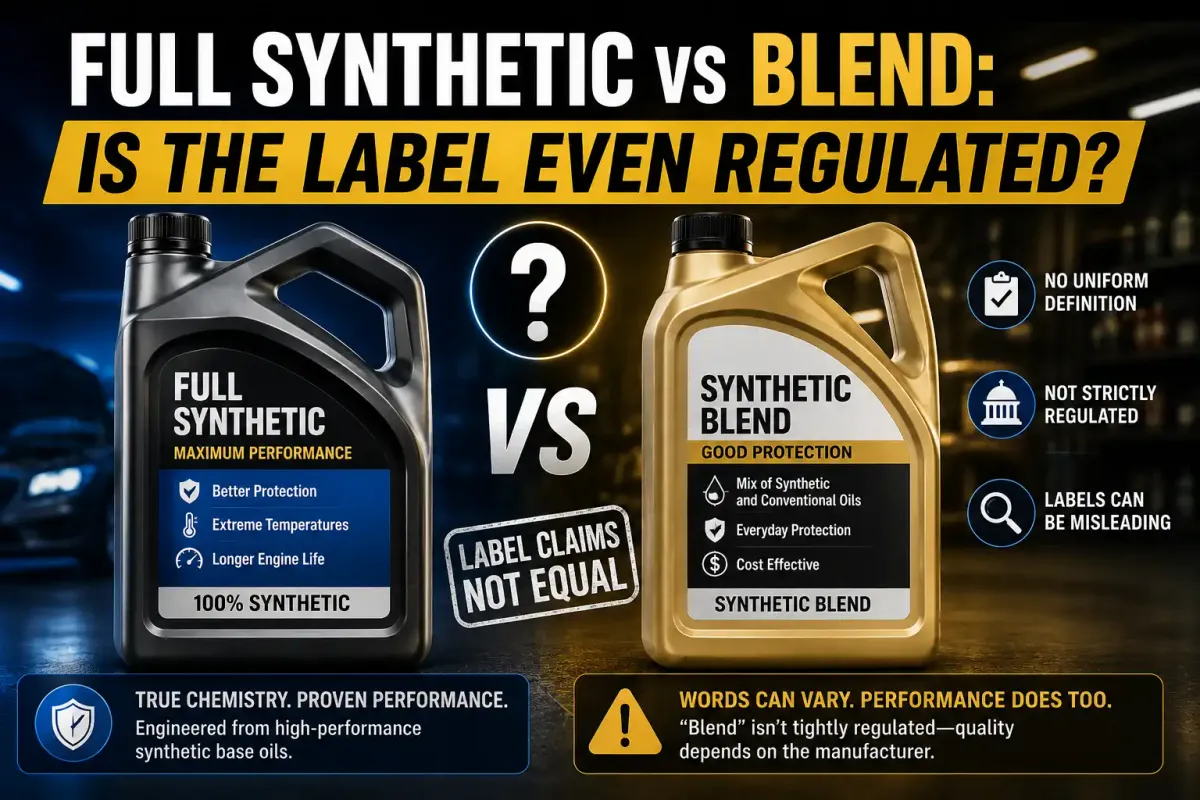
Short answer: the words on the front of the bottle are far less tightly defined than buyers assume, and the marks on the back are the part you can actually verify. "Full synthetic" is not a certification issued by anyone. It is a description of the product's base stock, and what qualifies has been contested within the industry rather than settled by a regulator.
That is a genuinely awkward thing for the oil aisle, and it is not something a page selling you oil is likely to lead with.


As an Amazon Associate we earn from qualifying purchases.
What base oil groups are
Engine oil is base oil plus an additive package. The base oil is the bulk of it, and base oils are classified into groups by how they are produced and what properties they have.
The groups run roughly from conventionally refined mineral oils at one end, through more heavily processed mineral oils in the middle, to oils synthesized from simpler molecules at the other end. Higher groups are generally more uniform in molecular structure, which is what gives them their performance characteristics.
That classification is technical and reasonably well defined. The marketing vocabulary sitting on top of it is where the looseness comes in.
Where the synthetic label sits relative to those groups
Here is the crux.
The strictest reading of "synthetic" would restrict it to oils actually synthesized rather than refined. In practice the term has been applied more broadly, to include heavily processed mineral base oils whose properties approach those of synthesized ones.
That broader usage has been contested within the industry, and the outcome has been that the term covers a wider range of base stocks than a literal reading suggests. Whether a given "full synthetic" is one thing or the other is not determinable from the front label.
We are not going to characterize any specific product or brand, and we are not going to tell you the term is meaningless. It is not meaningless. It is just not the certification buyers treat it as.


As an Amazon Associate we earn from qualifying purchases.
Why the term is not as tightly controlled as buyers assume
Because no independent body issues it.
Viscosity grades come from a classification system. API categories come from a licensing programme with a certification mark. ILSAC specifications come from a manufacturer committee with its own marks. Vehicle manufacturer approvals come with checkable identifiers: OEM oil approvals and what they mean.
"Full synthetic" comes from the label. There is no donut for it, no starburst, no licence number to look up.
That is the distinction to hold: some claims on a bottle are certified and some are described. The certified ones are on the back.
Synthetic blend, which is the vaguest of the three
If "full synthetic" is loose, "synthetic blend" is looser.
A blend is a mixture of synthetic and conventional base stocks. What is not specified anywhere accessible to a buyer is the proportion, and nothing on the label tells you whether a blend is mostly one or mostly the other.
So as a purchasing signal it conveys very little beyond "not marketed as either of the other two." It is not a fraud and it is not a grade.
What is actually verifiable on the bottle
Four things, all on the back, all checkable:
The viscosity grade, which is a classification: what 5W-30 actually describes.
The API service category in the donut, which is licensed: API service categories.
The ILSAC specification, shown by its mark.
Any vehicle manufacturer approval, with its identifier.
If a product meets your vehicle's requirements on those four, it meets them. If it does not, no amount of "full synthetic" on the front compensates.
That is the practical resolution of the whole question: the front label is not what you are buying against.


As an Amazon Associate we earn from qualifying purchases.
When your vehicle genuinely requires a synthetic
Some vehicles do, and it will be in the owner's manual rather than inferred.
Where the manual states a requirement in those terms, follow it. Where the manual instead names a viscosity grade, an API category, an ILSAC specification and possibly an approval, those are the requirements, and a product satisfying all of them satisfies your vehicle regardless of the word on the front.
Where the full list lives: how to find every fluid spec your vehicle requires.
There is a common assumption that a synthetic permits a longer time between changes. That is an interval question, not a specification question, and this site does not cover intervals at all. Your manual's maintenance schedule and a qualified technician are the sources for that.
How to choose without relying on the front label
The procedure, stated plainly.
Write down what your manual names. All of it, not just the viscosity grade.
Turn the bottle around. Check each named requirement against the marks and specifications on the back.
Where an approval is named, find the identifier. Not the brand, not the product family, the identifier on the grade you are buying.
Ignore everything on the front. Not because it is dishonest, but because it is not the thing you are checking against.
Reading the back label systematically: reading a motor oil label.


As an Amazon Associate we earn from qualifying purchases.
Frequently asked questions
Is "full synthetic" a regulated term?
It is not a certification issued by an independent body the way API and ILSAC marks are. It describes the base stock, and what qualifies has been applied more broadly than a literal reading suggests.
What is a synthetic blend?
A mixture of synthetic and conventional base stocks, with no disclosed proportion. As a purchasing signal it conveys very little.
Is synthetic oil better than conventional?
That is not answerable as a general claim, and it is the wrong question for a purchase. The right question is whether the product meets the specifications your vehicle's manual names.
Does my car need full synthetic?
Only if your owner's manual says so. Otherwise the requirements are the viscosity grade, API category, ILSAC specification and any approval it names.
Can I go longer between changes with synthetic?
That is a maintenance interval question, which this site does not cover. Your manual's maintenance schedule and a qualified technician are the sources.