What Does 5W-30 Mean? Two Grades, Not Two Units
The W is winter, not weight. Neither number is a measurement in any unit. They are grades from two separate tests, and that is the whole thing.

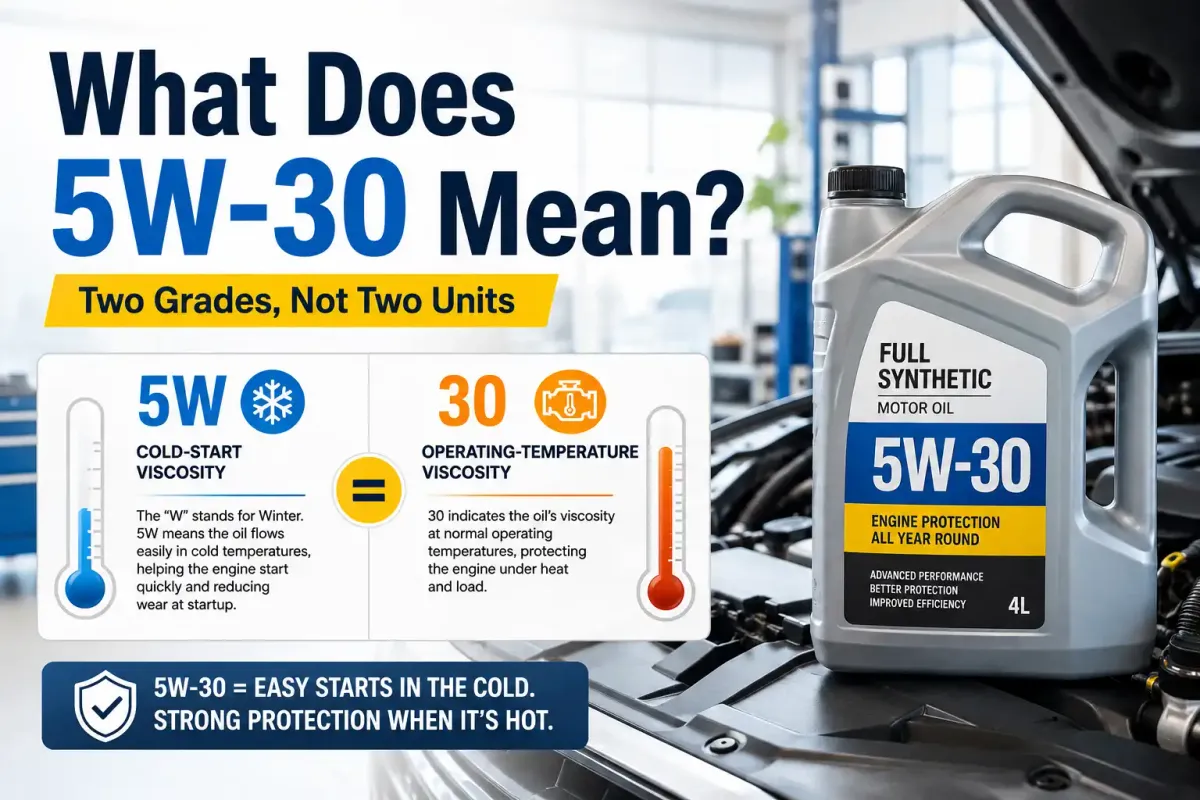
Short answer: they are two separate grades from two separate tests, and neither one is a measurement in any unit. You were right that the first relates to cold and the second to hot. What is missing from most explanations is that these are classification grades, not quantities, so asking what units they are in is a question with no answer. There are no units. They are categories.
That single correction resolves most of the confusion around this code.


As an Amazon Associate we earn from qualifying purchases.
What the W means
Winter, not weight.
This is close to a universal misconception and it matters, because "weight" implies the numbers measure something and reinforces the units question. They do not. The W marks the first number as the cold-temperature grade.
An oil carrying both a W grade and a second number is a multigrade oil, meaning it was assessed under both cold and high-temperature conditions and graded in both.
The first number: cold-temperature behavior
The number before the W is the cold-temperature grade, and a lower number indicates the oil remains more fluid at low temperatures.
Why that matters is straightforward. When an engine has been sitting overnight in cold weather, the oil has to flow to where it is needed as soon as the engine turns over. An oil that has become too thick to move quickly leaves parts unlubricated for longer at exactly the moment they are most vulnerable.
The grade is assigned by testing under standardized low-temperature conditions. A lower grade number means the oil passed at a colder condition, not that it is thinner by some proportion.


As an Amazon Associate we earn from qualifying purchases.
The second number: high-temperature behavior
The number after the W is the high-temperature grade, and a higher number indicates the oil is more viscous at operating temperature.
This is the other half of the job. At temperature, the oil has to maintain a film between moving parts under load, and an oil too thin for the engine's design does not.
Again it is a grade from a standardized test, assigned by which band the oil falls into. It is not a measurement you can do arithmetic on.
Why they are grades rather than measurements
This is the part worth holding onto.
Each grade corresponds to a band of measured behavior in a standardized test. An oil that falls anywhere inside a band gets that grade. Two oils with the same grade can differ measurably in actual viscosity while both being correctly labeled.
So the numbers are not proportional to anything, and the difference between two adjacent grades is not the difference between their numbers. This is the same structural point as the tire load index and the UTQG treadwear grade: a classification presented as a number invites arithmetic it does not support.


As an Amazon Associate we earn from qualifying purchases.
What a multigrade oil is doing
A common mental model is that a multigrade oil is "thin when cold and thick when hot," which sounds like magic and is not quite right.
All oils get thinner as they get hotter. What a multigrade oil does is thin out less across the temperature range than a single-grade oil would, so it stays within acceptable bands at both ends. It is not thickening when it heats up. It is resisting thinning.
That distinction is worth having because it explains why the two grades are separate assessments rather than two points on one curve you could interpolate between.
What the viscosity grade does not tell you
The grade is one of usually four systems on the bottle, and by itself it is not a specification.
It does not tell you the API service category, the ILSAC specification, or whether the product carries any vehicle manufacturer approval. All of those are separate marks, and a bottle with the right grade can fail any of them: reading a motor oil label.
It also does not tell you the base oil the product is made from, which is what the word synthetic is gesturing at: full synthetic, blend and conventional.
And it does not tell you which grade your engine requires. That comes from your owner's manual, which names the grade along with whatever else applies: how to find every fluid spec your vehicle requires.
We do not publish a viscosity recommendation for any vehicle. Your manual names yours, and where the manual gives a range or names conditions, those conditions are part of the specification rather than a footnote.
If your manual names an API category the shelf no longer carries, that has its own straightforward answer: API service categories, SP, SN Plus and the older letters.


As an Amazon Associate we earn from qualifying purchases.
Frequently asked questions
Does the W stand for weight?
No, it stands for winter. It marks the first number as the cold-temperature grade, and the weight misreading is what makes people look for units that do not exist.
What units are the numbers in?
Neither number is in any unit. They are classification grades, each assigned by which band an oil falls into under a standardized test.
Is the first number cold and the second hot?
Yes. The number before the W is the cold-temperature grade, and the number after it is the high-temperature grade.
Is 5W-30 thinner than 10W-30?
At cold temperatures it is graded for a colder condition. At operating temperature both carry the same high-temperature grade. The numbers are grades rather than proportional measurements.
Which viscosity does my engine need?
Whatever your owner's manual specifies for your vehicle and its conditions. We do not publish viscosity recommendations, and a grade from a chart for a similar vehicle is not your specification.