ILSAC GF-6A vs GF-6B: Not Two Grades of One Thing
The A and B are not a quality ladder. They cover different viscosity territory and are deliberately not interchangeable, which is unusual in this field.

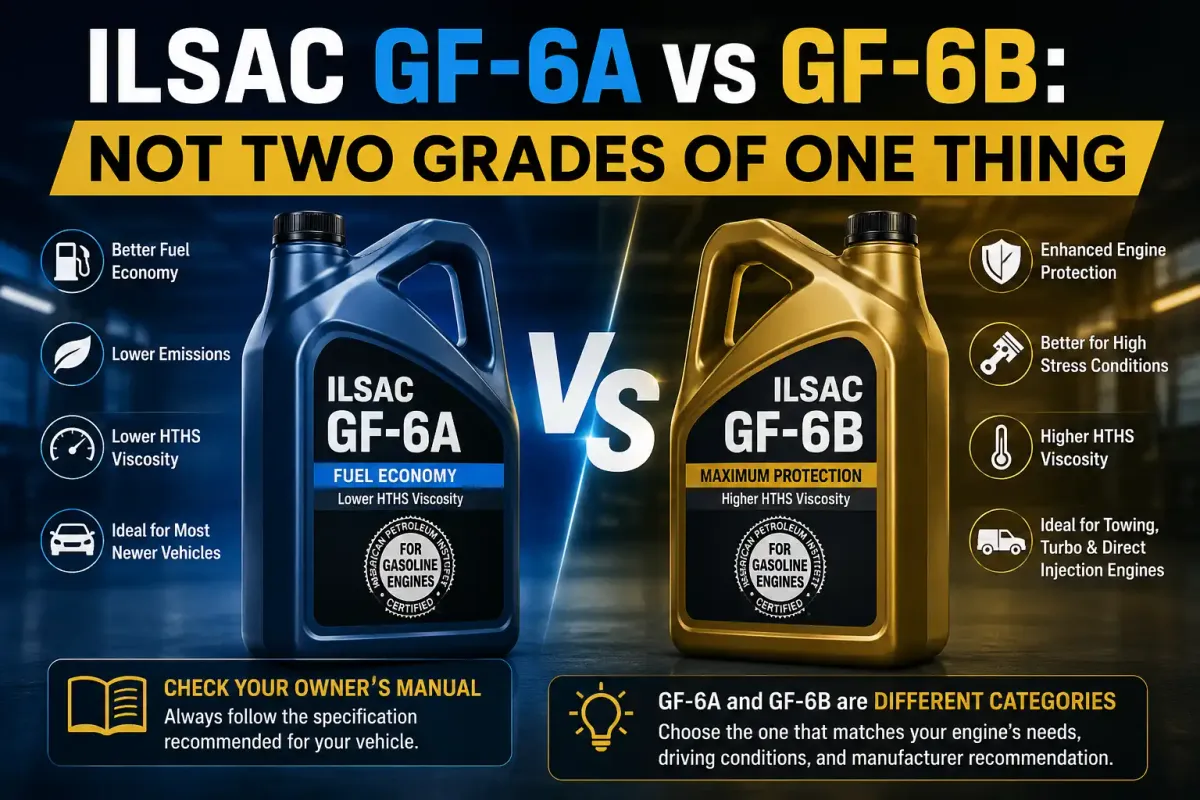
Short answer: they are not two grades of the same thing and they are not interchangeable, which makes this specification unusual. Almost everywhere else in this subject, a suffix or a higher number indicates a more capable version of the same requirement. Here the two designations cover different viscosity territory, and the letter follows from the viscosity grade your engine requires rather than being a choice you make.
Written and verified 2026-09-12. ILSAC specifications are updated periodically; check the current position before relying on any specific designation.


As an Amazon Associate we earn from qualifying purchases.
What ILSAC specifications are and who issues them
ILSAC is the International Lubricant Standardization and Approval Committee, a body formed by vehicle manufacturers to define engine oil performance requirements.
That origin is the point. ILSAC specifications come from the people who build the engines rather than from the oil industry, which is why they tend to be demanding in the areas manufacturers care about and why they exist alongside the API categories rather than duplicating them: reading a motor oil label.
An oil meeting an ILSAC specification displays a mark on the bottle, historically a starburst symbol, with a shield mark introduced alongside it for the newer designation.
What GF-6A covers
GF-6A is the successor to the previous ILSAC specification, and it applies in the viscosity territory that specification covered.
For most owners, this is the one their vehicle's requirement lands in, because it covers the viscosity grades that have been mainstream in passenger vehicles.
The important property: GF-6A was developed as a successor, so it stands in the ordinary relationship to what came before it. That is the normal case, and it is what makes GF-6B surprising.


As an Amazon Associate we earn from qualifying purchases.
What GF-6B covers and why it is separate
GF-6B covers a lower viscosity territory than GF-6A addresses, introduced because engines designed for lower-viscosity oils need a specification written for them.
It is not a lesser version of GF-6A and it is not a superior one. It is the specification for a different viscosity range, and an engine designed for that range requires it while an engine designed for the GF-6A range does not.
This is why the two carry different marks on the bottle. The separate mark exists precisely so that a product for the lower viscosity range cannot be mistaken for a general successor product.
Why this split is unusual
Worth pausing on, because it is the reason the question gets asked at all.
The pattern everywhere else in oil specifications is progression: a newer API category supersedes an older one, a newer ILSAC specification supersedes its predecessor. Readers learn that pattern and apply it, which is usually correct: API service categories, SP, SN Plus and the older letters.
Here the pattern does not apply, because the A and B are not sequential and not hierarchical. They are two branches of one specification addressing different viscosity territory.
The practical consequence: a reader reasoning "B is later than A, so B must be newer and better" reaches a wrong conclusion by applying a rule that is correct almost everywhere else.
The starburst and the shield marks
Two marks, and knowing they exist prevents the wrong-bottle error.
The starburst is the long-established ILSAC certification mark, and it appears on products meeting the specification in the mainstream viscosity territory.
The shield mark was introduced for the lower-viscosity designation, so that those products are visually distinguishable rather than relying on a reader parsing a letter suffix.
Look for the mark rather than for the text. A mark is a certification and a line of text on a back label may be a claim.


As an Amazon Associate we earn from qualifying purchases.
How to know which applies to your engine
You do not choose. Your engine's required viscosity grade determines it.
Your owner's manual names the viscosity grade your engine requires, and the ILSAC designation follows from which territory that grade sits in. If your manual names an ILSAC specification directly, that is your answer without any reasoning at all.
Where the full list lives: how to find every fluid spec your vehicle requires. And what the grade itself is describing: what 5W-30 actually describes.
If your manual predates these designations entirely, which is common, the useful question is which current specification corresponds to what it names, and that is a question for a dealer parts department with your VIN rather than for a chart.
Why substituting across the letters is not a judgement call
Most oil decisions have some room in them. This one has less.
An engine designed for a lower-viscosity oil and run on a higher-viscosity one is not getting the flow behavior it was designed around, and the reverse leaves an engine designed for higher viscosity with a thinner film than intended. Neither is a preference question and neither announces itself immediately.
That is also why the specifications were separated rather than merged. If the two territories were interchangeable, one specification would have covered both.
And where your vehicle also requires a manufacturer approval, that is a further requirement on top of all of this, and it is the strictest one: OEM oil approvals and why they are not optional.
We do not tell you which viscosity or which designation your engine takes. Your manual does.


As an Amazon Associate we earn from qualifying purchases.
Frequently asked questions
Is GF-6B newer or better than GF-6A?
Neither. They are not sequential. They cover different viscosity territory, and which one applies follows from the viscosity grade your engine requires.
Can I use GF-6A where GF-6B is specified?
They are deliberately not interchangeable. The designation follows from your engine's required viscosity grade, so substituting across them means running a viscosity the engine was not designed for.
What is the difference between the starburst and the shield?
The starburst is the established ILSAC certification mark. The shield was introduced for the lower-viscosity designation so those products are visually distinguishable.
Who issues ILSAC specifications?
A committee formed by vehicle manufacturers, which is why the specifications are demanding in the areas manufacturers care about and exist alongside the API categories.
My manual is older than GF-6. What do I use?
Ask a dealer parts department with your VIN which current specification corresponds to what your manual names. That is more reliable than a compatibility chart.