GL-4 vs GL-5 Gear Oil: Higher Is Not Better Here
The numbers describe different applications, not better and worse. In the wrong application the additive package is the problem rather than the benefit.

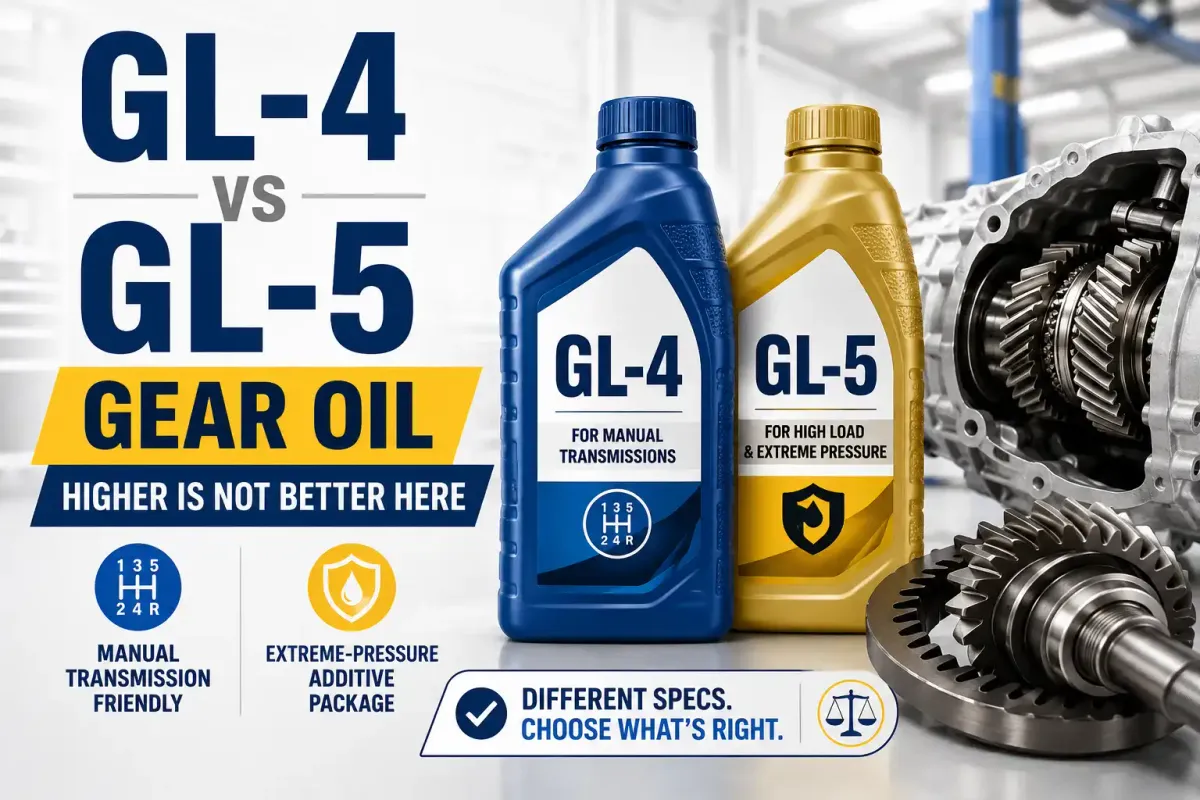
Short answer: no, and this is one of the clearest cases in the whole subject where a higher number is not an upgrade. GL-4 and GL-5 are API service designations describing different applications with different additive requirements. In an application specified for GL-4, the additive package that makes a GL-5 suitable elsewhere is the thing to be careful about rather than the benefit.
The instinct that a higher number is better is reasonable and it is wrong here, which makes this worth understanding rather than memorizing.


As an Amazon Associate we earn from qualifying purchases.
What an API gear oil designation covers
API maintains service designations for gear lubricants describing the service conditions the lubricant is intended for.
The distinguishing factor between the designations relevant here is the level of extreme pressure additive. Those additives exist to protect gear surfaces under high contact loads, where the lubricating film alone would not prevent metal-to-metal contact.
More additive is not neutral. Extreme pressure additives work through their chemistry, and chemistry that acts on surfaces acts on whatever surfaces are present.
GL-4 and where it is specified
GL-4 designates a lubricant with a moderate level of extreme pressure additive.
It is commonly specified for manual transmissions and transaxles, where the loading conditions are less severe than in a hypoid final drive and where the internal components include materials that benefit from a less aggressive additive package.
That last point is the crux of the whole article and it is the next section.


As an Amazon Associate we earn from qualifying purchases.
GL-5 and where it is specified
GL-5 designates a lubricant with a higher level of extreme pressure additive, intended for more severe service.
It is commonly specified for hypoid final drives, where the gear geometry produces sliding contact under high load and the surfaces genuinely need the additional protection. Specialist racing axles name their own lubricant, too; our Winters quick change gear chart quotes the gear oil Winters recommends for its quick change rears.
In that application the higher additive level is doing necessary work. That is what the designation is for. Gear oil cannot make up for a badly set-up gear set, though; our ring and pinion pattern chart shows how installers check where a hypoid ring and pinion actually make contact.
Why a higher rating is not automatically an upgrade
Because the designations describe applications rather than quality tiers.
A GL-5 lubricant in a hypoid final drive is the right product for a demanding application. The same lubricant in a manual transmission specified for GL-4 is a product with more additive than that application calls for, in an environment containing materials that may be affected by it.
This is the same structural mistake as reading DOT brake fluid numbers as a ladder or reading ILSAC letter suffixes as grades: a naming scheme that looks sequential describing things that are not: brake fluid DOT ratings.
The general rule that follows: use what the application specifies, and treat a higher designation as a different product rather than a better one.
The yellow-metal concern, stated carefully
This is the specific mechanism, and it is widely garbled online, so it is worth being precise about what is and is not established.
The documented concern is that certain extreme pressure additive chemistries can be corrosive to copper-containing alloys, the brass and bronze components sometimes used in manual transmission synchronizers. Because GL-5 lubricants carry higher levels of those additives, the concern attaches particularly to using GL-5 where GL-4 is specified.
Three honest qualifications.
Additive chemistry has developed, and products marketed as suitable for both designations exist. Whether a given product is genuinely appropriate for a GL-4 application is a question about that product.
Not every transmission contains the materials at issue, so the concern is not universal across all GL-4 applications.
We are not going to tell you how severe it is in your case, because that depends on the specific transmission, the specific lubricant and the conditions. That is a question for your vehicle's manufacturer or a qualified technician.
What we will say plainly: this is a real documented concern rather than an internet legend, and "higher number so it must be fine" is not a sound basis for overriding a GL-4 specification.


As an Amazon Associate we earn from qualifying purchases.
Limited-slip additives, which are a separate question
Readers conflate this with the GL rating and it is a different axis entirely.
A limited-slip differential contains clutches or a similar mechanism that allows controlled slip between the outputs. Those mechanisms have friction requirements, and lubricants for them either include a friction modifier or require one to be added.
This is orthogonal to the GL designation. A lubricant can carry the correct GL designation for the application and still lack the friction modifier a limited-slip differential requires, and the symptom of getting it wrong is typically behavior during low-speed turns rather than damage.
Whether your vehicle has a limited-slip differential, and whether its specified lubricant includes the modifier or requires it separately, is in the vehicle's documentation. It is not something to infer.
Where your vehicle's specification is written
The specifications section of the owner's manual, alongside the other fluids: how to find every fluid spec your vehicle requires.
Note that a vehicle may specify different lubricants for different units, so the manual transmission and the final drive are separate lines rather than one answer.
Where the manual is not enough: owner's manual vs service manual vs repair database. And a dealer parts department can confirm both the designation and the limited-slip question for your VIN.
For the general skill of reading a lubricant label and separating certified marks from marketing: reading a motor oil label. And the parallel situation in automatic transmissions: automatic transmission fluid specs.
We publish no lubricant recommendation, no capacity and no change interval for any vehicle.


As an Amazon Associate we earn from qualifying purchases.
Frequently asked questions
Is GL-5 better than GL-4?
No. They designate different applications with different extreme pressure additive levels. In an application specified for GL-4, the higher additive level is a concern rather than a benefit.
Can I use GL-5 in a GL-4 gearbox?
Not on the basis that the number is higher. The documented concern is that higher extreme pressure additive levels can be corrosive to copper-containing alloys used in some synchronizers. Check your vehicle's specification.
Is the yellow metal issue real?
It is a real documented concern rather than an internet legend, with qualifications: additive chemistry has developed, dual-rated products exist, and not every transmission contains the materials at issue.
What is a limited-slip additive?
A friction modifier required by limited-slip differentials. It is a separate question from the GL designation, and a correctly designated lubricant may still lack it.
Do my gearbox and differential take the same oil?
Not necessarily. A vehicle may specify different lubricants for different units, so check each line in the manual separately.