Dipstick Engine Oil Color Chart 2026: What Each Means
What each engine oil color on the dipstick means, according to the oil companies, and where they disagree.

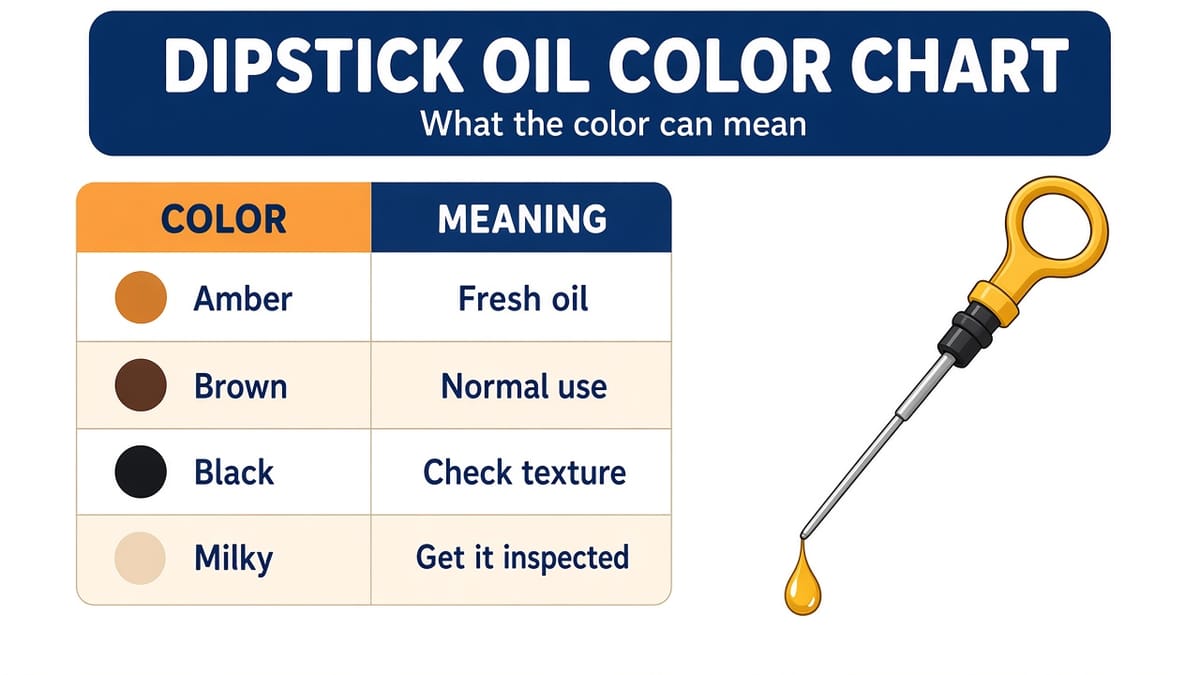
On a dipstick, fresh engine oil is golden or amber and see-through. It turns light brown, then darker brown and eventually black as it collects combustion byproducts and contaminants, and that darkening alone does not mean the oil has failed. The colors that do mean trouble are milky or foamy oil, which oil makers link to coolant or water getting into the oil, and oil that is gritty, sludgy or carries metallic flecks. Your manufacturer's oil change interval, not the color, decides when to change it.
This chart compiles what five oil companies (Valvoline, Motul, Castrol, Mobil and Liqui Moly) publish about oil color and condition. They agree on the extremes and disagree on the middle, especially on what black oil means, so where they differ we show each company's view rather than picking one.
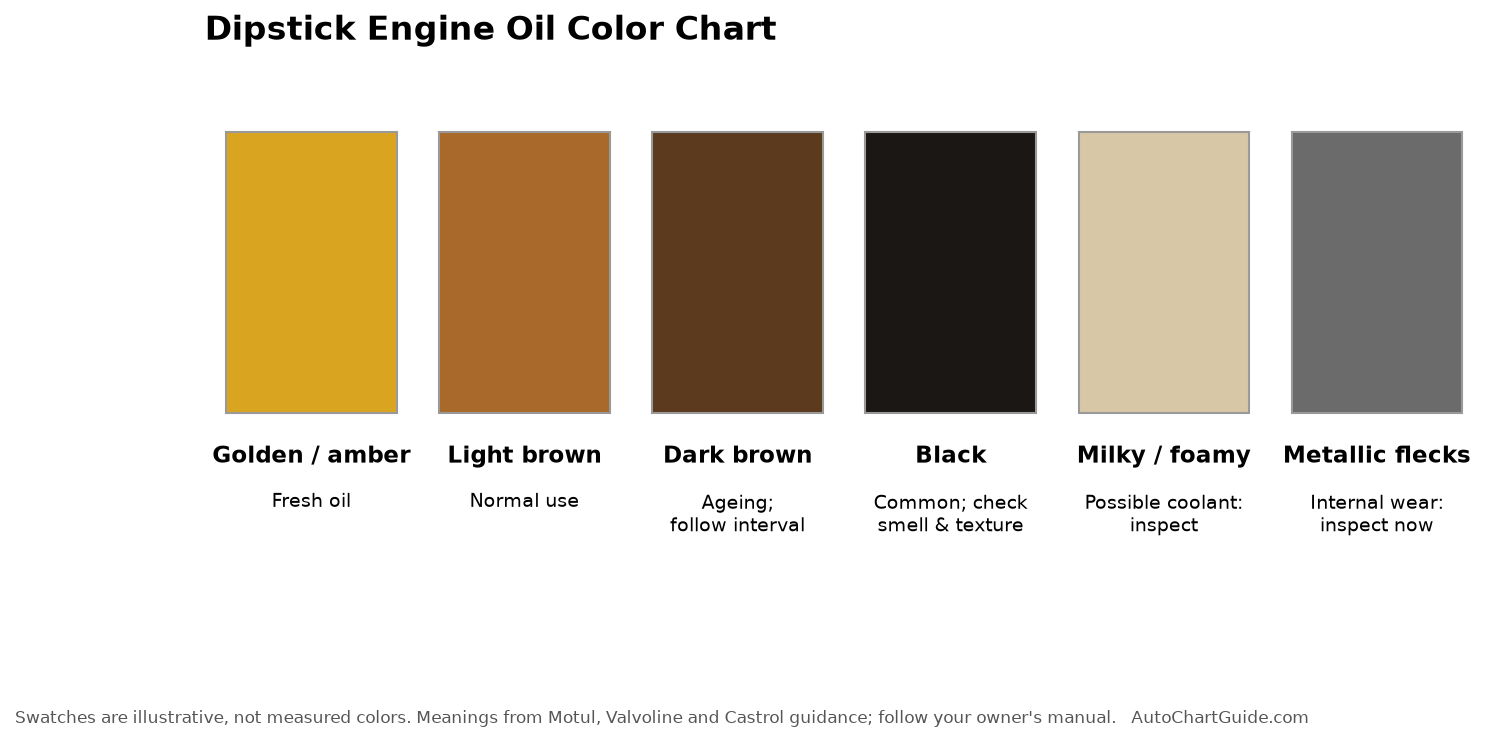
Dipstick engine oil color chart
| Color on the dipstick | What oil makers say it means | Suggested action |
|---|---|---|
| Golden / amber, translucent | Fresh, clean oil (Motul, Castrol, Valvoline) | None; continue normal interval |
| Light brown | Normal use (Motul); used but normal, mid-life (Valvoline) | Valvoline: check again in 1,000 miles |
| Dark brown | Ageing oil (Motul) | Follow your service interval |
| Black | Common in many engines, esp. diesel/turbo (Motul); may be approaching due (Valvoline) | Assess smell and texture; Valvoline: consider scheduling a change |
| Dark and gritty / sludge | Needs changing (Castrol); overdue (Valvoline) | Change oil |
| Milky, creamy or foamy | Possible coolant contamination, e.g. head gasket or oil cooler (Motul, Valvoline, Castrol) | Have the engine inspected promptly |
| Metallic flecks | Internal wear (Valvoline) | Have the engine inspected immediately |
Sources: Motul, Valvoline, Castrol (see Sources). These are general guidelines; your owner's manual takes precedence.
Read the chart from top to bottom as a rough life cycle: amber when new, brown in normal use, dark brown to black late in the interval. The last three rows are not stages of normal aging. They are signs of contamination or wear, and the oil companies all recommend having the engine checked rather than simply changing the oil.
Where the oil companies disagree
- Does dark oil need changing? Valvoline lists "when motor oil becomes dark, that means it's time to change it" as a myth, saying you cannot judge the life of motor oil by its appearance because it changes color for several reasons. Castrol's oil-change guide lists "dark, gritty oil" as a common sign you need an oil change, and its oil-check steps say "dark or gritty oil needs changing." The key word in Castrol's version is gritty; dark oil that is smooth is not the same thing.
- What black means. Motul calls black oil common in diesel and turbocharged engines and says darkening often happens as detergents suspend contaminants. Valvoline's color table says black oil "may be approaching due for a change" and suggests scheduling the next change.
- Light brown. Valvoline's table calls light brown "used but normal" mid-life oil and suggests checking again in 1,000 miles. Motul calls brown oil normal after several thousand kilometres and says it generally means the oil is working as intended.
Every source that discusses color in detail ends with the same advice: follow your vehicle manufacturer's oil change interval. Mobil explains why. Because it is hard for an individual driver to tell when contamination is too high, automakers set recommended intervals, and those intervals vary by model year, manufacturer and the type of service the car sees, with more frequent changes recommended for severe service.
Why oil turns dark
Darkening is the oil doing its job. Valvoline says engine oil is exposed to extreme temperatures that darken it over time, and to deposits, combustion byproducts and other contaminants that also change its color. Mobil describes the same jobs: carrying combustion byproducts away from the pistons and cylinders, handling the small amounts of water that form as the engine heats and cools, collecting dirt and dust that get past the air intake, and dealing with acids formed by water and other contaminants. Motul adds that detergents suspend contaminants, which is part of why oil darkens.
Over time, Mobil says, the oil's additives are used up and the oil itself can oxidize or thicken. At that point it can no longer do its job and must be changed. The color change usually starts long before that point, which is why color is a poor timer. Valvoline makes the point directly: at the end of its life the oil will have darkened significantly, and as it drains it carries away the dirt and contaminants it collected.
Milky oil: coolant or condensation?
Milky, creamy or coffee-colored oil is the one color every source treats as a warning. Motul says it can indicate coolant contamination from problems such as a leaking head gasket or a damaged oil cooler, and to arrange a workshop inspection immediately. Valvoline's table lists milky or foamy oil as possible coolant intrusion and possible head gasket failure, and says to have the engine checked. Castrol says milky oil may mean coolant is leaking and needs a mechanic's attention.
Not every milky deposit means coolant, though. Mobil says water gets into oil in two ways. The first is moisture from the engine "breathing" when it is not in use, as cold air enters a hot engine and water condenses, plus water from combustion; Mobil says you generally do not need to worry about this if you drive enough to burn the water off in normal driving. The second, more destructive route is a coolant leak from a bad gasket or an engine crack, which Mobil says generally causes serious problems including loss of power and oil sludging.
Liqui Moly describes the condensation case: during many short journeys, condensation collects in the oil pan, mixes with the oil and produces a yellowish sludge that often builds up around the valve cover and oil cap. A light deposit under the oil filler cap after a run of short trips fits that description. Milky oil on the dipstick itself is the case Motul, Valvoline and Castrol all say to have inspected. If you are unsure which you have, Mobil's advice is the simplest: consult your mechanic.
Gritty oil, sludge and metal flecks
Texture can tell you more than color. Motul suggests feeling the oil as well as looking at it: healthy oil should feel smooth and slippery. It lists five things to watch for: a burnt smell, a strong fuel smell, gritty particles, thick sludge deposits and an unusually watery consistency. Motul says black oil together with a burnt smell, gritty particles or rough running may need changing.
Valvoline's table treats gritty oil or sludge as overdue and says to change it, and metallic flecks as a sign of internal wear that needs an engine inspection immediately. A strong fuel smell points to fuel getting into the oil, which Mobil calls fuel dilution. Our guide to reading a motor oil label explains what the oil in the bottle is supposed to be before any of this happens.
How to read the dipstick level
Color is only half of a dipstick check. The other half is the level. Motul and Valvoline agree on what each reading means:
| Dipstick reading | Meaning | What to do |
|---|---|---|
| Below MIN | Too low | Top up now and check for leaks or consumption (Motul) |
| Between MIN and MAX | Safe range | Continue and monitor (Motul) |
| At MAX | Full | No oil needed |
| Above MAX | Overfilled | Have the excess drained; overfilled oil can foam (Motul, Valvoline) |
Sources: Motul; Valvoline.
Valvoline says most engines hold about a quart between the marks, so oil halfway between them is roughly half a quart low. That figure is Valvoline's general guide; the actual volume between marks depends on the engine, so check the owner's manual. Both companies warn against overfilling: Motul says too much oil can foam as the crankshaft churns through it, and Valvoline says overfilled oil aerates and can damage the engine. Mobil lists excessive foaming among the causes of an oil warning light.
How to check your oil
- Park on level ground and switch off the engine. Motul says checking on a slope or right after driving can give a misleading reading.
- Wait for the oil to drain back. Mobil recommends checking either before starting the engine or 5 to 10 minutes after shutting it down. Valvoline says the same, adding that cold is best and warm is acceptable. Motul says to wait about 10 minutes. Castrol's steps say to wait for the engine to cool.
- Pull, wipe and reinsert. Pull the dipstick out, wipe it with a lint-free cloth, push it fully back in and pull it out again. Motul notes the second reading is the one that counts, because the first may show oil splashed up the stick while driving.
- Read the level, then the color. Wiping the dipstick on a white rag or paper towel makes the color easier to see; Valvoline's steps include checking the color and consistency on the rag.
- Top up in small amounts. Valvoline suggests adding about half a quart at a time and rechecking rather than pouring in a full quart. Use the oil grade in your owner's manual.
Your owner's manual is the final word on how and when to check. Procedures vary by vehicle, as Motul notes, and Valvoline's own FAQ ends with "refer to your owner's manual for specifics." For how much oil your engine should hold, see our guide to engine oil capacity with a filter.
How often to check
Valvoline recommends checking at least once a month and before any road trip. For engines with 75,000 miles or more, or that burn even a small amount of oil between changes, it suggests checking every other fill-up. Castrol adds a tip: if the level is consistently low between changes, the engine may be burning oil and should be checked by a professional. Mobil notes that blue or blue-black smoke at startup may mean oil is being burned with the fuel, possibly from worn piston rings or an oil that is too thin.
Does synthetic oil look different?
None of the five oil companies publishes a separate color chart for synthetic oil, and their color guidance does not distinguish between oil types. Their descriptions of new oil (golden or amber) and of darkening in use are written for engine oil in general. Do not use color to tell synthetic from conventional oil; the label is the only reliable guide. Our comparison of full synthetic vs synthetic blend oil and our explainer on API SP vs SN cover the differences that matter. If your manufacturer requires a specific approval, see what an OEM oil approval means.
Don't confuse oil with other fluids
Color guides exist for other fluids too, and they are just as easy to misread. Coolant color in particular does not reliably tell you the coolant type, as our article on the coolant color myth explains. The oil companies' guidance is that anything milky or foamy in the oil may be coolant and should be checked by a mechanic.
Common mistakes
- Changing oil because it is dark. Valvoline calls this a myth; follow your service interval.
- Ignoring dark oil that is also gritty. Castrol and Motul both treat grit as a sign the oil needs changing.
- Assuming milky residue under the cap is always a head gasket. Mobil and Liqui Moly describe condensation from short trips; check the dipstick too.
- Reading the level straight after a drive. Wait 5 to 10 minutes, per Mobil and Valvoline.
- Overfilling. Every source that discusses it warns that excess oil can foam.
Frequently asked questions
What color should engine oil be on the dipstick?
New oil is golden or amber and translucent. Light to dark brown is normal in use, according to Motul and Valvoline.
Does black oil mean I need an oil change?
Not by itself. Valvoline calls that a myth, and Motul says black oil is common in diesel and turbocharged engines. Change it if it is also gritty or smells burnt, or when your service interval is due.
What does milky oil on the dipstick mean?
Motul, Valvoline and Castrol all link milky oil to possible coolant contamination, such as a leaking head gasket or oil cooler. Have the engine inspected.
Is milky residue under the oil cap always a head gasket?
No. Mobil and Liqui Moly describe condensation from short trips forming a yellowish or milky sludge around the cap. Check the dipstick and coolant level, and ask a mechanic if unsure.
What do metal flecks in oil mean?
Valvoline says metallic flecks indicate internal wear and the engine should be inspected immediately.
Should I check oil hot or cold?
Mobil recommends checking before starting the engine or 5 to 10 minutes after shutting it off. Valvoline says cold is best and warm is acceptable; follow your owner's manual.
How much oil is between the MIN and MAX marks?
Valvoline says most engines hold about a quart between the marks, but it varies by engine; check your owner's manual.
Why does my oil smell like fuel?
A strong fuel smell is one of Motul's warning signs. Mobil says fuel can leak into the oil, which is called fuel dilution.
How often should I check my oil?
Valvoline recommends at least once a month and before road trips, and every other fill-up on engines over 75,000 miles or that burn oil.
Sources
- Valvoline: Motor Oil Myths
- Valvoline Australia: Does the colour of my oil tell me if it's good or bad?
- Valvoline: How to Check Your Engine Oil the Right Way
- Motul: Engine Oil Dipstick: How to Read Levels and Colours
- Castrol USA: How to Change Oil
- Mobil: Motor Oil Product FAQ
- Liqui Moly: Sludge deposits on the oil cap