Can You Mix Coolant Types? What OAT, HOAT and IAT Do
It depends on what and how much, and that cannot be judged from a description. Here is what the chemistries are and why the damage is slow and quiet.

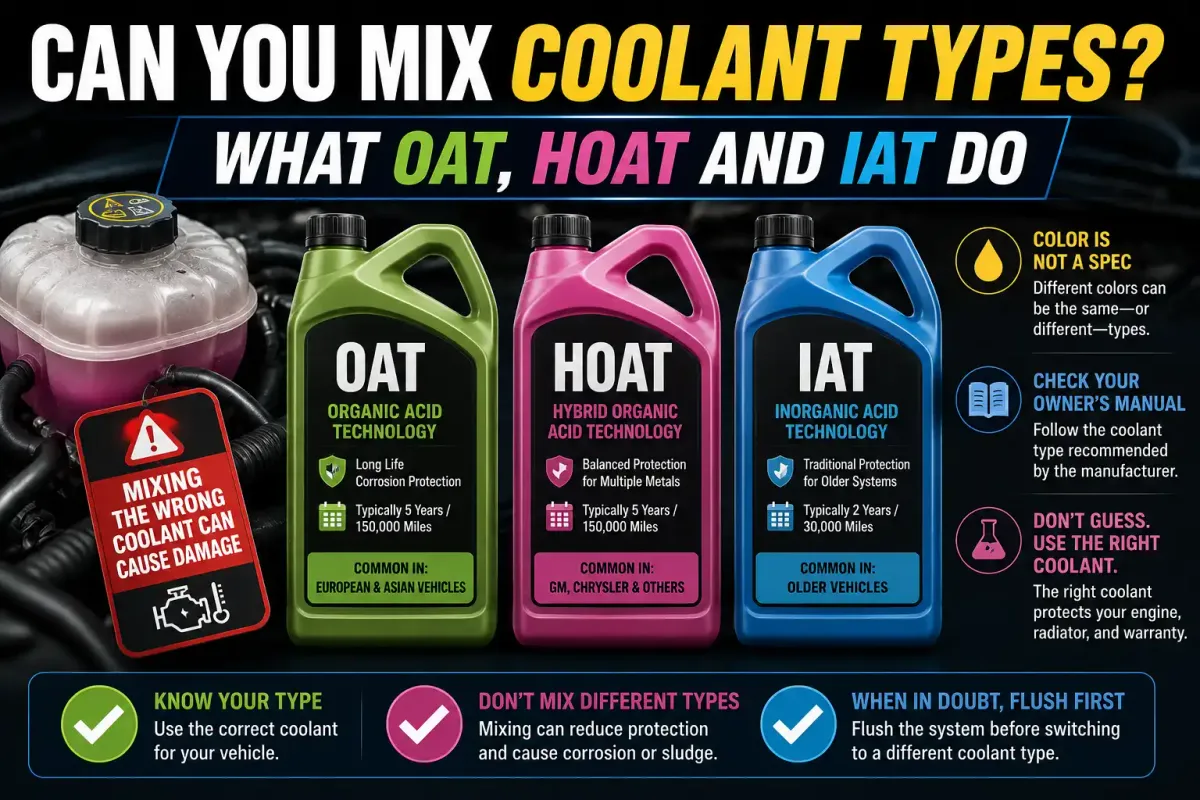
Short answer: how bad it is depends on which chemistries, how much, and what state the system was already in, and none of that can be judged from a description. This is a question for someone who can look at the system, not something to settle from a web page. What this article can give you is what the chemistries are, what mixing them can do, and why the answer is not a simple yes or no.
We are not going to reassure you and we are not going to alarm you. Both would be guesses about a system nobody here can see.
If you have already topped up with the wrong thing, the last section is the practical part.


As an Amazon Associate we earn from qualifying purchases.
What coolant is actually doing besides transferring heat
Most people think of coolant as the thing that carries heat away, and it is. That is the smaller half of its job.
The larger half is protecting the cooling system's materials. A cooling system contains several different metals in contact with each other and with a circulating fluid at temperature, which is close to ideal conditions for corrosion. It also contains non-metallic components that the fluid must not attack.
The additive package in coolant is what manages all of that. The base fluid handles the heat; the additives handle everything else. And it is the additives that differ between chemistries.
IAT, the older inorganic chemistry
IAT stands for inorganic additive technology, and it is the older approach.
It uses inorganic inhibitors that protect by forming a barrier layer on metal surfaces. The approach works, and it was the standard for a long period.
Its characteristic property is that the inhibitors are consumed as they work. That is a design consequence rather than a flaw, and it is part of why coolant in these systems was expected to be serviced on a schedule. What that schedule is for your vehicle is a maintenance question, not a specification question, and this site does not cover intervals.


As an Amazon Associate we earn from qualifying purchases.
OAT, the organic acid chemistry
OAT stands for organic acid technology, and it protects differently.
Rather than forming a general barrier layer, OAT inhibitors act more selectively, which means they are consumed more slowly. That property is what allowed the longer service expectations associated with these coolants.
The different mechanism is also why the two are not simply stronger and weaker versions of one another. They are different approaches to the same problem, suited to different material sets.
HOAT and the hybrids
HOAT stands for hybrid organic acid technology, combining elements of both approaches.
Hybrids exist because different material sets benefit from different protection, and a system containing a mix of materials may be better served by a combination than by either pure approach.
There are further variants beyond these three, including chemistries defined by which specific inhibitor families they exclude. The naming across the market is genuinely inconsistent, which is another reason a category name on a bottle is a weaker guide than the manufacturer specification the bottle claims to meet: OEM oil approvals and what they mean describes the same approval-versus-claim distinction that applies here.
What can happen when chemistries are mixed
Two broad categories of concern, and they are different from each other.
Dilution of protection. Mixing two chemistries produces a fluid in which neither additive package is at its designed concentration. The system may end up with less effective protection than either product would have provided alone, without anything visibly wrong.
Interaction between additive packages. Some combinations can react, and the documented concern is the formation of deposits or gel-like material that can restrict passages and interfere with circulation. Restricted flow in a cooling system is a serious matter because it undermines the function the whole system exists for.
Which of these applies, and to what degree, depends on the specific chemistries and proportions. That is not something to determine by reasoning from a category name, which is why the answer to the question in the title is genuinely "it depends."


As an Amazon Associate we earn from qualifying purchases.
Why the damage is slow and quiet
The pattern this whole cluster keeps returning to.
Corrosion protection is preventive. When it is degraded, nothing happens immediately, because what has changed is the rate at which something bad accumulates rather than an event.
Deposit formation is similarly gradual. Passages restrict progressively, and cooling performance degrades over a range that the vehicle can compensate for until it cannot.
So the absence of a symptom after a wrong top-up is not evidence that it was fine. It is the expected outcome either way in the short term, and that is exactly what makes people conclude the concern is overblown.
What to do now if you have already topped up wrong
Practical, in order.
Stop adding anything. More of either product does not improve the situation.
Write down what you added, including the product name and the approximate amount, and keep the bottle if you still have it. That information is what a technician needs and what you will otherwise forget.
Find out what your vehicle actually specifies, so you know what should be in there: coolant by color is a myth covers why the fluid's appearance will not tell you, and how to find every fluid spec your vehicle requires covers where the specification lives.
Take it to a qualified technician with that information. They can inspect the system, assess the state of the fluid, and advise on whether the system needs draining and flushing. That assessment requires seeing the vehicle, and it is not something we or any other website can do for you.
What we will not do is tell you a proportion below which it is fine, or a procedure for flushing your system. Both would be figures and instructions we cannot verify for your vehicle, and this is a system where being wrong is expensive.
The same reasoning applies to the other fluid where chemistry compatibility is not negotiable: brake fluid DOT ratings and why DOT 5 is not a substitute. And for the vehicle's own documentation generally: owner's manual vs service manual vs repair database.


As an Amazon Associate we earn from qualifying purchases.
Frequently asked questions
Is it bad to mix coolant types?
It can be, and how bad depends on which chemistries, how much, and the state of the system. That cannot be judged from a description, which is why it is a question for someone who can inspect the vehicle.
What is the difference between IAT, OAT and HOAT?
They are different additive technologies. IAT uses inorganic inhibitors forming a barrier layer, OAT uses organic acid inhibitors acting more selectively, and HOAT combines elements of both.
What actually goes wrong when they are mixed?
Two things: the protection can be diluted below its designed effectiveness, and some combinations can form deposits or gel-like material that restricts circulation.
I topped up with the wrong coolant and nothing happened. Is it fine?
The absence of an immediate symptom is expected either way. Corrosion and deposit formation are gradual, so the short term tells you very little.
What should I do now?
Stop adding anything, record what you added and how much, establish what your vehicle specifies, and take that information to a qualified technician who can inspect the system.