Ford F-150 Payload Capacity Chart 2026: Complete Guide
Ford F-150 payload capacity chart by engine for 2024-2026: max 2,440 lb (3.5L EcoBoost), 4x2 vs 4x4, Ford's own figures and where they disagree.

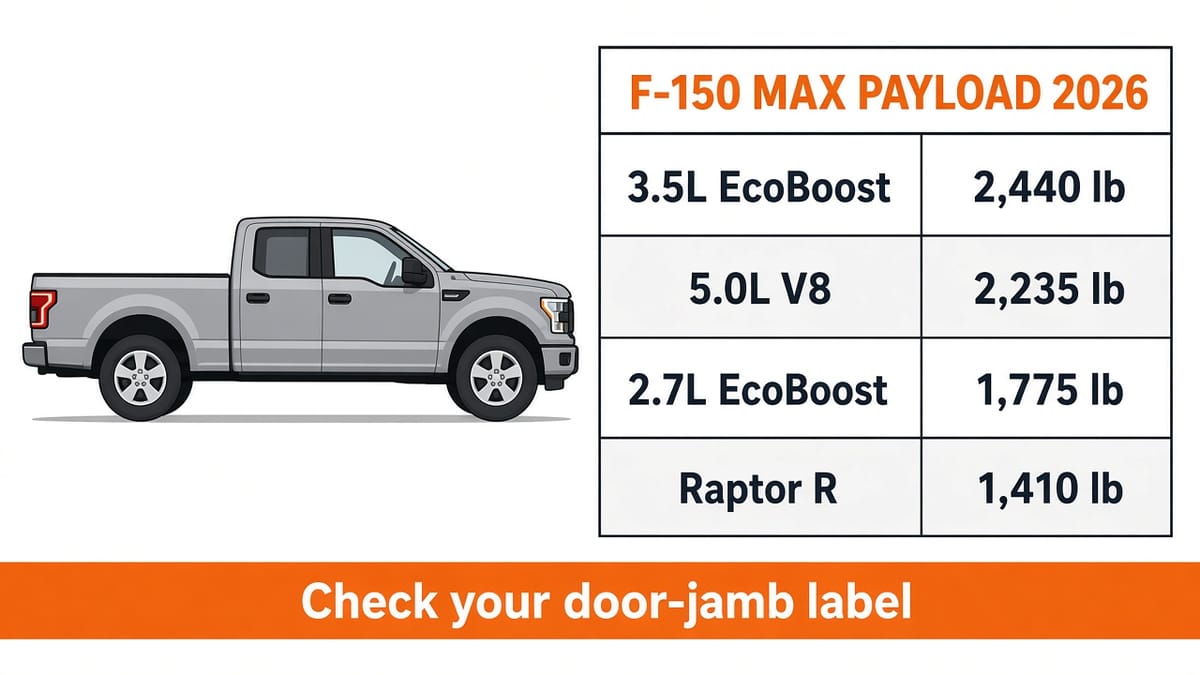
The 2026 Ford F-150 has a maximum payload of 2,440 lb, with the 3.5L EcoBoost V6, according to Ford's 2026 F-150 towing guide. Every other engine is rated lower: 2,235 lb for the 5.0L V8, 1,775 lb for the 2.7L EcoBoost, 1,740 lb for the PowerBoost hybrid (Ford's 2026 technical specifications list 2,045 lb for a 4x2 hybrid, a conflict we explain below), and about 1,400 lb for the Raptor's two engines. Those are maximums for the best configuration of each engine. Ford is explicit that the real number for any truck is on its door-jamb label.
This chart compiles the maximum payload Ford publishes for each engine in its 2024, 2025 and 2026 F-150 towing guides, along with the footnotes that qualify them. Where Ford's own documents disagree, we show both figures.
2026 F-150 payload: 4x2 vs 4x4
| Engine (2026) | 4x2 max payload (lb) | 4x4 max payload (lb) |
|---|---|---|
| 2.7L EcoBoost V6 | 1,775 | 1,715 |
| 5.0L Ti-VCT V8 | 2,235 | 2,080 |
| 3.5L EcoBoost V6 | 2,440 | 2,175 |
| 3.5L PowerBoost Hybrid | 2,045 | 1,740 |
| 3.5L EcoBoost H.O. (Raptor) | — | 1,405 |
| 5.2L Supercharged V8 (Raptor R) | — | 1,410 |
Source: Ford 2026 F-150 Technical Specifications (03/31/26). — = not offered.
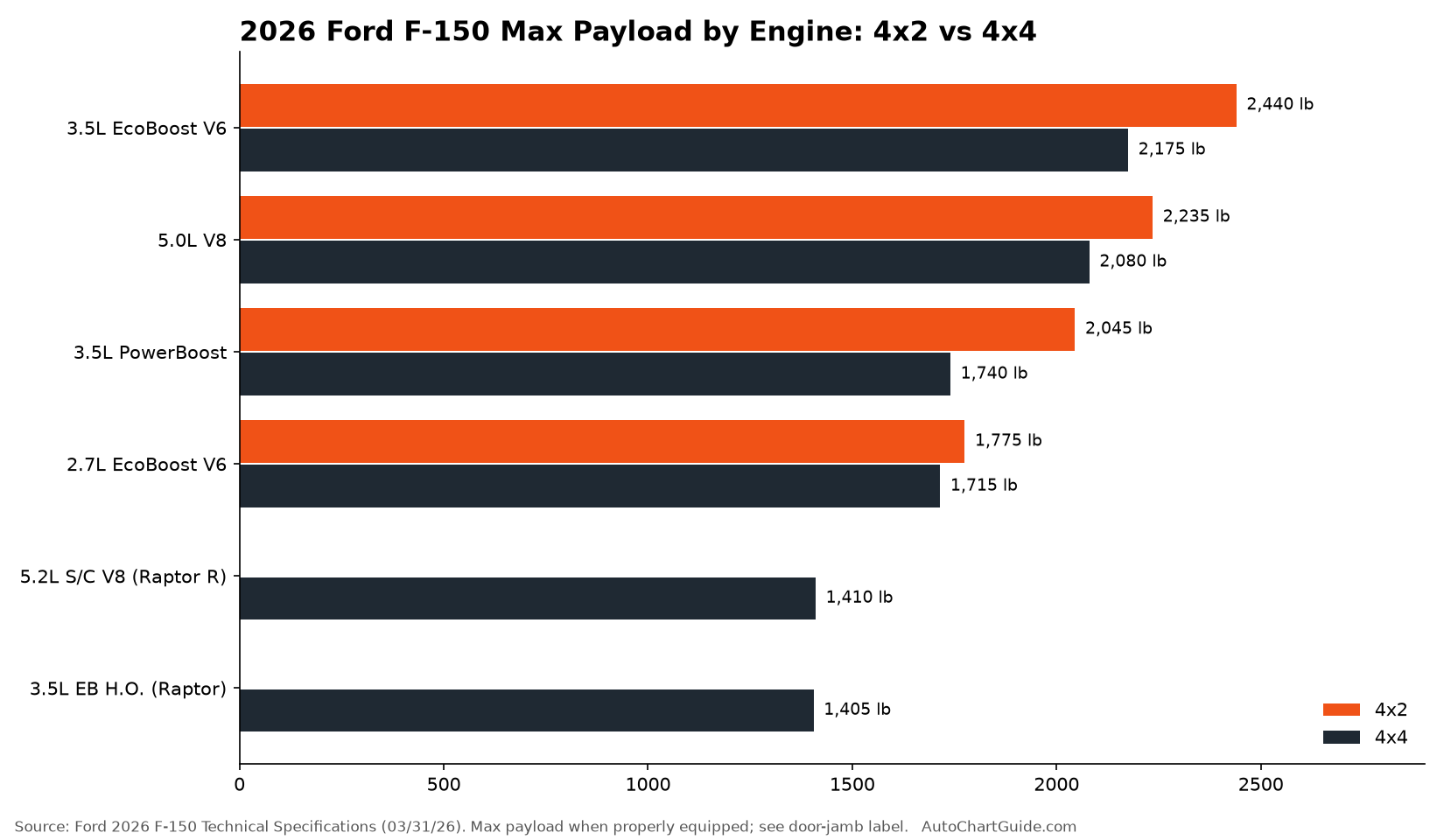
Ford's 2026 technical specifications split maximum payload by drivetrain. The 4x4 figure is lower for every engine offered with both, by 60 lb on the 2.7L and by 265 lb on the 3.5L EcoBoost. The Raptor and Raptor R are 4x4 only. The spec sheet carries the same footnote as the towing guide: maximum payload varies with accessories and configuration, and the doorjamb label gives the carrying capacity of a specific vehicle.
Ford F-150 payload capacity chart by year
| Engine | 2026 max payload (lb) | 2025 max payload (lb) | 2024 max payload (lb) | Notes |
|---|---|---|---|---|
| 3.5L EcoBoost V6 | 2,440 | 2,440 | 2,445 | Highest F-150 payload all three years |
| 5.0L Ti-VCT V8 | 2,235* | 2,225* | 2,230* | *SuperCrew 4x2 footnote: 2,225 (2026, 2025), 2,230 (2024), with Tow/Haul Pkg and Max Tow Axle |
| 2.7L EcoBoost V6 | 1,775 | 1,775 | 1,775 | — |
| 3.5L PowerBoost Full Hybrid | 1,740 | 1,815 | 1,755 | 2026 spec sheet: 2,045 (4x2); Ford.com 2025 FAQ lists 1,750 |
| 3.5L EcoBoost H.O. (Raptor) | 1,405 | 1,405 | 1,405 | 37-inch tires; Ford.com 2025 FAQ lists 1,400 |
| 5.2L Supercharged V8 (Raptor R) | 1,410 | 1,410 | 1,410 | Ford.com 2025 FAQ lists 1,400 |
Source: Ford F-150 towing guides for each model year (available max payload, properly equipped). See door-jamb label for a specific truck.
Read across the rows and the pattern is stable. The 3.5L EcoBoost has carried the highest payload rating in all three years, at 2,445 lb for 2024 and 2,440 lb for 2025 and 2026. The 2.7L EcoBoost has stayed at 1,775 lb. The Raptor's 3.5L High Output (1,405 lb) and the Raptor R's 5.2L supercharged V8 (1,410 lb) have not changed. The PowerBoost hybrid moves the most from year to year: 1,755 lb in 2024, 1,815 lb in 2025 and 1,740 lb in 2026, according to each year's guide.
The footnotes that qualify each number
Ford attaches conditions to the payload maximums, and they matter as much as the figures:
- Configuration. Ford says maximum payload "varies and is based on accessories and vehicle configuration," and tells buyers to see the label on the door jamb for the carrying capacity of a specific vehicle.
- 5.0L V8. The 2026 guide lists 2,235 lb as the maximum, and its footnote says the maximum payload is 2,225 lb on a SuperCrew 4x2 with the 5.0L engine, the Tow/Haul Package and the Max Tow Axle upgrade. The 2025 guide lists 2,225 lb with the same footnote, and the 2024 guide gives 2,230 lb for that SuperCrew 4x2 configuration.
- 3.5L EcoBoost H.O. The 1,405 lb figure is footnoted "37-inch tires," and the engine is Raptor only.
- 5.2L supercharged V8. Raptor R only.
- Independent attributes. Ford notes that horsepower, torque, payload and towing "are independent attributes and may not be achieved simultaneously." The configuration with the most payload is not necessarily the one with the most towing.
Where Ford's documents disagree
Ford publishes F-150 numbers in several places, and they do not always match. Three examples are worth knowing:
- 2025 PowerBoost payload. The 2025 towing guide lists 1,815 lb. Ford's 2025 F-150 web page answers "What is the maximum payload weight capacity of a 2025 F-150?" with 1,750 lb for the PowerBoost.
- 2025 Raptor engines. The guide lists 1,405 lb and 1,410 lb. The same Ford web FAQ rounds both to 1,400 lb.
- 2026 PowerBoost payload. The 2026 towing guide lists 1,740 lb as the hybrid's maximum payload. Ford's 2026 technical specifications (dated 03/31/26) list 2,045 lb for a 4x2 hybrid and 1,740 lb for a 4x4. The guide's figure matches the spec sheet's 4x4 number, not its 4x2 number.
- Raptor footnotes. The towing guide attaches the 37-inch tire footnote to the 3.5L H.O. Raptor's 1,405 lb. In the spec sheet as we read it, the 37-inch tire footnote appears beside the Raptor R's 1,410 lb. The payload numbers match; only the footnote placement differs.
- 2026 PowerBoost towing and ratings. The 2026 towing guide lists the hybrid at 420 hp and 12,400 lb of maximum towing. Ford's current F-150 page lists the PowerBoost at 430 hp and "up to 11,600 lbs" of towing. The guide also lists the 3.5L EcoBoost at 382 hp, while the website lists 400 hp.
We use the towing guide figures in the chart because that is the document Ford publishes for towing and hauling, with configuration footnotes. We cannot tell from the documents which figure is current when they conflict. If you are close to a limit, the label on your truck settles it.
Why your F-150's payload is lower than the chart
A maximum payload rating belongs to the lightest, most payload-friendly version of a given engine. Most trucks on a dealer lot are heavier than that. Ford's footnotes say maximum payload varies with accessories and vehicle configuration. Larger cabs, 4x4, bigger wheels, a sunroof and upscale trims all add curb weight, and every pound of curb weight comes out of payload because the GVWR does not rise to compensate.
Payload is the difference between the Gross Vehicle Weight Rating and what the truck weighs empty. The GVWR is on the Safety Compliance Certification Label on the driver's door frame, and the payload, often described as "the combined weight of occupants and cargo should never exceed" a stated figure, is on the tire and loading information label. Our guide to the door-jamb sticker explains the two labels, and our guide to the tire and loading information placard covers the payload label in detail.
Payload and towing: the tongue weight problem
For most F-150 owners, payload matters most when towing. Ford's guide bases its ratings on a tongue weight of 10 percent, and the general rules follow from that:
- Tongue weight should be 10 percent of the total loaded trailer weight for conventional towing.
- Payload must cover it. The tongue load counts as cargo, so payload has to cover the tongue load plus passengers and everything else in the truck.
- Axle and GVWR limits. The tongue load plus passengers and cargo cannot cause the truck to exceed its rear GAWR or GVWR.
Run the numbers and payload often limits towing before the trailer rating does. A 10,000 lb conventional trailer puts about 1,000 lb on the hitch. On a truck with 1,600 lb of payload, that leaves about 600 lb for the driver, passengers and anything in the cab or bed. Fifth-wheel and gooseneck trailers put a larger share of their weight in the bed than conventional trailers, so payload runs out even faster. Our Ford F-350 towing capacity chart works through that king pin math for a 34,900 lb 5th-wheel trailer on a dually.
Ford's towing ratings assume a 150-lb driver and passenger, per the guide's footnote. A full crew cab of adults adds several hundred pounds beyond that, and all of it comes out of payload. Our Ford F-150 towing capacity chart covers the trailer ratings in detail. This chart is the other half of the same calculation.
Payload, GVWR, GAWR and GCWR
Four ratings decide how much an F-150 can carry. The Gross Vehicle Weight Rating (GVWR) is the most the loaded truck may weigh, including passengers, cargo, fuel and any tongue load. The Gross Axle Weight Rating (GAWR) is the most each axle may carry. The Gross Combined Weight Rating (GCWR) is the most the truck and a loaded trailer may weigh together. Payload is what remains between the empty truck and the GVWR. All four apply at once, so the useful limit is whichever one you reach first. A truck can be under its payload and still over its rear GAWR if the load sits far back in the bed, or under its GVWR and over its GCWR with a heavy trailer behind it. Weighing the loaded truck, axle by axle, on a public scale is the most reliable way to know where a real load stands.
Hitch receiver limits
Ford's 2026 guide lists separate limits for the hitch receiver. A 2-inch receiver rated at 11,600 lb is standard. The Max Tow Axle includes a 2-inch reinforced receiver rated at 14,000 lb. For the F-150, Ford lists a maximum tongue load of 500 lb weight-carrying and 1,400 lb weight-distributing. Ford's towing ratings above 5,000 lb assume a weight-distribution system.
The receiver ratings are not payload, but they work the same way: the tongue load has to fit inside the receiver's rating, the truck's payload and the rear axle rating at the same time. The lowest of those limits is the one that applies.
How to find your truck's exact payload
- Read the door-jamb labels. The tire and loading label gives the maximum combined weight of occupants and cargo for that specific truck, as built.
- Check the GVWR. It is on the Safety Compliance Certification Label. Subtracting a weighed curb weight from the GVWR gives the same answer as the label, and it accounts for anything added after the truck left the factory.
- Find the axle code. Ford's guide says the axle code is on the Safety Compliance Certification Label, and the guide converts the code to the axle ratio.
- Identify the configuration. Engine, cab, box length and drive determine which row of Ford's charts applies. Our guide to getting a window sticker by VIN shows how to confirm the factory equipment of a used truck, and our guide to telling what trim your car is helps when the badges do not match the build.
- Subtract what you have added. A bed cover, toolbox, bedliner, aftermarket bumpers or a hitch-mounted accessory all count against payload.
Payload and tires
Payload ratings assume the tires on the truck are the ones it was built with, or equivalent. The Raptor's 1,405 lb rating, footnoted to 37-inch tires, shows how directly tire choice can enter a payload figure. If you replace tires on an F-150 that carries or tows heavy loads, match or exceed the original load rating. Our guide to load range vs load index explains how to compare them.
Weight distribution in the bed
Ford's spec-sheet footnote ends with a simple instruction: always properly secure cargo. Beyond that, keep the load low and balanced side to side. In a pickup bed, a heavy load placed behind the rear axle shifts weight off the front axle, so the rear GAWR can be the limit you reach first even when total payload is within its rating.
Payload when shopping used
The year-to-year chart is most useful when you are comparing used trucks. A 2024 3.5L EcoBoost and a 2026 one have nearly identical maximum payload ratings on paper, so the difference between two specific trucks will come from configuration, not model year. Compare the door-jamb labels on the actual trucks, not the brochure figures. A SuperCrew 4x4 with a long list of options can sit hundreds of pounds below the maximum for its engine, and a plain 4x2 work truck with the same engine can sit close to it. If a seller cannot show you the label, ask for the VIN and confirm the build with the window sticker before you assume a number.
Common payload mistakes
- Quoting 2,440 lb for any F-150. That figure belongs to one engine in its best configuration. Many F-150s on the road have far less.
- Treating towing and payload as separate. Tongue weight is payload. A heavy trailer uses payload before you add people.
- Forgetting accessories. Ford's own footnotes say payload varies with accessories. Every add-on reduces it.
- Using the brochure instead of the label. Ford says to see the door-jamb label for the carrying capacity of a specific vehicle.
- Ignoring the rear axle. Staying under total payload does not guarantee you are under the rear GAWR, especially with tongue weight and cargo behind the axle.
Frequently asked questions
What is the max payload of a 2026 Ford F-150?
2,440 lb with the 3.5L EcoBoost V6 in its best configuration, according to Ford's 2026 F-150 towing guide.
What is the payload of an F-150 with the 5.0L V8?
Ford's 2026 guide lists 2,235 lb as the maximum, with a footnote giving 2,225 lb for a SuperCrew 4x2 with the Tow/Haul Package and Max Tow Axle.
What is the payload of the F-150 PowerBoost hybrid?
Ford's 2026 towing guide lists 1,740 lb, while Ford's 2026 technical specifications list 2,045 lb for 4x2 and 1,740 lb for 4x4. The 2025 guide lists 1,815 lb and the 2024 guide 1,755 lb.
What is the payload of the F-150 Raptor?
Ford lists 1,405 lb for the 3.5L EcoBoost H.O. Raptor (with 37-inch tires) and 1,410 lb for the 5.2L supercharged Raptor R.
Where do I find my F-150's actual payload?
On the tire and loading information label in the driver's door jamb. Ford says to see that label for the carrying capacity of a specific vehicle.
Is 4x4 F-150 payload lower than 4x2?
Yes. Ford's 2026 specifications list 2,440 lb (4x2) vs 2,175 lb (4x4) for the 3.5L EcoBoost, and 1,775 vs 1,715 lb for the 2.7L.
Does tongue weight count against payload?
Yes. The tongue load counts as cargo. Ford's towing ratings assume a tongue weight of 10 percent of the trailer weight.
Why is my F-150's payload lower than 2,440 lb?
Ford's maximum applies to one engine and configuration. Ford says maximum payload varies with accessories and vehicle configuration; 4x4 and heavier trims carry less.
Did F-150 payload change between 2024 and 2026?
Slightly. The 3.5L EcoBoost went from 2,445 lb (2024) to 2,440 lb (2025 and 2026), and the PowerBoost hybrid changed each year. The 2.7L and Raptor figures stayed the same.