Ram 2500 Towing Capacity Chart 2026: Official Ratings
Ram 2500 towing capacity chart for 2026: every HEMI and Cummins rating by axle, cab, bed and drive, up to 20,000 lb, from Ram's official chart.

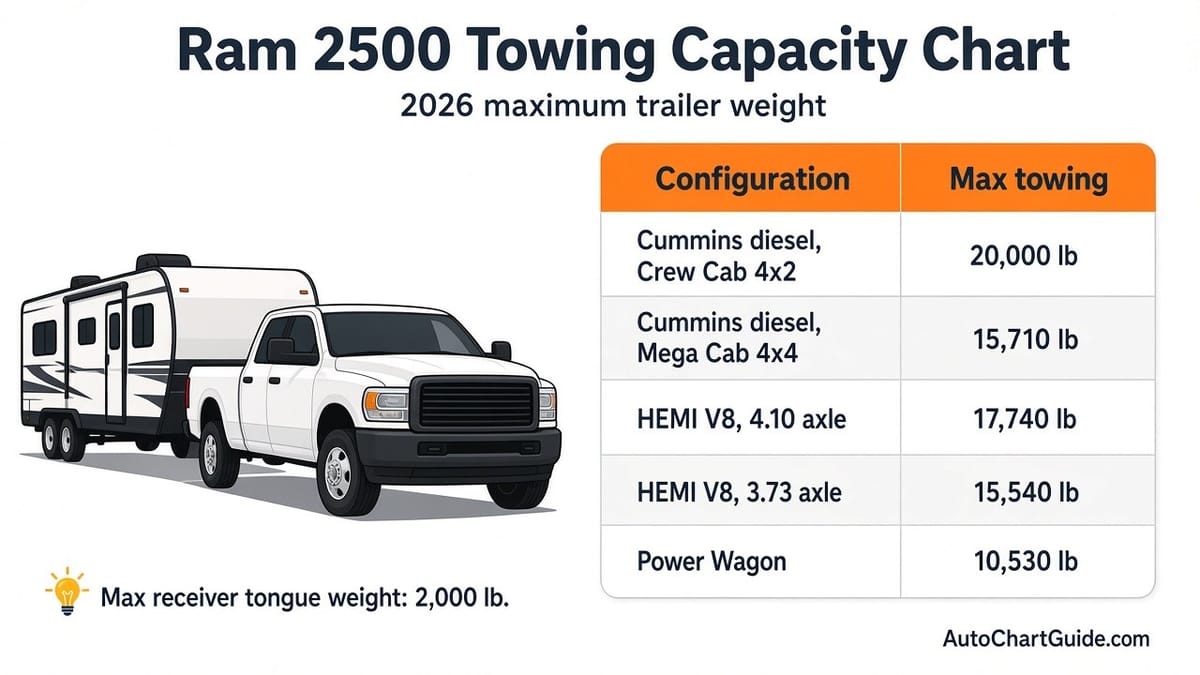
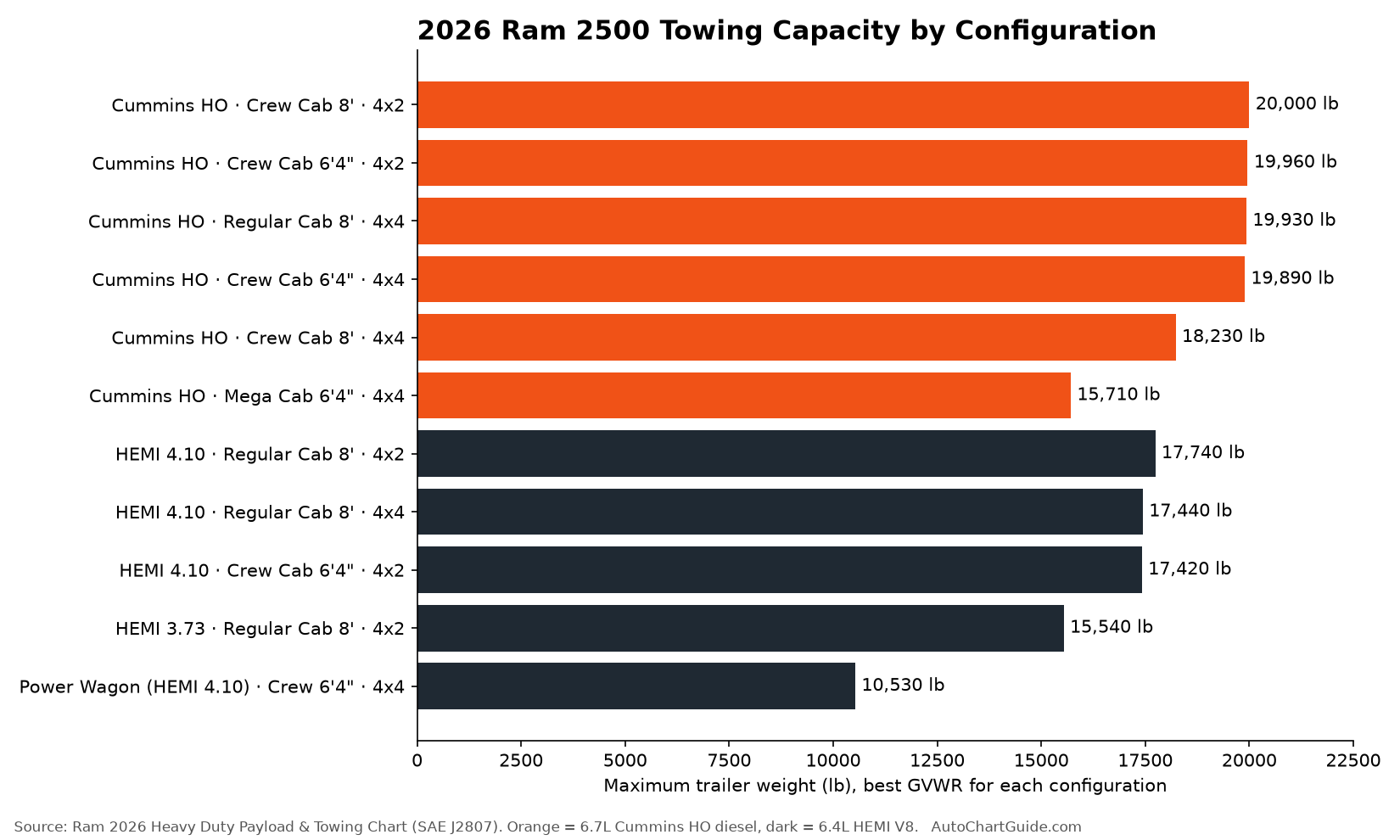
The 2026 Ram 2500 tows up to 20,000 lb with the High-Output 6.7L Cummins turbo diesel and up to 17,740 lb with the 6.4L HEMI V8, according to Ram's official 2026 Heavy Duty towing chart. Those are the two headline numbers. Most Ram 2500 trucks are rated for less. The chart below gives the rating for every engine, axle ratio, cab, bed, GVWR and drive combination that Ram publishes. If you find your exact configuration, you have your truck's real number rather than the brochure's best case.
Every figure on this page comes from Ram's 2026 Ram Heavy Duty payload and towing chart (SAE J2807 compliant), cross-checked against the Stellantis "What's New for 2026: Ram Heavy Duty" release and the Ram 2500 capability page. Where those sources disagree, we say so.
Ram 2500 towing capacity at a glance
Ram builds the 2026 2500 with two engines. The 6.4L HEMI V8 makes 405 hp and 429 lb-ft and is paired with the TorqueFlite 8HP75-LCV eight-speed automatic. The High-Output 6.7L Cummins I6 turbo diesel makes 430 hp and 1,075 lb-ft and is paired with the TorqueFlite HD eight-speed automatic. Stellantis gives these maximums for the 2500:
- 6.4L HEMI V8: up to 17,740 lb towing and up to 3,930 lb payload.
- 6.7L Cummins HO turbo diesel: up to 20,000 lb towing and up to 3,600 lb payload.
One small discrepancy is worth knowing. Ram's consumer capability page lists the HEMI's maximum towing as 17,750 lb, while both the Stellantis release and the detailed towing chart give 17,740 lb. We use 17,740 lb because it is the figure in the configuration-level chart, which is the document Ram flags as SAE J2807 compliant. A 10 lb difference will never decide whether a trailer is safe. It does show that the marketing page is not the document to settle a close call.
The 2026 2500 comes in four body configurations: Regular Cab with an 8-foot bed, Crew Cab with a 6-foot 4-inch bed, Crew Cab with an 8-foot bed, and Mega Cab with a 6-foot 4-inch bed. The Mega Cab is 4x4 only. The Stellantis release lists the model lineup as Tradesman, Black Express, Warlock, Big Horn, Laramie, Rebel, Power Wagon, Limited and Limited Longhorn. Ram's towing chart is organized by drivetrain and weight rating, not trim. To read it you need your engine, axle ratio, GVWR, cab, bed and whether the truck is 4x2 or 4x4.
6.4L HEMI V8 towing chart
Each cell shows the 4x2 rating, then the 4x4 rating. "NA" means Ram does not offer that combination. All figures are in pounds and come from the maximum trailer weight table in Ram's 2026 Heavy Duty chart.
| Axle | GVWR (lb) | GCWR (lb) | Regular Cab 8' | Crew Cab 6'4" | Crew Cab 8' | Mega Cab 6'4" |
|---|---|---|---|---|---|---|
| 4.10 (Power Wagon) | 8,565 | 18,000 | — | NA/10,530 | — | — |
| 3.73 | 9,900 | 22,050 | 15,540/15,220 | 15,210/14,920 | 15,070/14,730 | — |
| 3.73 | 10,000 | 22,050 | 15,540/15,240 | 15,220/14,930 | 15,080/14,720 | — |
| 3.73 | 11,040 | 22,050 | NA/15,150 | — | NA/14,580 | — |
| 4.10 | 9,900 | 24,250 | 17,740/17,420 | 17,410/17,120 | 17,270/16,930 | — |
| 4.10 | 10,000 | 24,250 | 17,570/17,440 | 17,420/17,130 | 17,280/16,920 | — |
| 4.10 | 11,040 | 24,250 | NA/17,350 | — | — | — |
Values are 4x2/4x4 in lb. NA = not offered. — = no rating listed. * Ram: applies to vehicles produced with sales code Z2K/Z7G/Z3Y. Source: Ram 2026 Heavy Duty Payload and Towing Chart.
The axle ratio matters most for the gas truck. With a 3.73 axle and a 22,050 lb GCWR, the best HEMI 2500 tows 15,540 lb. With a 4.10 axle, GCWR rises to 24,250 lb and the same Regular Cab 8-foot 4x2 truck is rated for 17,740 lb. That is about 2,200 lb of extra capacity from the gearing alone. If you plan to tow anything near 15,000 lb with a gas 2500, the axle ratio is the first thing to check on the window sticker or build sheet.
The Power Wagon is a separate case. It is listed with a 4.10 axle, an 8,565 lb GVWR and an 18,000 lb GCWR. Its maximum trailer rating is 10,530 lb, and only as a Crew Cab 6-foot 4-inch 4x4. Its lower GVWR and GCWR are what set the number. The Power Wagon is rated for about 7,000 lb less than the strongest gas 2500 in the chart, despite the same engine.
6.7L Cummins High-Output diesel towing chart
The diesel's ratings depend on cab, bed and drive far more than on the axle. Every 2026 Ram 2500 diesel in the chart uses a 3.42 axle. Values are 4x2/4x4 in pounds, as above.
| Axle | GVWR (lb) | GCWR (lb) | Regular Cab 8' | Crew Cab 6'4" | Crew Cab 8' | Mega Cab 6'4" |
|---|---|---|---|---|---|---|
| 3.42 | 9,900 | 24,290 | — | — | — | NA/14,630 |
| 3.42 | 10,000 | 24,290 | — | — | — | NA/15,380 |
| 3.42 | 11,040* | 24,290 | — | — | — | NA/15,710 |
| 3.42 | 9,900 | 26,580 | — | — | NA/17,080 | — |
| 3.42 | 10,000/10,190 | 26,580 | — | — | NA/18,230 | — |
| 3.42 | 11,040* | 26,580 | — | — | NA/18,230 | — |
| 3.42 | 9,900 | 28,110 | — | NA/18,820 | — | — |
| 3.42 | 9,900/10,000/10,190 | 27,820 | NA/19,900 | — | — | — |
| 3.42 | 11,040* | 27,820 | NA/19,930 | — | — | — |
| 3.42 | 9,900/10,000/10,190/11,040* | 27,870 | — | 19,960/NA | — | — |
| 3.42 | 10,000 | 28,110 | — | NA/19,770 | — | — |
| 3.42 | 10,190 | 28,110 | — | NA/19,890 | — | — |
| 3.42 | 11,040* | 28,110 | — | NA/19,890 | — | — |
| 3.42 | 9,900 | 28,010 | — | — | 19,980/NA | — |
| 3.42 | 10,000/10,190/11,040* | 28,010 | — | — | 20,000/NA | — |
Values are 4x2/4x4 in lb. NA = not offered. — = no rating listed. * Ram: applies to vehicles produced with sales code Z2K/Z7G/Z3Y. Source: Ram 2026 Heavy Duty Payload and Towing Chart.
The 20,000 lb maximum applies to one configuration: a Crew Cab 8-foot bed 4x2 diesel at a 28,010 lb GCWR. Ram lists it at GVWRs of 10,000, 10,190 and 11,040 lb. The same truck at a 9,900 lb GVWR is rated for 19,980 lb. Several other configurations come within 100 lb: the Crew Cab 6-foot 4-inch 4x2 at 19,960 lb and the Regular Cab 8-foot 4x4 at up to 19,930 lb.
The surprise in the diesel chart is the Crew Cab 8-foot 4x4. It is rated for 17,080 lb at a 9,900 lb GVWR and 18,230 lb at higher GVWRs, and its GCWR is 26,580 lb rather than the 28,000-plus of most other diesel configurations. That is about 1,800 lb less than the same cab and bed in 4x2 form, a much larger gap than the 4x2/4x4 difference elsewhere in the chart. The Mega Cab is lower still: 14,630 lb, 15,380 lb or 15,710 lb depending on GVWR, at a 24,290 lb GCWR. A Mega Cab diesel is rated for less than a 4.10-axle HEMI Regular Cab.
Payload: the other half of the towing number
Ram's footnote says trailer weight and payload rating are "mutually exclusive." In practice that means you cannot use the maximum trailer rating and the maximum payload at the same time. The trailer's tongue weight counts against payload, and so do passengers, cargo and any hitch in the bed. These are Ram's 2026 payload figures for representative GVWRs:
| Engine | GVWR (lb) | Regular Cab 8' | Crew Cab 6'4" | Crew Cab 8' | Mega Cab 6'4" |
|---|---|---|---|---|---|
| 6.4L HEMI | 9,900 | 3,830/3,510 | 3,500/3,210 | 3,360/3,020 | — |
| 6.4L HEMI | 10,000 | 3,930/3,630 | 3,610/3,320 | 3,470/3,110 | — |
| 6.4L HEMI | 11,040 | NA/4,580 | — | NA/4,010 | — |
| 6.7L Cummins HO | 9,900 | NA/2,450 | 2,460/2,170 | 2,350/2,010 | NA/1,790 |
| 6.7L Cummins HO | 10,000 | NA/2,550 | 2,560/2,260 | 2,460/2,120 | NA/1,860 |
| 6.7L Cummins HO | 11,040* | NA/3,590 | 3,600/3,300 | 3,500/3,160 | NA/2,900 |
Values are 4x2/4x4 in lb. NA = not offered. — = no rating listed. * Ram: applies to vehicles produced with sales code Z2K/Z7G/Z3Y. Source: Ram 2026 Heavy Duty Payload and Towing Chart.
One inconsistency stands out. Ram's chart lists 4,580 lb (Regular Cab 8-foot 4x4) and 4,010 lb (Crew Cab 8-foot 4x4) for HEMI trucks at the 11,040 lb GVWR. Both figures are above the 3,930 lb maximum gas payload that Stellantis and Ram's capability page publish. We reproduce the chart as printed, but we cannot confirm which figure is right. If you are buying a high-GVWR gas truck for payload, confirm the number on the actual truck's door-jamb label before relying on it.
The diesel engine is heavier, which is why the HEMI trucks have more payload at the same GVWR. For example, a gas Crew Cab 6-foot 4-inch 4x2 at 10,000 lb GVWR has 3,610 lb of payload. The diesel Crew Cab 6-foot 4-inch 4x2 at the 11,040 lb GVWR has 3,600 lb, despite the higher GVWR. Ram lists the 11,040 lb diesel figures for vehicles built with sales codes Z2K, Z7G or Z3Y. Your truck's actual payload is printed on the tire and loading information label in the door jamb. That number reflects the options your truck was built with, so trust it over any chart, including this one.
Tongue weight and hitch limits
Ram's chart sets several limits that matter as much as the trailer rating:
- Recommended tongue weight: 10 percent of the gross trailer weight for a conventional hitch.
- Maximum receiver tongue weight: 2,000 lb for the Ram 2500 Class V receiver hitch.
- Trailers over 20,000 lb: Ram says a 5th-wheel or gooseneck hitch is required. Since no 2026 2500 is rated above 20,000 lb, the practical point is that the top-rated configurations reach their maximum right at the edge of what Ram allows on a conventional hitch.
- Gooseneck and 5th-wheel tongue weight: must never exceed any manufacturer recommendation, including payload and GAWR (gross axle weight rating).
Put the numbers together and a heavy conventional trailer gets tight. A 20,000 lb conventional trailer at 10 percent tongue weight puts exactly 2,000 lb on the receiver, the Class V limit. That 2,000 lb also comes out of a diesel's payload of at most 3,600 lb before anyone sits in the cab. Ram also says GAWRs, GVWRs and GCWRs "should never be exceeded." A truck can be under its trailer rating and still overloaded on the rear axle.
How Ram calculates these ratings
Ram says the trailer weight ratings are calculated as specified in SAE J2807, the industry standard for tow vehicle trailering ratings. SAE says J2807 sets minimum performance criteria at GCWR and a calculation method for trailer weight ratings, and it covers vehicles up to 14,000 lb GVWR, which includes every Ram 2500. Ram's footnote lists the J2807 assumptions it uses: 300 lb of passengers and 100 lb of options. It also adds a trailering equipment weight: 75 lb for a conventional hitch, 40 lb for a gooseneck and 250 lb for a 5th-wheel. Ram describes all weights as applying "when properly equipped" and rounds them to the nearest 10 lb.
Those assumptions explain why your own number is probably lower than the chart's. A rating built on 300 lb of passengers and 100 lb of options does not cover a family of four, a bed toolbox and a full load of gear. Every pound you add to the truck beyond the J2807 assumptions comes out of what is left under the GCWR, and the GCWR is the ceiling for the truck and trailer combined.
Why GCWR is the number to watch
The Gross Combined Weight Rating is the maximum weight of the loaded truck plus the loaded trailer. In Ram's chart, it explains most of the differences between configurations. The 4.10 HEMI trucks share a 24,250 lb GCWR, the 3.73 HEMI trucks share 22,050 lb, and the diesel configurations range from 24,290 lb for the Mega Cab to 28,110 lb for some Crew Cabs.
A simple way to use it: weigh your truck loaded as you will tow, with fuel, passengers, cargo and hitch. Subtract that from the GCWR. The result is the most the trailer can weigh, and it may be less than the chart's maximum trailer weight because your truck probably weighs more than the J2807 test truck. Then check that the tongue weight fits within the remaining payload and the rear GAWR, and that the trailer is within the hitch limits above.
How to find your exact Ram 2500 configuration
To use the chart, you need six facts about the truck:
- Engine: 6.4L HEMI or 6.7L Cummins HO. It is on the window sticker and usually on the badging.
- Axle ratio: 3.73 or 4.10 for the HEMI, 3.42 for the diesel. It is listed on the window sticker and in the build sheet. Our guide to getting a window sticker by VIN covers how to retrieve it for a used truck.
- GVWR: printed on the certification label in the driver's door jamb.
- Cab and bed: Regular Cab 8-foot, Crew Cab 6-foot 4-inch or 8-foot, or Mega Cab 6-foot 4-inch.
- Drive: 4x2 or 4x4.
- Sales codes: for the 11,040 lb diesel GVWR rows, Ram notes that the figures apply to vehicles built with sales codes Z2K, Z7G or Z3Y. Those codes appear on the build sheet.
Trim names are not enough. A Laramie can be a Crew Cab or a Mega Cab, 4x2 or 4x4, gas or diesel, and its towing rating can change by several thousand pounds across those options. If you are unsure of the trim itself, our guide to telling what trim your car is helps, but for towing the configuration matters more than the badge.
Ram 2500 vs the Ram 3500 and half-ton trucks
The 2500 sits between the half-ton Ram 1500 and the Ram 3500. Stellantis gives the 2026 Ram 3500 a maximum of 18,150 lb with the HEMI and 36,610 lb with the Cummins, with up to 7,590 lb of payload. The 3500's top diesel rating comes from dual-rear-wheel (DRW) configurations with a 14,000 lb GVWR. For the 3500, Ram requires a 5th-wheel or gooseneck hitch for trailers over 23,000 lb. If your trailer is near or above 20,000 lb, or you need more payload than the 2500's published maximums of 3,600 lb (diesel) and 3,930 lb (gas), the 3500 is the Ram built for that job, and our Ram 3500 towing capacity chart lists every 2027 and 2026 rating for it. For Ford's one-ton, our Ford F-350 towing capacity chart lists every 2026 F-350 rating, up to 38,000 lb with a dually and a gooseneck.
If you are comparing against a half-ton, our Ford F-150 towing capacity chart shows the same configuration-by-configuration approach for that truck. The trailer numbers can overlap at the low end. The difference is in GVWR, payload and how much margin you have when the trailer is heavy.
Tires, hitches and equipment
A towing rating assumes the truck is properly equipped. That covers the hitch and wiring, and it also covers the tires. The load and inflation figures on the placard are part of the truck's rated capacity. If you replace tires, match or exceed the original load rating. Our guides to load range vs load index and the tire and loading information placard explain how to read those numbers.
Ram offers a factory fifth-wheel/gooseneck tow prep group on the 2026 Heavy Duty. Ram says it adds factory-installed provisions for 5th-wheel and gooseneck mounts, plus a 7-pin wiring harness in the bed and a 12-pin connector for an auxiliary Mopar camera. Stellantis also lists trailer reverse steering control, Blind-spot Monitoring with Trailer Tow Detection, a digital rearview mirror with tow mode, and power-folding, power-telescoping trailer tow mirrors among the available towing technology. None of these features changes the published rating. They make it easier to tow at the rating safely.
Common mistakes when reading the Ram 2500 chart
- Using 20,000 lb for every diesel. Only Crew Cab 8-foot 4x2 diesels at a GVWR of 10,000 lb or more reach it. A Mega Cab diesel can be rated more than 4,000 lb lower.
- Assuming 4x4 costs only a few hundred pounds. In most configurations it does. The diesel Crew Cab 8-foot is the exception, where 4x4 drops the rating from 20,000 lb to 18,230 lb or less.
- Ignoring the axle on a HEMI. A 3.73 HEMI is rated for about 2,200 lb less than a 4.10 HEMI in the same body.
- Treating the Power Wagon as a regular 2500. At 10,530 lb it is rated for barely more than half of the diesel maximum.
- Forgetting payload. A trailer inside its rating can still overload the truck if tongue weight, passengers and cargo exceed payload or the rear GAWR.
Older Ram 2500 model years
This chart covers the 2026 model year only. Ram publishes a separate towing guide for each model year, and ratings change when engines, transmissions or weight ratings change. Ram's chart lists the 2026 High-Output Cummins at 430 hp (+10) and says the 2026 High-Output diesel improves 2500 and 3500 standard-output horsepower by 60. Those changes are why earlier years' figures will not match. If you own an older truck, find the towing guide for its model year rather than applying 2026 numbers. The owner's manual and the door-jamb labels for your truck are the authoritative source either way.
Frequently asked questions
What is the max towing capacity of a 2026 Ram 2500?
20,000 lb, with the High-Output 6.7L Cummins diesel in a Crew Cab 8-foot bed 4x2 configuration at a 10,000 lb or higher GVWR. The 6.4L HEMI V8 tops out at 17,740 lb.
How much can a gas Ram 2500 tow?
The 6.4L HEMI 2500 is rated from 14,580 lb to 17,740 lb in its regular configurations, depending on axle, cab, bed and drive. The Power Wagon is rated for 10,530 lb.
Does the axle ratio change Ram 2500 towing capacity?
Yes, for the HEMI. With the 4.10 axle the gas 2500 tows up to 17,740 lb; with the 3.73 axle it tows up to 15,540 lb. Every 2026 diesel 2500 uses a 3.42 axle. Ford's rival works differently: our Ford F-250 towing capacity chart shows how the axle package moves a diesel F-250 between 15,500 and 22,000 lb.
How much can a Ram 2500 Power Wagon tow?
Ram's 2026 chart rates the Power Wagon (Crew Cab 6-foot 4-inch 4x4, 4.10 axle, 8,565 lb GVWR) for 10,530 lb.
What is the Ram 2500 Mega Cab towing capacity?
The 2026 Mega Cab is diesel 4x4 only in the towing chart, rated for 14,630 lb, 15,380 lb or 15,710 lb depending on GVWR.
What is the maximum tongue weight for a Ram 2500?
Ram limits the 2500's Class V receiver hitch to 2,000 lb and recommends a tongue weight of 10 percent of the trailer weight for a conventional hitch.
Do I need a fifth-wheel or gooseneck hitch with a Ram 2500?
Ram says a 5th-wheel or gooseneck hitch is required for trailers over 20,000 lb. Below that, a conventional hitch can be used within the truck's ratings.
What is the payload of a 2026 Ram 2500?
Ram and Stellantis publish maximums of 3,930 lb with the HEMI and 3,600 lb with the Cummins diesel, though Ram's detailed chart lists higher figures for some 11,040 lb GVWR HEMI trucks. Your truck's own payload is printed on the door-jamb label.
Are Ram 2500 towing ratings SAE J2807 compliant?
Yes. Ram's 2026 chart says its trailer weight ratings are calculated as specified in SAE J2807.