Holley Accelerator Pump Cam Chart 2026: Official Color Guide
Holley's official pump cam shot order, the number on every cam, what is in the 20-12 kit, which screw hole to use and how to set the pump lever.

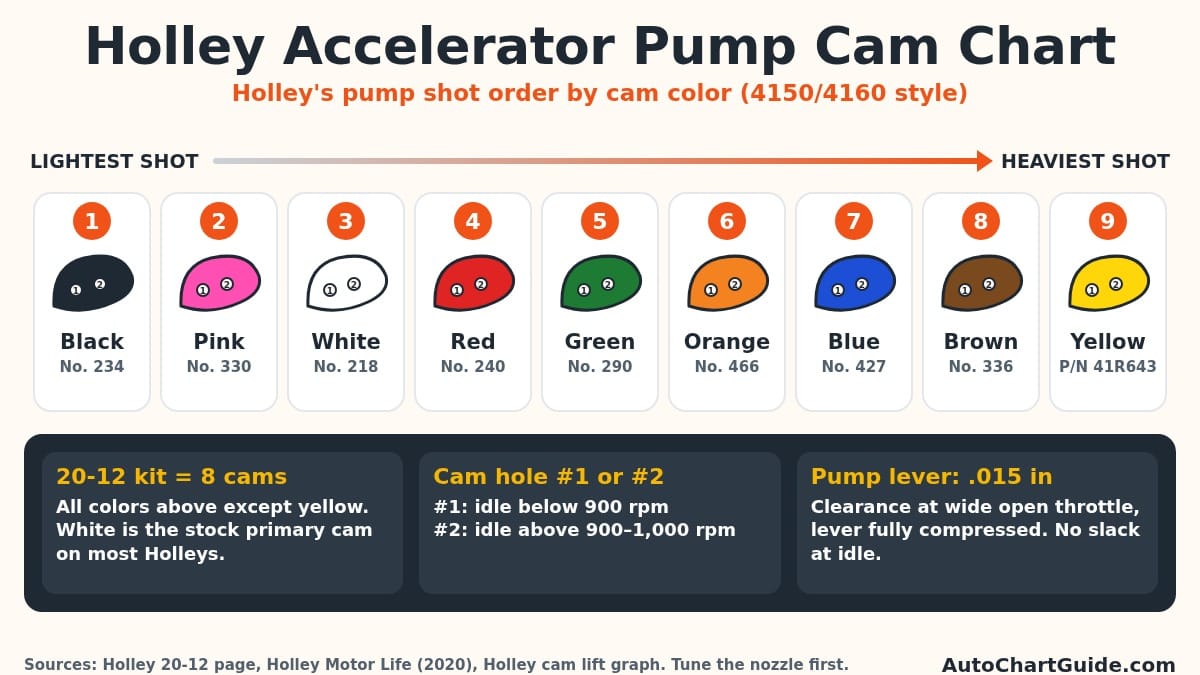
Short answer: Holley ranks its accelerator pump cams from the lightest to the heaviest shot as Black, Pink, White, Red, Green, Orange, Blue, Brown, Yellow. The 20-12 assortment kit holds eight of them (every color except yellow in Holley's cam table), and white is the stock primary cam on most Holley carburetors. Pick the cam after the nozzle, mount it in hole #1 if the engine idles below about 900 rpm, and set about .015 in of pump lever clearance at wide open throttle.
Everything in this chart comes from Holley's own documents, all read on November 1, 2026: the 20-12 pump cam kit product page, Holley's "Pump Cam Lift vs. Throttle Position" graph, the Holley Motor Life article "Accelerator Pump Tuning For Holley Carburetors" (December 4, 2020), Holley's High Performance Tuning Instructions (January 20, 2014) and the Holley Carburetor Tech Info sheet. Holley says: "Accelerator pump shot relative to cam color from lightest to heaviest are as follows: Black, Pink, White, Red, Green, Orange, Blue, Brown, Yellow." We have not bench-tested any cam; where Holley's documents disagree, we show both versions.
Holley Accelerator Pump Cam Chart (4150 and 4160 style)
This is the chart most people are looking for: each cam color, the number molded into it, Holley's part number from its lift graph, and where it sits in Holley's shot ranking. The numbers matter because the colors fade. Holley notes that "If you are unsure of the color of cam, or it has faded from use, each cam is also numbered."
| Shot rank (1 = lightest) | Cam color | Number on the cam | Part number on Holley's lift graph | In the 20-12 kit? |
|---|---|---|---|---|
| 1 | Black | 234 | 41R234 | Yes |
| 2 | Pink | 330 | 41R330 | Yes |
| 3 | White | 218 | 41R218 | Yes (the stock primary cam on most Holleys) |
| 4 | Red | 240 | 41R240 | Yes |
| 5 | Green | 290 | 41R290 | Yes |
| 6 | Orange | 466 | 41R466 | Yes |
| 7 | Blue | 427 | 41R427 | Yes |
| 8 | Brown | 336 | 41R336 | Yes |
| 9 | Yellow | Not listed by Holley | 41R643 | Not in Holley's 20-12 cam table |
Sources: shot order from the Holley 20-12 product page; cam numbers from Holley's 2020 "Accelerator Pump Tuning" cam color table; 41R part numbers from Holley's "Pump Cam Lift vs. Throttle Position" graph. All read November 1, 2026.
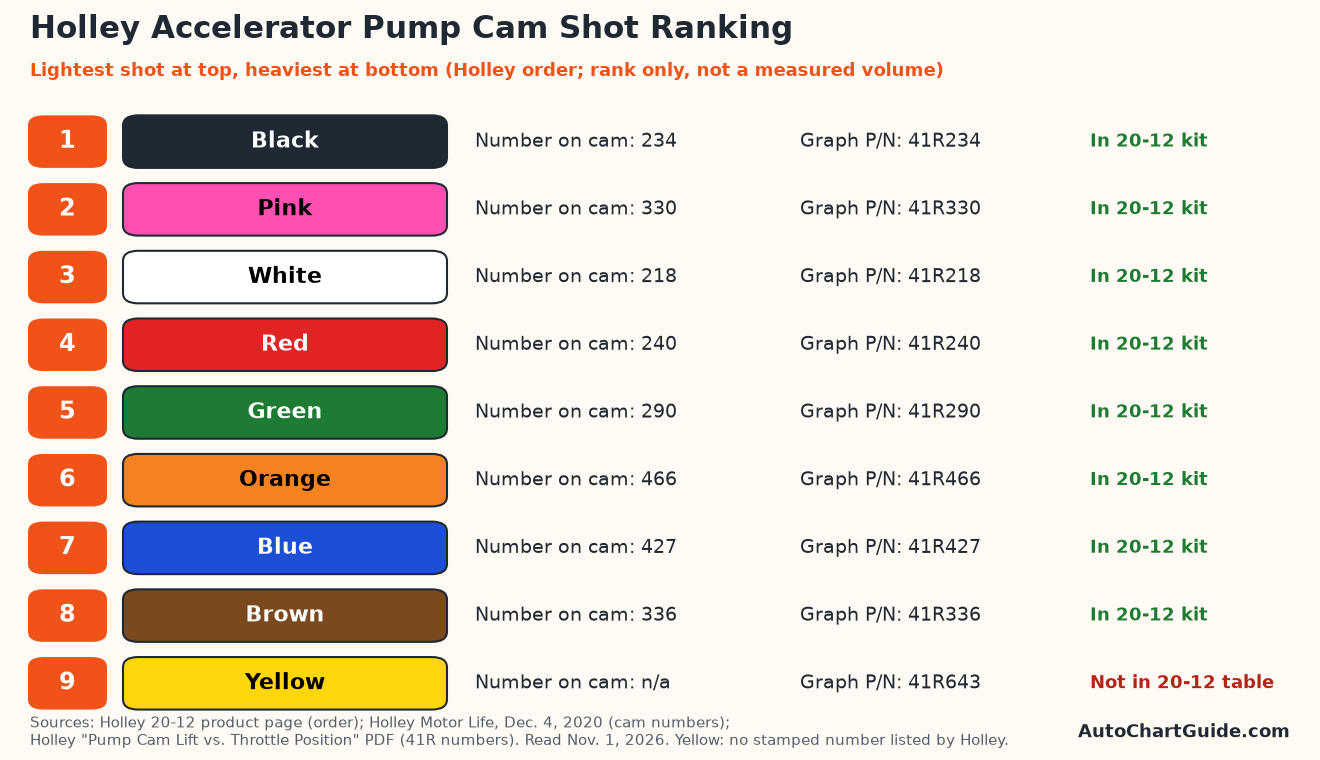
Two details are easy to miss. First, the yellow cam appears on Holley's lift graph as 41R643 and tops the ranking, but it is not in the cam color table Holley prints for the 20-12 kit, and the graph does not say which carburetor it is meant for. Second, the rank is a summary. On Holley's graph the curves cross each other, so a cam ranked "lighter" can be pushing the pump harder than a "heavier" one at a particular throttle angle. That is why Holley talks about lift and duration rather than a single size.
How to Read Holley's Pump Cam Lift Graph
Holley's graph plots pump cam lift in inches (0 to 0.600 in on the vertical axis) against throttle rotation in degrees (0 to 80 degrees on the horizontal axis) for all nine cams. Lift is how far the cam pushes the pump lever, and the lever stroke is what squeezes fuel out of the pump. Holley describes its cams as having "uniquely different lift and duration profiles" and says switching cams "will directly affect the movement of the accelerator pump lever and, subsequently, the amount of fuel available at the pump nozzle." The curve shows both at once: how much lift, and over how much throttle travel it arrives.
Read the graph like this:
- Steepness near 0 to 20 degrees shows how hard the cam hits the pump as you first crack the throttle, which is when an off-idle stumble happens.
- Where a curve goes flat shows when the cam has finished its work. Past that point, opening the throttle further adds no more pump stroke.
- The height at the right edge shows the total lift the cam can give over 80 degrees of throttle rotation.
On Holley's graph the blue cam rises steeply and then flattens out partway through the throttle travel, while the pink and black cams are still climbing at 80 degrees. Pink also starts out as the slowest curve at small throttle angles. The yellow and brown curves finish well above the rest. We have deliberately not copied lift values off the curves into a table, because Holley publishes the graph, not a list of numbers, and reading points off a line by eye would be our estimate, not Holley's figure. If you need the shape in detail, open the PDF itself.
What Comes in the Holley 20-12 Pump Cam Kit
Holley describes the 20-12 kit as a way to "tailor" the accelerator pump to the engine's actual needs, with each cam having a different shape. The product page lists a quantity of 8, plastic construction and mounting hardware included. Holley's 2020 article adds that seven of the eight cams are different from the stock white cam used on the primary side of most Holley carburetors, so you are really getting the stock profile plus seven alternatives.
The kit and the related service parts are summarized below. When you shop for these, look at Holley's accelerator pump parts category as well: it also lists a Quick Fuel Technology "Pump Cam Assortment Pack of 8" (41-100QFT) and a Demon kit (120077) described as eight color-coded cams for 4150 four-barrels and 2300 two-barrels. Those are separate products, and Holley does not say their colors map one-to-one onto the 20-12 chart, so check each maker's own chart before mixing them. Our guide to OEM, OES and aftermarket parts explains why a matching color or shape is not proof of a matching part.
| Item | Holley part number | What Holley says |
|---|---|---|
| Accelerator pump cam assortment kit | 20-12 | Qty 8, plastic, mounting hardware included |
| 50cc accelerator pump conversion kit | 20-11 | New pump housing, stud, arm, diaphragm, spring and longer pump housing screws |
| Accelerator pump tuning kit | 36-184 | Listed in Holley's accelerator pump parts list |
| 30cc rubber accelerator pump diaphragm | 135-5 | Standard replacement diaphragm |
| 30cc alcohol-compatible diaphragm (GFLT, green) | 135-10 | Synthetic diaphragm "designed to stay pliable" |
| Umbrella check valve | 26-41 | Listed in Holley's parts list |
| Discharge nozzle screw, solid / hollow | 121-6 / 121-7 | Use the hollow screw with .040 in and larger nozzles |
| Squirter nozzle gaskets (10 per package) | 1008-844 | Listed in Holley's parts list |
| 30cc metal pump arm | 20-144 | Listed in Holley's parts list |
| 30cc pump cover, standard / polished | 26-139 / 26-139B | Listed in Holley's parts list |
Source: Holley Motor Life, "Accelerator Pump Tuning For Holley Carburetors" (Dec. 4, 2020) parts list, plus the 20-12 and 20-11 product pages. Read November 1, 2026.
Dominator 4500 Pump Cams Are Different
Holley also sells two single pump cams for its 4500 Dominator carburetors. They share the white and yellow colors with cams in the 4150 chart, which causes confusion when people search by color alone.
| Holley part number | Carburetor | Cam color | Holley's description | Mounting holes |
|---|---|---|---|---|
| 20-80 | 4500 Dominator | White | "Gives a quick, early shot of fuel but it does not empty the pump." | 2 |
| 20-81 | 4500 Dominator | Yellow | "Delivers an early fuel shot and continues until the pump empties." | 1 |
Source: Holley 20-80 and 20-81 product pages, read November 1, 2026. These are Dominator parts; do not read them as the white or yellow cams in the 4150/4160 chart above.
If your carburetor is a Dominator, use these part numbers and Holley's Dominator documentation. If it is a 4150 or 4160-style four-barrel, the 20-12 chart is the one Holley's tuning articles use.
Pump Capacity: 30cc vs 50cc
A pump cam can only move as much fuel as the pump holds. Holley says all 4150 and 4160 style carburetors use the standard 30cc pump reservoir, and it is specific about what that rating means: "This capacity rating is not the amount of fuel delivered per full stroke of the accelerator pump system but instead is the volume after 10 strokes." Depending on the cam, the volume delivered after 10 strokes is usually less than 30cc. Holley's example is the stock white cam, which "will deliver less than 20 cc of fuel after 10 strokes."
The bigger option is the Holley 20-11 50cc accelerator pump conversion kit, which includes a new pump housing, stud, arm, diaphragm, spring and longer pump housing screws. Holley's tech sheet gives one clear trigger for it: "If you must use a #37 (.037") or larger pump nozzle, then also use a 50cc pump." Its 2020 article adds a reality check for street cars, calling it "extremely rare" for a tuner to find a street car that needs the 50cc pump on a 4150-style carburetor. Holley says these larger reservoirs are found on the much larger 4500-series Dominator carburetors.
Pump Cam Position: Hole #1, #2 or #3
Each cam has two and sometimes three screw holes, numbered 1, 2 and 3. Moving the screw changes when the cam starts working relative to the throttle blade. Holley gives slightly different rpm guidance in different documents, so both are shown here.
| Holley document | Position #1 | Position #2 (and #3) |
|---|---|---|
| High Performance Tuning Instructions (2014) and Carburetor Tech Info sheet | Activates the pump "a little early"; suits engines that idle around 600 or 700 rpm | Delay the pump action; "good for engines that idle around 1000 RPM and above" |
| Accelerator Pump Tuning For Holley Carburetors (2020) | Recommended for idle speeds below 900 rpm | Recommended for engines that idle above 900 to 1,000 rpm; delays peak cam lift |
Read November 1, 2026. The two documents use different rpm figures but point the same way: the higher the idle speed, the later the cam position.
The logic is the same in both. An engine with a higher idle speed already has the throttle open further at rest. Holley says the later positions make "allowance for the extra throttle rotation required to maintain the relatively higher idle setting," so the cam is not already partway up its ramp at idle. Holley's Model 4160 specification sheet shows that the factory made the same choice: most list numbers are set at #1, while some, such as R1971, R2052, R3916, R4581, R8159 and R9776, are set at #2.
Whatever hole you use, Holley says pump arm adjustment and clearance "should be checked and verified each and every time the pump cam and/or pump cam position is changed."
Setting the Pump Lever Clearance (.015 in)
The pump linkage adjustment is the step people most often skip, and Holley treats it as part of the cam job. Its tuning instructions describe it in two parts.
- Check the clearance at full throttle. Hold the throttle wide open and hold the pump operating lever fully compressed. The gap between the adjusting nut and the pump lever arm should be .015 in. The point of the gap is that the diaphragm is never stretched to its limit at wide open throttle, which Holley says causes premature pump failure.
- Check for zero lag at idle. Let the throttle return to idle, then open it slowly. Any movement at the throttle lever should show at the pump operating lever. If it doesn't, adjust the spring-loaded screw and nut until the slack is gone, without preloading the lever.
Holley warns against one shortcut in strong terms: never adjust the pump override spring so it coil-binds or bottoms out. It says such "adjustments" only give you "bent accelerator pump actuating levers and ruptured pump diaphragms." Its 2020 article adds that the .015 in figure is often misread as a clearance to set at rest; set at rest, it creates exactly the off-idle hesitation you are trying to cure.
How to Choose and Install a Holley Pump Cam, Step by Step
Holley's instructions put the nozzle first and the cam second: "Once a pump nozzle size selection has been made the accelerator pump system can be further tailored with the pump cam." Here is the order its documents describe, put into steps.
- Start from the stock calibration. Holley's tuning instructions say to rebuild the carb to stock form, keeping the original pump nozzle and pump cam, so every change can be judged against the baseline.
- Fix the linkage first. Set the .015 in clearance and remove any idle slack as described above. Holley calls a linkage gap after the bowl has been removed and refitted "the most common cause of an annoying off-idle hesitation on Holley carbs."
- Tune the nozzle. If the car hesitates and then picks up, or backfires on acceleration, go up in nozzle size; if response is not crisp, the nozzle may be too big. Holley suggests jumping three sizes at a time, for example from #28 to #31.
- Lay out the cams. Holley's own tip is to lay the cams side by side and compare the profiles before choosing. A cam whose curve climbs faster at small throttle angles moves the pump lever further right off idle; a flatter early curve spreads the stroke over more throttle travel.
- Swap the cam. Loosen the one slotted screw, place the new cam next to the throttle lever in the hole you want, and tighten it. Holley says the pump lever should move "instantly with the slightest throttle rotation" when the cam is installed correctly.
- Recheck the clearance at wide open throttle, because the new profile changes the lever position.
- Drive and record. Holley's advice is to make one change at a time and write down the result. A simple log like the one in our guide to keeping a record of your car's specifications makes it easy to go back to the last good setup.
Holley's guiding rule for the whole circuit is restraint. The 2020 article says "the ideal accelerator pump tune is the least amount of fuel required to create optimal acceleration," and its tuning instructions warn that the saying "if a little is good, a lot is better" does not apply here.
Pump Cam vs Pump Nozzle: Which Does What
Holley separates the two jobs clearly. The amount of fuel one pump stroke can deliver is set by the pump's capacity and the cam profile. The time it takes to deliver that fuel is set by the nozzle size. A larger nozzle gets the fuel in sooner; a smaller one, like a 28, "will merely create a longer duration shot of fuel." Holley adds that "The nozzle or squirter size has no bearing on the volume delivered," and that adding cam lift also extends the duration of the shot, which matters on road race or autocross cars where the throttle moves constantly.
Nozzles are stamped with their drilled hole size, so a nozzle stamped "35" is drilled .035 in. Holley's 2014 instructions say nozzle sizes run from .025 in to .052 in; its 2020 parts table also lists a smaller .021 in nozzle (121-121). Whenever you fit a .040 in or larger nozzle, Holley says to use the hollow nozzle screw so the nozzle, not the screw, is the restriction.
| Nozzle size (in) | Straight nozzle P/N | Tube nozzle P/N |
|---|---|---|
| 0.021 | 121-121 | n/a |
| 0.025 | 121-125 | 121-25 |
| 0.028 | 121-128 | 121-28 |
| 0.031 | 121-131 | 121-31 |
| 0.032 | 121-132 | n/a |
| 0.035 | 121-135 | 121-35 |
| 0.037 | 121-137 | 121-37 |
| 0.040 | 121-140 | 121-40 |
| 0.042 | 121-142 | 121-42 |
| 0.045 | 121-145 | 121-45 |
| 0.047 | 121-147 | n/a |
| 0.050 | 121-150 | n/a |
Source: Holley Motor Life accelerator pump nozzle table (Dec. 4, 2020), read November 1, 2026. Holley's table also lists 121-118 against a second 0.028 entry; we left that row out because the size printed for it duplicates 121-128 and we could not confirm it.
For reference, Holley's worked example in the 2020 article is a 750 cfm Holley HP double pumper (PN 82751), which ships with a 0.031 in primary nozzle and a 0.028 in secondary nozzle. Holley suggests trying a 0.035 in primary first, or raising both sides, on an engine with an aggressive camshaft, a single-plane intake and a one-inch spacer.
Troubleshooting Chart: Symptom to First Fix
| What you notice | What Holley says it points to | First thing to try |
|---|---|---|
| Car hesitates, then picks up | Pump shot arriving too late | Step up the nozzle size (Holley suggests jumping three sizes, e.g. #28 to #31) |
| Backfire through the carb on acceleration | Lean condition | Step up the nozzle size |
| Off-idle response feels soft or not "clean" | Nozzle may already be too large | Go down a nozzle size |
| Hesitation right after the fuel bowl was removed | Extra gap between the pump lever and cam linkage | Reset the linkage so the pump arm moves the instant the throttle moves |
| Bog under heavy throttle after adding cam lift | Too much pump fuel can cause hesitation too | Back off to a lighter cam or a smaller nozzle |
| No pump shot at all after the carb sat for months | Check valve under the nozzle stuck, or a hardened diaphragm | Free the check valve with the nozzle removed; replace a brittle diaphragm |
Sources: Holley High Performance Tuning Instructions (2014) and "Accelerator Pump Tuning For Holley Carburetors" (2020), read November 1, 2026.
Two more points from Holley help here. Vacuum secondary four-barrels have no secondary pump at all, so a stumble when the secondaries open on those carburetors is a secondary spring issue, not a pump cam issue; Holley says it means the secondary diaphragm spring is too light, opening the secondaries too soon. Double pumpers (mechanical secondaries) have an accelerator pump on both the primary and secondary sides, and in Holley's HP example the secondary nozzle is smaller than the primary. Also, never test a nozzle by working the throttle with the nozzle removed: Holley warns the pump shot can launch the check valve into the intake, where it can cause engine damage.
Fitting Notes: Torque, Fuel Pressure and Parts Diagrams
If the carburetor comes off during this work, Holley's instructions give a hold-down nut torque of 60 to 80 in-lbs, tightened progressively in a crisscross pattern, and warn that overtightening can warp or crack the throttle body. That is inch-pounds, not foot-pounds; our torque unit conversion guide shows how to convert it if your wrench reads in newton-meters. Holley's recommended fuel pressure for these carburetors is 5 to 7 psi in the same instructions, with 7-1/2 psi as the stated maximum and 5 psi as the minimum.
When you order replacement linkage parts, diaphragms or covers, work from the exploded view for your exact list number rather than from photos. Our article on how to read an exploded parts diagram walks through matching callout numbers to part numbers, and the superseded part number guide covers what to do when the number in an old manual has been replaced.
Common Mistakes With Holley Pump Cams
- Chasing a stumble with more pump. Holley says a bog under heavy throttle can come from too much pump fuel, not too little.
- Setting .015 in at idle. The clearance belongs at wide open throttle with the lever compressed; at idle the arm should have no slack.
- Changing cam, nozzle and position at once. You will not know which change helped. Holley says to change one thing at a time. If you also swap rear gears between sessions, log them separately; our Winters quick change gear chart lists the final drive ratio of every gear set.
- Mixing up Dominator and 4150 cams. Holley's 20-80 white and 20-81 yellow are Dominator cams, not the white 218 or the yellow 41R643 in the 4150 chart.
- Judging a faded cam by color. Read the number on the cam instead.
- Forgetting the recheck. Any cam or hole change means rechecking the lever clearance.
Frequently Asked Questions
What is the order of Holley accelerator pump cams from smallest to largest shot?
Holley lists them from lightest to heaviest shot as Black, Pink, White, Red, Green, Orange, Blue, Brown and Yellow. That order is printed on the product page for the 20-12 pump cam assortment kit.
Which pump cam comes on a Holley carburetor from the factory?
Holley says the white cam is the stock cam on the primary side of most Holley carburetors. Its 20-12 kit contains eight cams, seven of which differ from that stock white cam.
What do the numbers on Holley pump cams mean?
They identify the profile, so you can tell cams apart when the color has faded. Holley lists White 218, Blue 427, Red 240, Orange 466, Black 234, Green 290, Pink 330 and Brown 336. Its lift graph shows the same numbers with a 41R prefix, such as 41R218 for white.
Should I use pump cam hole #1 or #2?
Holley's 2020 guidance is hole #1 for engines idling below 900 rpm and #2 for engines idling above 900 to 1,000 rpm. Its older tuning instructions say #1 suits 600 to 700 rpm idles and #2 or #3 suit idles around 1,000 rpm and above.
How much clearance should the Holley accelerator pump lever have?
About .015 in, checked at wide open throttle with the pump lever held fully compressed. At idle there should be no slack: the pump arm should move as soon as the throttle moves.
Does a bigger pump cam or a bigger nozzle add more fuel?
The cam and the pump capacity decide how much fuel one stroke can deliver. The nozzle decides how fast it is delivered. Holley notes that nozzle size has no bearing on volume, and that adding cam lift also lengthens the shot.
Do I need the 50cc accelerator pump?
Rarely on a street 4150-style carburetor, according to Holley. Its tech sheet says that if you need a #37 (.037 in) or larger nozzle, you should also use a 50cc pump, available as kit 20-11.
Are the white and yellow Dominator pump cams the same as the 4150 cams?
No. Holley sells 20-80 (white) and 20-81 (yellow) specifically for 4500 Dominator carburetors. The 20-12 chart is the one Holley's tuning articles use for 4150 and 4160-style carburetors. For 2300 two-barrels, Holley's tuning instructions say to tune them the same way as the primary side of a four-barrel.
Why does my Holley still hesitate after I changed the pump cam?
Check the basics first. Holley says the most common cause of off-idle hesitation is a pump linkage gap after the primary bowl has been removed and refitted. Too much pump fuel can also cause a bog.
Sources
- Holley, Accelerator Pump Cam Assortment Kit 20-12, product page, read November 1, 2026.
- Holley, Pump Cam Lift vs. Throttle Position (PDF, 2010), read November 1, 2026.
- Jeff Smith, Holley Motor Life, Accelerator Pump Tuning For Holley Carburetors, December 4, 2020, read November 1, 2026.
- Holley Motor Life, High Performance Tuning Instructions, January 20, 2014, read November 1, 2026.
- Holley, Carburetor Tech Info (PDF), read November 1, 2026.
- Holley, Model 4160 Specifications (PDF), read November 1, 2026.
- Holley, 50cc Accelerator Pump Conversion Kit 20-11, product page, read November 1, 2026.
- Holley, Accelerator Pump Cam 20-80 (4500 Dominator, white), product page, read November 1, 2026.
- Holley, Accelerator Pump Cam 20-81 (4500 Dominator, yellow), product page, read November 1, 2026.
- Holley, Accelerator Pumps, Nozzles, and Booster Parts category page, read November 1, 2026.