Ram 3500 Towing Capacity Chart 2026: Official Ratings
Every 2027 and 2026 Ram 3500 towing rating from Ram's own charts, with payload, GCWR, hitch limits, worked examples and the chart's quirks explained.

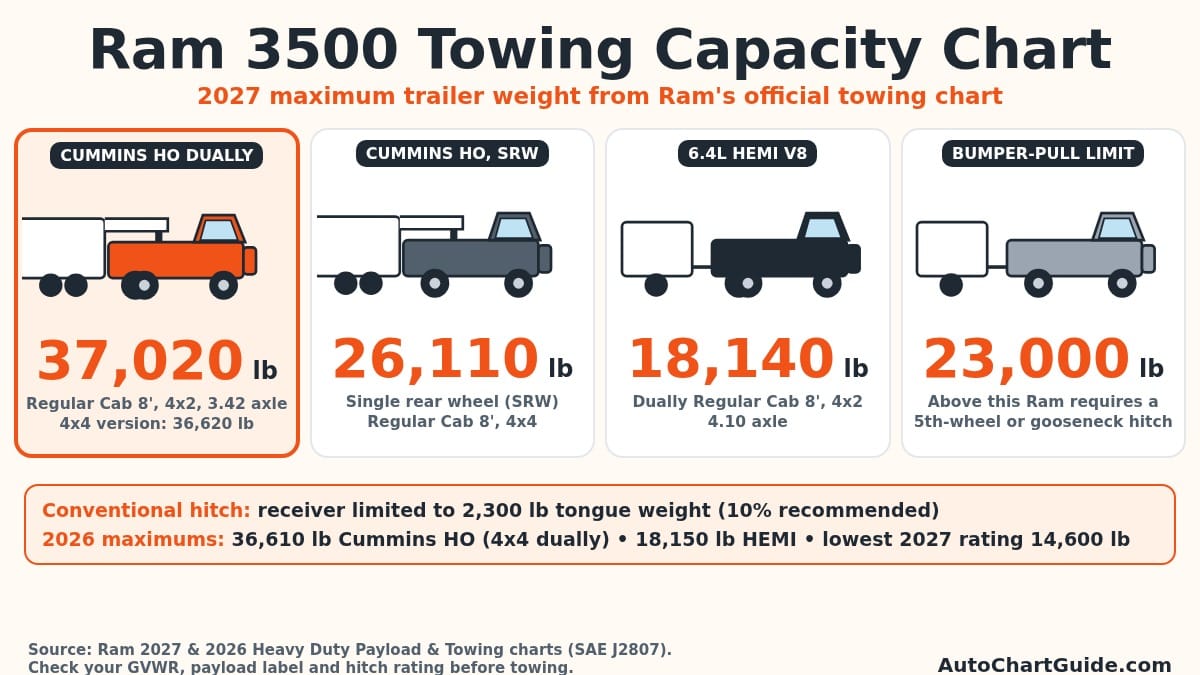
Short answer: The 2027 Ram 3500 tows up to 37,020 lb, according to Ram's own 2027 towing chart. That top rating belongs to one configuration: a 4x2 Regular Cab dually (dual rear wheels, DRW) with the 8-foot bed, the High-Output 6.7L Cummins diesel and the 3.42 axle. The same truck with four-wheel drive is rated at 36,620 lb. The best single-rear-wheel (SRW) 3500 is rated at 26,110 lb, and the best 6.4L HEMI V8 3500 at 18,140 lb. The lowest Ram 3500 rating in the chart is 14,600 lb. For the 2026 model year, Ram lists maximums of 36,610 lb with the diesel and 18,150 lb with the HEMI. Ram also says any trailer over 23,000 lb needs a 5th-wheel or gooseneck hitch, so a bumper-pull trailer behind a 3500 tops out at 23,000 lb.
Every rating on this page comes from Ram's own documents. We used the 2027 Ram Heavy Duty Payload & Towing Weight Capacities chart and the 2026 version of the same chart, both published on ramtrucks.com, and cross-checked the maximums against Stellantis's What's New for 2027: Ram Heavy Duty release and the Ram 3500 capability page. We read them on November 3, 2026. Ram prints both trucks, the 2500 and the 3500, on one sheet. We copied only the 3500 columns, cell by cell, and checked each one against the rendered PDF. Where Ram's documents disagree with each other, we say so rather than pick one.
Ram 3500 towing capacity at a glance
Ram's chart has dozens of cells, but they come down to a handful of answers. The engine sets the broad range. The rear wheels (single or dual) and the hitch decide how much of that range a given truck can use. This table pulls out the numbers most buyers are looking for, for both model years.
| Measure | 2027 Ram 3500 | 2026 Ram 3500 | Configuration (from Ram's charts) |
|---|---|---|---|
| Maximum towing, 6.7L Cummins HO | 37,020 lb (4x2); 36,620 lb (4x4) | 36,610 lb (4x4 only) | Dually Regular Cab 8', 3.42 axle, 14,000 lb GVWR, 45,000 lb GCWR |
| Maximum towing, 6.4L HEMI V8 | 18,140 lb | 18,150 lb | Dually Regular Cab 8', 4.10 axle, 4x2 |
| Maximum towing, single rear wheel | 26,110 lb | 26,080 lb | Cummins HO Regular Cab 8', 4x4, 11,830 lb GVWR |
| Lowest listed rating | 14,600 lb | 14,560 lb | HEMI, 3.73 axle, single rear wheel Crew Cab 8', 4x4 |
| Maximum payload, HEMI | 7,580 lb | 7,590 lb | Dually Regular Cab 8', 4x2 |
| Maximum payload, Cummins HO | 6,460 lb (4x2) | 6,050 lb (4x4 only) | Dually Regular Cab 8' |
| Conventional (ball) hitch | 23,000 lb trailer; 2,300 lb tongue | 23,000 lb trailer; 2,300 lb tongue | 5th-wheel or gooseneck required above 23,000 lb |
Source: Ram 2027 and 2026 Heavy Duty Payload & Towing Weight Capacities charts (ratings, footnote 10). Maximums match Stellantis's 2027 (preliminary) and 2026 Ram Heavy Duty releases.
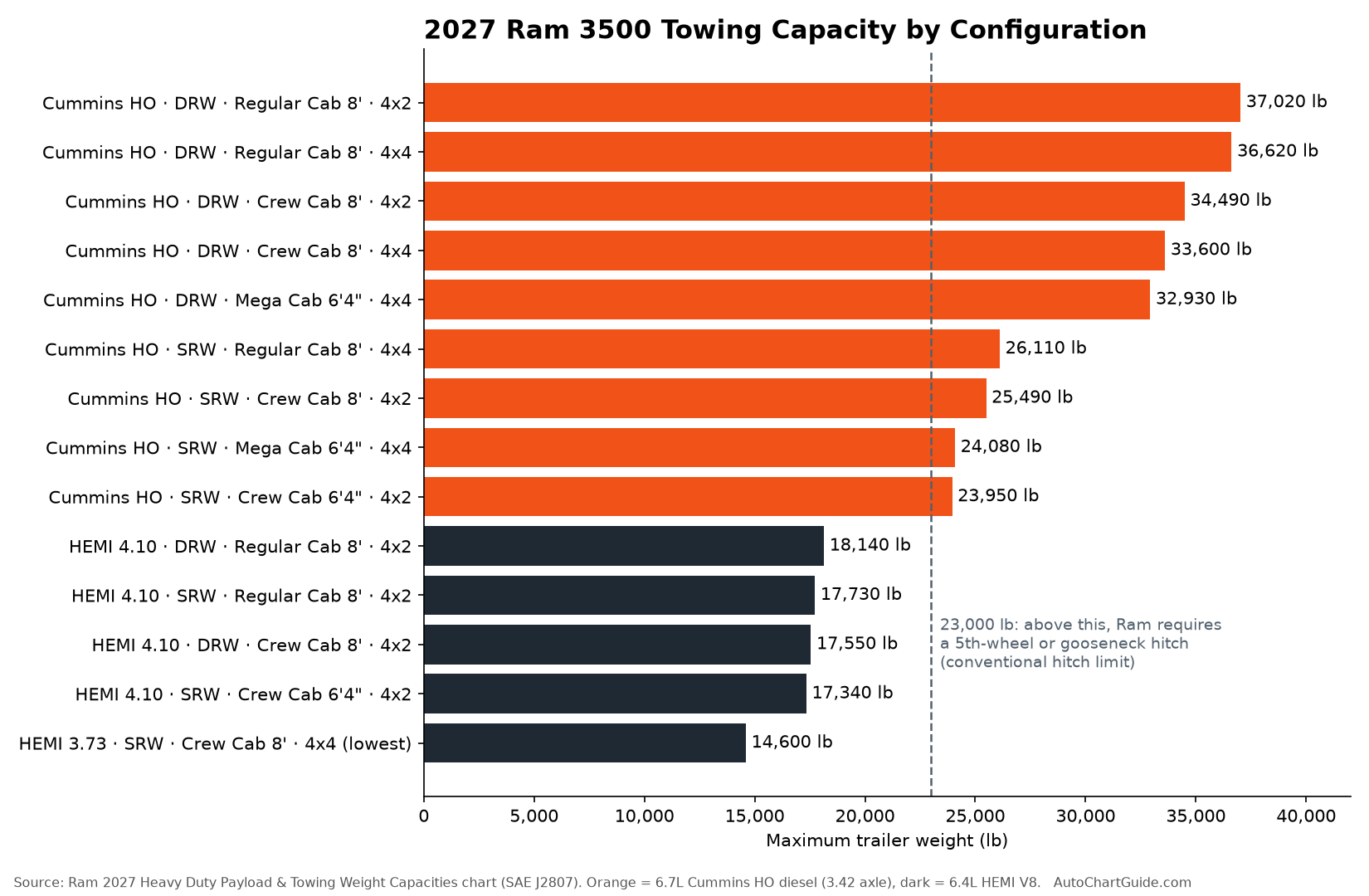
The gap between the two engines is the largest single factor. Every Cummins-powered 3500 in the 2027 chart is rated at 23,580 lb or more, and every HEMI 3500 at 18,140 lb or less. The diesel's ratings start above the HEMI's best. If you are coming from a three-quarter-ton truck, our Ram 2500 towing capacity chart shows that the 2500's ceiling is 20,000 lb. The 3500's extra capability shows up mainly in its diesel ratings: even the best single-rear-wheel diesel 3500 (26,110 lb) is rated above the 2500's best, and the dually adds about 11,000 lb more.
Full 2027 Ram 3500 towing chart: 6.4L HEMI V8
The 6.4L HEMI V8 makes 405 horsepower and 429 lb-ft of torque and is paired with the TorqueFlite 8HP75-LCV eight-speed automatic, according to Stellantis. In the 3500 it is offered with two axle ratios, 3.73 and 4.10, and that choice moves the rating by 2,230 to 2,400 lb in every configuration. Ram's chart lists no HEMI rating for the Mega Cab 3500, so that column is empty here.
| Rear wheels | Axle | GVWR (lb) | GCWR (lb) | Regular Cab 8' | Crew Cab 6'4" | Crew Cab 8' |
|---|---|---|---|---|---|---|
| SRW | 3.73 | 11,040*/11,040 | 22,000 | 15,490/15,110 | 15,100/14,800 | — |
| SRW | 3.73 | 11,150/11,440 | 22,000 | — | — | 14,930/14,600 |
| SRW | 4.10 | 11,040 | 24,240 | 17,730/17,340 | 17,340/17,040 | — |
| SRW | 4.10 | 11,150/11,440 | 24,240 | — | — | 17,170/16,840 |
| DRW | 3.73 | 14,000 | 22,600 | 15,740/15,360 | — | 15,150/14,800 |
| DRW | 4.10 | 14,000 | 25,000 | 18,140/17,760 | — | 17,550/17,200 |
Values in lb, 4x2/4x4. NA = drive layout not offered. — = no Ram 3500 rating listed.No Mega Cab HEMI 3500 is listed. * Ram: "Applies to vehicles produced with sales code Z2K/Z7G/Z3Y". Source: Ram 2027 Heavy Duty Payload & Towing Weight Capacities chart.
Read across any row and the 4x4 number is a few hundred pounds lower than the 4x2 number. Four-wheel drive adds weight to the truck, and under the SAE J2807 method Ram uses, every pound of truck comes off the trailer rating when the combined limit stays the same. Read down a column and the 4.10 rows beat the 3.73 rows by a similar margin each time: 17,730 against 15,490 lb for a 4x2 Regular Cab, for example. The axle ratio changes the gross combined weight rating (GCWR), from 22,000 lb to 24,240 lb on single-rear-wheel trucks, and the trailer rating moves with it.
The dually rows show a smaller gain than you might expect for the HEMI. A 4x2 Regular Cab dually with the 4.10 axle is rated at 18,140 lb, only 410 lb more than the single-rear-wheel truck with the same axle. With the gas engine, the GCWR, not the rear axle, is the ceiling. Dual rear wheels pay off mainly in payload with the HEMI: 7,580 lb for that Regular Cab dually, against 4,970 lb for the single-rear-wheel version.
Full 2027 Ram 3500 towing chart: 6.7L Cummins High-Output diesel
Every 2027 Ram 3500 diesel in the chart uses the High-Output 6.7L Cummins inline-six, rated by Stellantis at 430 horsepower and 1,075 lb-ft, with the TorqueFlite HD eight-speed automatic and a 3.42 axle. Ram lists each cab and bed at specific GVWRs (gross vehicle weight ratings), and each GVWR comes with its own GCWR. That is why the same cab can appear on more than one row.
| Rear wheels | Axle | GVWR (lb) | GCWR (lb) | Regular Cab 8' | Crew Cab 6'4" | Crew Cab 8' | Mega Cab 6'4" |
|---|---|---|---|---|---|---|---|
| SRW | 3.42 | 11,500 | 31,850 | — | 23,950/NA | — | — |
| SRW | 3.42 | 11,800 | 31,820 | — | NA/23,580 | — | — |
| SRW | 3.42 | 11,830 | 34,000 | NA/26,110 | — | — | — |
| SRW | 3.42 | 12,000 | 33,530 | — | — | 25,490/NA | — |
| SRW | 3.42 | 12,300 | 32,720 | — | — | — | NA/24,080 |
| SRW | 3.42 | 12,300 | 33,610 | — | — | NA/25,190 | — |
| DRW | 3.42 | 14,000 | 42,530 | — | — | NA/33,600 | — |
| DRW | 3.42 | 14,000 | 41,950 | — | — | — | NA/32,930 |
| DRW | 3.42 | 14,000 | 43,040 | — | — | 34,490/NA | — |
| DRW | 3.42 | 14,000 | 45,000 | 37,020/36,620 | — | — | — |
Values in lb, 4x2/4x4. NA = drive layout not offered. — = no Ram 3500 rating listed. * Ram: "Applies to vehicles produced with sales code Z2K/Z7G/Z3Y". The 26,940/NA cell Ram prints under the 2500 heading (11,530 lb GVWR) is not included; see the 2027 changes section. Source: Ram 2027 Heavy Duty Payload & Towing Weight Capacities chart.
Three things stand out. First, the dually rows are in a different class. The 14,000 lb GVWR trucks carry GCWRs from 41,950 to 45,000 lb and trailer ratings from 32,930 to 37,020 lb. The single-rear-wheel diesel trucks, with GVWRs of 11,500 to 12,300 lb, have GCWRs of 31,820 to 34,000 lb and are rated from 23,580 to 26,110 lb. Second, many cells are offered in only one drive layout. The single-rear-wheel Crew Cab 8-foot is listed as 25,490 lb in 4x2 form at a 12,000 lb GVWR and as 25,190 lb in 4x4 form at 12,300 lb. Third, the Mega Cab is 4x4 only in Ram's chart for both wheel types, which matches Stellantis's configuration list ("Mega Cab 6-foot, 4-inch bed (4x4 only)").
A 2027 Regular Cab 4x2 single-rear-wheel diesel does not appear in this table, even though the payload chart lists one. The reason is a layout problem in Ram's PDF, explained in the 2027 changes section below.
How to read Ram's towing chart
Ram's chart is dense, and several of its conventions trip people up. This is how we read it, and how the tables above are laid out.
- Two numbers per cell. The column headers say "Ram 3500 (4x2/4x4)", so the first number is the 4x2 rating and the second is the 4x4 rating. "37,020/36,620" means 37,020 lb for 4x2 and 36,620 lb for 4x4.
- NA. An "NA" on one side of the slash means that drive layout is not offered in that configuration. "NA/33,600" is a 4x4-only rating.
- Blank cells. A blank means Ram lists no 3500 rating for that cab and bed at that GVWR and GCWR. Do not fill it in from a neighboring row.
- The asterisk. Some GVWRs are printed as "11,040*". Ram's footnote says: "* Applies to vehicles produced with sales code Z2K/Z7G/Z3Y". The chart does not say what those codes are. The window sticker lists a truck's equipment, and our guide to getting a window sticker by VIN covers how to pull one if yours is missing. A Ram dealer can also decode the sales codes from the VIN.
- "When properly equipped". Ram's footnote 10 applies to every rating. Ram's Canadian chart spells out what that means: "Max Trailer Weight Rating represents a properly equipped base trim configuration." Higher trims and options add weight, so a loaded Limited will not reach the same number as the base truck in the same cell.
- Rounding. "All weights given in pounds and rounded to the nearest 10 lb," according to Ram. A 10 lb difference between two documents can be rounding.
Ram also states that "Trailer Weight and Payload Rating are mutually exclusive." The trailer rating assumes a truck with nothing in the bed beyond the allowances built into the J2807 calculation. The payload rating assumes no trailer. You cannot have both maximums at once.
2027 vs 2026 Ram 3500 towing capacity: what changed
Most 2027 ratings match 2026 to within 40 lb, but a few cells moved more than that, and one configuration is new. Stellantis's 2027 release says the new trucks would be "In dealerships this August." This table lists every Ram 3500 towing cell that differs between the two charts.
| Configuration | 2026 rating (lb) | 2027 rating (lb) | GCWR 2026 → 2027 (lb) |
|---|---|---|---|
| Cummins HO dually Regular Cab 8' | NA/36,610 | 37,020/36,620 | 45,000 → 45,000 |
| Cummins HO dually Crew Cab 8' (4x4 row) | NA/33,890 | NA/33,600 | 42,800 → 42,530 |
| Cummins HO dually Mega Cab 6'4" | NA/32,890 | NA/32,930 | 41,950 → 41,950 |
| Cummins HO SRW Regular Cab 8' (11,830 GVWR) | NA/26,080 | NA/26,110 | 34,000 → 34,000 |
| Cummins HO SRW Crew Cab 8' (12,300 GVWR) | NA/25,180 | NA/25,190 | 33,610 → 33,610 |
| Cummins HO SRW Crew Cab 6'4" (11,800 GVWR) | NA/23,550 | NA/23,580 | 31,820 → 31,820 |
| HEMI 4.10 dually Regular Cab 8' | 18,150/17,760 | 18,140/17,760 | 25,000 → 25,000 |
| HEMI 3.73 dually Regular Cab 8' | 15,750/15,360 | 15,740/15,360 | 22,600 → 22,600 |
| HEMI 4.10 SRW Regular Cab 8' (11,040 GVWR) | 17,730/17,330 | 17,730/17,340 | 24,250 → 24,240 |
| HEMI 4.10 SRW Crew Cab 6'4" (11,040 GVWR) | 17,340/17,010 | 17,340/17,040 | 24,250 → 24,240 |
| HEMI 4.10 SRW Crew Cab 8' (11,150/11,440 GVWR) | 17,170/16,800 | 17,170/16,840 | 24,240 → 24,240 |
| HEMI 3.73 SRW Regular Cab 8' (11,040 GVWR) | 15,490/15,100 | 15,490/15,110 | 22,050 → 22,000 |
| HEMI 3.73 SRW Crew Cab 6'4" (11,040 GVWR) | 15,100/14,770 | 15,100/14,800 | 22,050 → 22,000 |
| HEMI 3.73 SRW Crew Cab 8' (11,150/11,440 GVWR) | 14,930/14,560 | 14,930/14,600 | 22,000 → 22,000 |
Values 4x2/4x4 in lb. Every other Ram 3500 towing cell is identical in both charts. Source: Ram 2026 and 2027 Heavy Duty Payload & Towing Weight Capacities charts.
The headline change is the new 4x2 version of the Regular Cab dually. In 2026, Ram's chart listed that diesel dually as 4x4 only, at 36,610 lb. For 2027, it adds a 4x2 version at 37,020 lb and rates the 4x4 at 36,620 lb, with the same 45,000 lb GCWR. Stellantis's 2027 release gives the 37,020 lb figure as the 3500's diesel maximum and calls its capability figures "preliminary." The 4x4 Crew Cab 8-foot dually went the other way. Its rating fell from 33,890 to 33,600 lb, along with a lower GCWR (42,800 to 42,530 lb). On the 11,040 lb GVWR row, the single-rear-wheel HEMI trucks lost 50 lb of GCWR with the 3.73 axle (22,050 to 22,000 lb) and 10 lb with the 4.10 axle (24,250 to 24,240 lb). Their trailer ratings barely moved, and several 4x4 ratings went up by 10 to 40 lb.
Three places where Ram's own documents disagree.
- A 26,940 lb cell in the wrong column. The 2027 chart prints "26,940/NA" for a diesel single-rear-wheel truck with an 11,530 lb GVWR and a 34,420 lb GCWR, but places it under the Ram 2500 Regular Cab heading. That cannot be a 2500 rating as printed. Stellantis gives the 2027 Ram 2500's diesel maximum as 20,000 lb, and Ram's own footnote requires a 5th-wheel or gooseneck hitch on a 2500 above 20,000 lb. The 11,530 lb GVWR appears in the 2027 payload chart only under the 3500 Regular Cab, next to a new 4x2 payload of 4,490 lb. The cell probably belongs to a 4x2 Regular Cab 3500, but Ram has not printed it that way, so we have left it out of the tables above. If you are shopping for that truck, ask the dealer to confirm its rating from the VIN.
- 36,610 or 36,620 lb. The 2027 chart rates the 4x4 Regular Cab dually at 36,620 lb. Ram's 2027 Heavy Duty professional page still shows a 3500 maximum of 36,610 lb and a payload of 6,050 lb. Those are the 2026 figures from the 2026 chart and the 2026 Ram 3500 capability page. Use the chart for your model year.
- The 11,440 lb HEMI GVWR. Stellantis's 2027 release says "Ram 3500 4x4 SRW Regular Cab 8-foot box and Crew Cab 6-foot, 4-inch box trucks with the 6.4-liter HEMI V8 now offer a maximum GVWR of 11,440 lbs." Ram's 2027 chart does not show that. It lists those two trucks at 11,040 lb GVWR, as in 2026, and gives the 11,150/11,440 lb GVWR only to the Crew Cab 8-foot. Check the GVWR on your truck's door-jamb label.
Full 2026 Ram 3500 towing chart
If you own or are shopping for a 2026 truck, use the 2026 numbers. The layout is the same as 2027: two numbers per cell (4x2/4x4), and NA where a drive layout is not offered. The 2026 chart has no 4x2 Regular Cab dually and no 11,530 lb GVWR row.
| Engine | Rear wheels | Axle | GVWR (lb) | GCWR (lb) | Regular Cab 8' | Crew Cab 6'4" | Crew Cab 8' | Mega Cab 6'4" |
|---|---|---|---|---|---|---|---|---|
| HEMI | SRW | 3.73 | 11,040*/11,040 | 22,050 | 15,490/15,100 | 15,100/14,770 | — | — |
| HEMI | SRW | 3.73 | 11,150/11,440 | 22,000 | — | — | 14,930/14,560 | — |
| HEMI | SRW | 4.10 | 11,040 | 24,250 | 17,730/17,330 | 17,340/17,010 | — | — |
| HEMI | SRW | 4.10 | 11,150/11,440 | 24,240 | — | — | 17,170/16,800 | — |
| HEMI | DRW | 3.73 | 14,000 | 22,600 | 15,750/15,360 | — | 15,150/14,800 | — |
| HEMI | DRW | 4.10 | 14,000 | 25,000 | 18,150/17,760 | — | 17,550/17,200 | — |
| Cummins HO | SRW | 3.42 | 11,500 | 31,850 | — | 23,950/NA | — | — |
| Cummins HO | SRW | 3.42 | 11,800 | 31,820 | — | NA/23,550 | — | — |
| Cummins HO | SRW | 3.42 | 11,830 | 34,000 | NA/26,080 | — | — | — |
| Cummins HO | SRW | 3.42 | 12,000 | 33,530 | — | — | 25,490/NA | — |
| Cummins HO | SRW | 3.42 | 12,300 | 32,720 | — | — | — | NA/24,080 |
| Cummins HO | SRW | 3.42 | 12,300 | 33,610 | — | — | NA/25,180 | — |
| Cummins HO | DRW | 3.42 | 14,000 | 42,800 | — | — | NA/33,890 | — |
| Cummins HO | DRW | 3.42 | 14,000 | 41,950 | — | — | — | NA/32,890 |
| Cummins HO | DRW | 3.42 | 14,000 | 43,040 | — | — | 34,490/NA | — |
| Cummins HO | DRW | 3.42 | 14,000 | 45,000 | NA/36,610 | — | — | — |
Values in lb, 4x2/4x4. NA = drive layout not offered. — = no Ram 3500 rating listed. * Ram: "Applies to vehicles produced with sales code Z2K/Z7G/Z3Y". Source: Ram 2026 Heavy Duty Payload & Towing Weight Capacities chart.
Stellantis's 2026 release lists the same maximums as this chart: "Ram 3500 HEMI V-8: Up to 18,150 lbs. max towing; up to 7,590 lbs. max payload Ram 3500 Cummins turbo diesel: Up to 36,610 lbs. max towing; up to 6,050 lbs. max payload." The same release says select heavy-duty models gained up to 850 lb of GVWR for 2026, "achieved through revised testing and certification procedures." That is one reason older-model-year charts will not match these numbers, even for a truck that looks the same.
Ram 3500 payload chart (2027)
Payload is the other half of the question, and with a heavy trailer it is often the limit you hit first. The tongue weight or gooseneck pin weight of the trailer counts against payload, along with people, tools and the hitch itself. Ram's Canadian chart defines it simply: "Payload = GVWR – Base Weight." These are Ram's 2027 payload ratings for the 3500.
| Engine | Rear wheels | GVWR (lb) | Regular Cab 8' | Crew Cab 6'4" | Crew Cab 8' | Mega Cab 6'4" |
|---|---|---|---|---|---|---|
| HEMI | SRW | 11,040 | 4,970/4,580 | 4,580/4,280 | — | — |
| HEMI | SRW | 11,150/11,440 | — | — | 4,520/4,480 | — |
| HEMI | DRW | 14,000 | 7,580/7,200 | — | 6,990/6,640 | — |
| Cummins HO | SRW | 11,500/11,800 | — | 4,040/4,000 | — | — |
| Cummins HO | SRW | 11,500/11,530/11,830 | 4,490/4,380 | 4,040/NA | — | — |
| Cummins HO | SRW | 12,000/12,300 | — | — | 4,400/4,320 | NA/4,100 |
| Cummins HO | DRW | 14,000 | 6,460/6,060 | — | 5,890/5,510 | NA/5,420 |
Maximum payload in lb, 4x2/4x4. NA = drive layout not offered. — = no Ram 3500 rating listed. Where Ram lists several GVWRs in one row, the payload applies across them as printed. Source: Ram 2027 Heavy Duty Payload & Towing Weight Capacities chart.
Two patterns are worth knowing. At the same GVWR, the HEMI trucks carry more than the diesels. Payload is GVWR minus base weight, so the higher HEMI figure means a lighter base truck. The Regular Cab dually is rated at 7,580 lb with the HEMI and 6,460 lb with the Cummins in 4x2 form. And within the diesel rows, the trucks with the highest tow ratings are not the ones with the most payload left over, as the worked examples below show. The number that matters for your truck is printed on the Tire and Loading Information placard on the driver's door pillar. Our guide to the door-jamb stickers explains which label carries payload and which carries the GVWR and axle ratings.
GCWR and SAE J2807: where the numbers come from
Ram's footnote says its trailer ratings "are calculated as specified in SAE J2807." SAE describes J2807 as a recommended practice that sets "minimum performance criteria at GCWR and calculation methodology to determine tow-vehicle TWR" for vehicles up to 14,000 lb GVWR. That ceiling is exactly the GVWR of the 3500 dually. The method has two parts. The truck and trailer must pass performance tests at the GCWR. Then the trailer weight rating (TWR) is whatever is left of the GCWR after the tow vehicle trailering weight, which is the truck plus a set of assumed loads. Ram lists those assumptions in its footnote: "Passenger Weight = 300 lb, Options Weight = 100 lb, Trailering Equipment Weight = 75 lb for conventional hitch, 40 lb for gooseneck and 250 lb for 5th-wheel."
Because both numbers are in the chart, the arithmetic can be run backwards. The table below subtracts each trailer rating from its GCWR. The result is the tow vehicle trailering weight Ram used, including the 300 lb of passengers and 100 lb of options. This is our arithmetic on Ram's published figures, not a weight Ram prints.
| Engine | Rear wheels | Cab and bed | Drive | GCWR (lb) | Max trailer (lb) | GCWR − trailer = tow vehicle trailering weight (lb) |
|---|---|---|---|---|---|---|
| HEMI 4.10 | SRW | Regular Cab 8' | 4x2 | 24,240 | 17,730 | 6,510 |
| HEMI 4.10 | SRW | Regular Cab 8' | 4x4 | 24,240 | 17,340 | 6,900 |
| HEMI 4.10 | SRW | Crew Cab 6'4" | 4x2 | 24,240 | 17,340 | 6,900 |
| HEMI 4.10 | SRW | Crew Cab 6'4" | 4x4 | 24,240 | 17,040 | 7,200 |
| HEMI 4.10 | SRW | Crew Cab 8' | 4x2 | 24,240 | 17,170 | 7,070 |
| HEMI 4.10 | SRW | Crew Cab 8' | 4x4 | 24,240 | 16,840 | 7,400 |
| HEMI 4.10 | DRW | Regular Cab 8' | 4x2 | 25,000 | 18,140 | 6,860 |
| HEMI 4.10 | DRW | Regular Cab 8' | 4x4 | 25,000 | 17,760 | 7,240 |
| HEMI 4.10 | DRW | Crew Cab 8' | 4x2 | 25,000 | 17,550 | 7,450 |
| HEMI 4.10 | DRW | Crew Cab 8' | 4x4 | 25,000 | 17,200 | 7,800 |
| Cummins HO | SRW | Crew Cab 6'4" | 4x2 | 31,850 | 23,950 | 7,900 |
| Cummins HO | SRW | Crew Cab 6'4" | 4x4 | 31,820 | 23,580 | 8,240 |
| Cummins HO | SRW | Regular Cab 8' | 4x4 | 34,000 | 26,110 | 7,890 |
| Cummins HO | SRW | Crew Cab 8' | 4x2 | 33,530 | 25,490 | 8,040 |
| Cummins HO | SRW | Mega Cab 6'4" | 4x4 | 32,720 | 24,080 | 8,640 |
| Cummins HO | SRW | Crew Cab 8' | 4x4 | 33,610 | 25,190 | 8,420 |
| Cummins HO | DRW | Crew Cab 8' | 4x4 | 42,530 | 33,600 | 8,930 |
| Cummins HO | DRW | Mega Cab 6'4" | 4x4 | 41,950 | 32,930 | 9,020 |
| Cummins HO | DRW | Crew Cab 8' | 4x2 | 43,040 | 34,490 | 8,550 |
| Cummins HO | DRW | Regular Cab 8' | 4x2 | 45,000 | 37,020 | 7,980 |
| Cummins HO | DRW | Regular Cab 8' | 4x4 | 45,000 | 36,620 | 8,380 |
Our arithmetic on Ram's 2027 chart figures (GCWR minus maximum trailer weight). Under SAE J2807 the result includes the truck plus 300 lb of passengers, 100 lb of options and the hitch equipment weight. HEMI 3.73 rows give the same results as the 4.10 rows to within 10 lb.
The results explain the chart. The 4x4 version of the top dually is 400 lb heavier in the calculation (8,380 against 7,980 lb), and the 400 lb comes straight off its trailer rating at the same 45,000 lb GCWR. The Mega Cab dually works out heaviest, at 9,020 lb, and also has the lowest dually GCWR (41,950 lb). Together they give it the lowest dually rating. The HEMI trucks work out roughly 1,000 to 1,150 lb lighter than diesels with the same cab, bed and wheels. But their GCWRs are far lower (22,000 to 25,000 lb, against 31,820 to 45,000 lb for the diesels), so the lighter truck does not make up the difference.
Hitch rules: bumper pull, 5th-wheel and gooseneck
The single most practical rule in Ram's footnote is the hitch rule: "For Ram 3500 (4x2/4x4)A 5th-wheel or gooseneck hitch is required for trailers over 23,000 lb." Ram also limits the receiver: "for Ram 3500 (4x2/4x4) Class V (receiver hitch) is limited to 2,300 lb," and says "The recommended tongue weight for a conventional hitch is 10 percent of the gross trailer weight." The two limits agree. Ten percent of 23,000 lb is 2,300 lb. Any conventional trailer heavier than 23,000 lb would put more on the receiver than Ram allows.
In practice, every 3500 rating above 23,000 lb can only be used with a 5th-wheel or gooseneck hitch. On a ball hitch, even a 37,020 lb dually is limited to 23,000 lb. The HEMI trucks, rated at 18,140 lb or less, stay under the line either way, but the 2,300 lb receiver limit and the 10 percent guideline still apply. For gooseneck and 5th-wheel trailers, Ram says "the tongue weight should never exceed any of the manufacturer recommendations including but not limited to payload and GAWR." The chart lists a factory "Fifth-Wheel/Gooseneck Tow Prep Group" with "Fully integrated factory-installed provisions for 5th-wheel/gooseneck mounts" and "Additional 7-pin wiring harness in the bed and 12-pin connector with auxiliary Mopar® camera."
Ram's Canadian 2026 chart words the hitch rule differently: "A fifth-wheel hitch is required for trailers over 10,432 kg (23,000 lb). A Gooseneck hitch is required for trailers over 13,608 kg (30,000 lb)." It also gives a pin-weight figure the US chart does not: "15 percent of the gross trailer weight for a fifth wheel or Gooseneck hitch." The US chart does not draw a 5th-wheel/gooseneck distinction at 30,000 lb. For a trailer above 30,000 lb, ask Ram or the hitch maker which hitch type the rating assumes for your truck. The trailer's own equipment matters too. Its tires have to carry the trailer's weight, and our trailer tire load range chart lists what each load range is rated for.
Worked examples: how much of the rating can you use?
These three examples use only Ram's 2027 chart numbers and its stated assumptions. Each example is a calculation for a base-trim truck. A real truck with more options will have less payload, so use the figure on your own door label.
1. Crew Cab 8-foot dually, 4x4, Cummins, gooseneck
Rated trailer: 33,600 lb. Payload for that truck: 5,510 lb. At the 15 percent pin weight in Ram's Canadian chart, a 33,600 lb gooseneck trailer puts 5,040 lb on the truck. Add the 40 lb gooseneck hitch and the 300 lb of passengers from J2807, and the total is 5,380 lb, leaving 130 lb of payload for everything else. At the full rating, this truck is almost exactly payload-limited. A heavier trim, a toolbox in the bed or a third passenger would put it over, and the trailer would have to be lighter.
2. Crew Cab 6'4" single rear wheel, 4x4, Cummins, bumper pull
Rated trailer: 23,580 lb at an 11,800 lb GVWR. On a ball hitch, Ram's 23,000 lb rule applies, so the usable maximum is 23,000 lb. At 10 percent, the tongue weight is 2,300 lb, exactly the receiver limit. The payload for that truck is 4,000 lb. Subtract the 2,300 lb tongue, 75 lb of conventional hitch equipment and 300 lb of passengers, and 1,325 lb is left for cargo and options. This truck has payload to spare at its hitch limit. The limits are the receiver and the 23,000 lb rule, not the truck's payload.
3. Crew Cab 6'4" HEMI, 4x4: why the axle ratio matters
With the 4.10 axle, this truck is rated at 17,040 lb. With the 3.73 axle, it is rated at 14,800 lb, a difference of 2,240 lb for the same truck. At 10 percent, a 17,040 lb trailer puts 1,704 lb on the hitch, well within both the 2,300 lb receiver limit and the truck's 4,280 lb payload. For a HEMI buyer, the axle ratio is the biggest towing decision after choosing the engine, and it is printed on the window sticker.
Ram 3500 vs Ram 2500 vs Ford F-350
The 3500's main rivals are its own smaller sibling and Ford's one-ton. The figures below come from each maker's own documents. Ford's are from the 2026 RV & Trailer Towing Guide, as quoted in our Ford F-350 towing capacity chart.
| Ram 3500 (2027) | Ram 2500 (2027) | Ford F-350 (2026) | |
|---|---|---|---|
| Maximum trailer weight | 37,020 lb (Cummins HO dually, 5th-wheel or gooseneck) | 20,000 lb (Cummins HO) | 38,000 lb (gooseneck, DRW 6.7L High Output diesel) |
| Maximum on a conventional hitch | 23,000 lb (Ram: 5th-wheel or gooseneck required above this) | 20,000 lb (Ram: 5th-wheel or gooseneck required above this) | 28,000 lb (DRW) |
| Receiver tongue weight limit | 2,300 lb (Class V) | 2,000 lb (Class V) | See Ford's guide for each receiver |
| Maximum gas-engine rating | 18,140 lb (6.4L HEMI) | 17,740 lb (6.4L HEMI) | 22,500 lb (gas, best configuration) |
Sources: Ram 2027 Heavy Duty Payload & Towing chart (footnote 10) and Stellantis What's New for 2027: Ram Heavy Duty; Ford 2026 RV & Trailer Towing Guide as summarized in our Ford F-350 chart.
On the maximum figure, the F-350's 38,000 lb gooseneck rating is above the Ram 3500's 37,020 lb. The bigger difference is the conventional hitch. Ford rates its DRW F-350 at up to 28,000 lb on a conventional hitch. Ram requires a 5th-wheel or gooseneck hitch on the 3500 above 23,000 lb. If your trailer is a heavy bumper-pull, that is the number to compare, not the headline maximum. Both makers say they follow SAE J2807, but each prints ratings for its own configurations and hitch types, so compare like with like: the same cab, bed, drive and hitch.
Do you need a CDL to tow with a Ram 3500?
It depends on how the truck is used, and the answer is not in Ram's chart. Under federal rules, Group A is "Any combination of vehicles with a gross combination weight rating (GCWR) of 11,794 kilograms or more (26,001 pounds or more) provided the GVWR of the vehicle(s) being towed is in excess of 4,536 kilograms (10,000 pounds)," according to 49 CFR 383.91. Every Cummins-powered 3500 in Ram's 2027 chart carries a GCWR of 31,820 lb or more, and every HEMI 3500 a GCWR of 22,000 to 25,000 lb. The federal commercial driver's license rules apply to commercial motor vehicle operation, and states run licensing and set their own rules for non-commercial towing. If you tow for a business, or tow a trailer rated over 10,000 lb, check with your state's licensing agency before you buy.
Why websites show different Ram 3500 towing numbers
Search for the Ram 3500's towing capacity and you will see 36,610, 36,620, 37,020 and other figures. Most of the differences have ordinary explanations.
- Model year. 36,610 lb is the 2026 maximum. 37,020 lb is the 2027 maximum (4x2) and 36,620 lb the 2027 4x4 figure. Earlier model years had different ratings and different GVWRs.
- 4x2 or 4x4. Many sites print one number without saying which side of Ram's slash it came from.
- Lagging pages. Ram's own 2027 professional page still shows 36,610 lb, as noted above.
- Hitch type. A maximum that needs a gooseneck is often presented as the truck's towing capacity, even though a conventional hitch is capped at 23,000 lb.
- Base trim versus your truck. The chart is for a properly equipped base configuration, while the door label reflects your truck's actual options.
We cover the general problem in why car specs differ between websites. The short rule is to trust the manufacturer's chart for your exact model year and configuration, then your door label.
How to find your own Ram 3500's towing capacity
- Confirm the model year, cab, bed, engine and drive (4x2 or 4x4). They are on the window sticker and the registration.
- Find the rear-wheel type and axle ratio. Dual rear wheels are obvious. The axle ratio (3.73 or 4.10 on a HEMI, 3.42 on the diesel) is on the window sticker.
- Read the GVWR from the door-jamb certification label. Ram's chart has separate rows for each GVWR, and the GVWR picks the row.
- Look up the cell in the chart for your model year. Note the GCWR on the same row, and the payload from the payload chart.
- Apply the hitch limits. 23,000 lb and 2,300 lb tongue weight on a conventional hitch. Above that, use a 5th-wheel or gooseneck hitch and stay within the hitch maker's rating.
- Check payload against the real tongue or pin weight. Use the payload on your Tire and Loading Information placard, not the chart's base figure.
- Weigh the loaded truck and trailer on a certified scale, and confirm you are under the GVWR, the GCWR and each axle rating (GAWR). As Ram puts it: "GAWRs, GVWRs and GCWRs should never be exceeded."
If anything in the chart is unclear for your configuration, such as the sales-code GVWRs or the 26,940 lb cell, ask a Ram dealer to check the rating against your VIN before you hitch up.
Frequently asked questions
What is the maximum towing capacity of a 2027 Ram 3500?
37,020 lb, according to Ram's 2027 chart. That rating is for a 4x2 Regular Cab dually with the 8-foot bed, the High-Output 6.7L Cummins and the 3.42 axle. The same truck in 4x4 form is rated at 36,620 lb.
What is the 2026 Ram 3500 towing capacity?
Up to 36,610 lb with the High-Output Cummins (4x4 Regular Cab dually) and up to 18,150 lb with the 6.4L HEMI, according to Ram's 2026 chart and Stellantis's 2026 release.
How much can a Ram 3500 with the HEMI tow?
The 2027 HEMI 3500 is rated from 14,600 lb to 18,140 lb. The 4.10 axle adds 2,230 to 2,400 lb over the 3.73 axle in every configuration.
How much can a single-rear-wheel Ram 3500 tow?
With the Cummins, Ram rates the 2027 single-rear-wheel 3500 at 23,580 to 26,110 lb, the top figure for a 4x4 Regular Cab 8-foot at an 11,830 lb GVWR. With the HEMI, the single-rear-wheel ratings run from 14,600 to 17,730 lb.
How much can a Ram 3500 tow with a bumper pull hitch?
No more than 23,000 lb. Ram limits the 3500's Class V receiver to 2,300 lb of tongue weight, recommends 10 percent tongue weight, and requires a 5th-wheel or gooseneck hitch for trailers over 23,000 lb.
What is the towing capacity of a Ram 3500 Mega Cab?
Ram lists the Mega Cab 3500 as a 4x4 diesel only. The 2027 ratings are 24,080 lb with single rear wheels and 32,930 lb as a dually.
What is the Ram 3500 payload capacity?
Ram's 2027 chart lists up to 7,580 lb with the HEMI and up to 6,460 lb with the Cummins, both for 4x2 Regular Cab duallys. Your truck's actual payload is printed on the Tire and Loading Information placard on the door pillar.
Is a Ram 3500 dually worth it for towing?
For trailers over about 26,110 lb, yes. That is the highest single-rear-wheel rating in Ram's 2027 chart, while the diesel duallys are rated from 32,930 to 37,020 lb. With the HEMI, the dually adds only a few hundred pounds of towing but a lot of payload.
Are Ram 3500 towing ratings SAE J2807 compliant?
Yes. Ram's chart says its trailer weight ratings are calculated as specified in SAE J2807, using 300 lb of passengers, 100 lb of options and a hitch equipment weight that depends on hitch type.
Why do some sites say the Ram 3500 tows 36,610 lb and others 37,020 lb?
36,610 lb is the 2026 maximum. 37,020 lb is the 2027 maximum for the new 4x2 Regular Cab dually, and 36,620 lb is the 2027 4x4 figure. Ram's own 2027 professional page still shows 36,610 lb.
Sources
- Ram / FCA US, 2027 Ram Heavy Duty Payload & Towing Weight Capacities (PDF chart, footnote 10 and Ram 3500 columns). Read November 3, 2026.
- Ram / FCA US, 2026 Ram Heavy Duty Payload & Towing Weight Capacities (PDF chart). Read November 3, 2026.
- Stellantis North America, What's New for 2027: Ram Heavy Duty (powertrains, preliminary maximum towing and payload, GVWR change, configurations, availability). Read November 3, 2026.
- Stellantis North America, What's New for 2026: Ram Heavy Duty (2026 maximum towing and payload, GVWR increase). Read November 3, 2026.
- Ram, 2026 Ram 3500 Heavy Duty Capability and 2027 Ram Heavy Duty Professional pages on ramtrucks.com. Read November 3, 2026.
- Ram Truck Canada, 2026 Ram Heavy Duty Payload and Towing (PDF; base-trim note, payload definition, pin weight and hitch wording). Read November 3, 2026.
- SAE International, J2807_202411, Performance Requirements for Determining Tow-Vehicle Gross Combination Weight Rating and Trailer Weight Rating, published November 21, 2024. Read November 3, 2026.
- Electronic Code of Federal Regulations, 49 CFR 383.91, Commercial motor vehicle groups. Read November 3, 2026.