How to Tell What Trim Your Car Is (Badges Lie)
A badge is the weakest evidence on the car. Here is the evidence hierarchy for verifying trim, and why trim decides which part or spec applies to you.

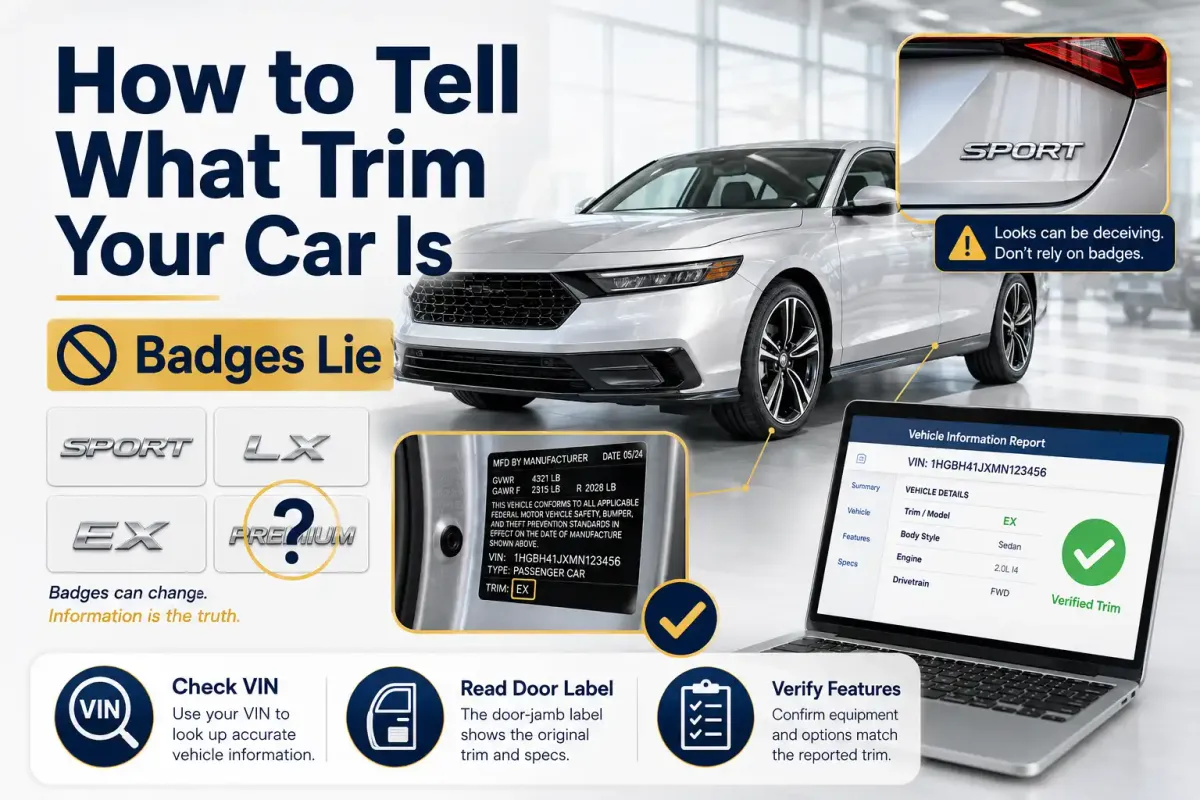
Short answer: a badge is the weakest evidence on the vehicle, and on a used car it should be the last thing you rely on. Badges are inexpensive, widely available and fitted by owners for all sorts of reasons. The factory documentation attached to the vehicle is the strong evidence, and physically verifying the specific equipment is stronger still. This page gives you the hierarchy in order.
This matters beyond bragging rights. Trim frequently decides which of two listed parts or specifications applies to a vehicle, and getting it wrong produces a part that may fit while being incorrect.
Why badges get swapped, and how common it is
Trim badges are trim pieces. They come off with adhesive remover and go on with adhesive, they are sold openly, and there is nothing unusual or particularly dishonest about a vehicle wearing one it did not leave the factory with.
Owners fit higher badges for appearance. Owners remove badges they find cluttered. Body shops fit whatever was available after a repair. Any of those produces a vehicle whose exterior says one thing and whose build record says another, with no intent to deceive anybody.
The result is simple: treat a badge as a hint about where to start looking, not as a fact.
The evidence hierarchy, weakest to strongest
| Rank | Evidence | Why it sits here |
|---|---|---|
| Weakest | Exterior badge | Removable, replaceable, sold openly |
| Seller's description | Frequently derived from the badge | |
| Generic VIN decoder result | Coarse; trim coding is manufacturer-specific | |
| Window sticker or build sheet | Factory documentation, but describes the original build | |
| Option or RPO sticker on the vehicle | Factory build list, physically attached | |
| Strongest | The equipment itself, verified physically | Describes the car as it is now |
The bottom two rows are the ones people skip, and they are the ones that answer the question.
Using the option or RPO sticker
The option code sticker is the factory build list attached to the car, and for this purpose it is the best document most vehicles carry.
It lists what the vehicle was actually built with rather than what a model was offered with, which is exactly the distinction a trim question turns on. On General Motors vehicles this is the RPO sticker, most commonly in the glovebox: reading GM RPO codes. Other manufacturers run equivalent systems in their own formats and locations.
Photograph it. The print is dense and you will want it again.
Using the window sticker or build sheet
Where the sticker is missing or unreadable, the paperwork route is next.
The window sticker lists standard and optional equipment as sold, and several manufacturers host it free by VIN for recent model years: how to get the original window sticker by VIN.
The build sheet is the assembly record and is often more granular, though much less consistently available: what a build sheet is and how to pull one.
Both describe the original build. On a vehicle that has been modified, they tell you what it was, not what it is.
What the VIN does and does not settle about trim
Some manufacturers encode a series or line within the VIN descriptor section, and where they do it gives a coarse answer.
Two limits. The coding in that section is manufacturer-specific rather than standardized, which is why generic decoders disagree on exactly this field. And it identifies a line rather than the optional equipment fitted, so two vehicles with the same VIN-implied trim can be equipped very differently.
Use the free NHTSA decoder at vpic.nhtsa.dot.gov rather than a commercial one, since it returns manufacturer-reported data. The structure and its limits: what each VIN character encodes.
Verifying physically, which is the strongest evidence of all
For a used vehicle, what is actually fitted matters more than what was originally fitted, and it is something you can check yourself.
Work from the question rather than from the trim name. If you need to know which brake option the vehicle has, look at the brakes. If you need to know the axle, find the axle code. If the question is about seats, drivetrain or a specific system, verify that system.
This inverts the usual approach and it is more reliable, because it skips the trim label entirely and goes to the thing the trim label was only ever a proxy for.
Why trim decides which part or spec applies to you
The practical payoff.
Parts catalogues routinely list two or more options for one model year, split by trim, engine, axle or build date. When you cannot answer which one you are, you have a coin flip, and a part that physically fits is not evidence that it was the right one.
The same applies to specifications. Where a figure differs by trim, using the wrong one is not a small error. This is one of the structural reasons published charts disagree: why two websites give your car two different numbers.
When trim alone does not resolve a catalogue split, the other common splitter is build date: model year vs build date.
Frequently asked questions
How can I tell if my trim badge is original?
You generally cannot from the badge itself. Check the factory documentation instead: the option code sticker on the vehicle, the window sticker or the build sheet.
Can a VIN decoder tell me my trim?
Only coarsely. Trim coding within the VIN descriptor section is manufacturer-specific and identifies a line rather than the optional equipment fitted.
Does it matter if the badge is wrong?
For a parts or specification question, yes. Trim frequently decides which of two listed options applies, and a part that fits is not necessarily the correct one.
Where is the option sticker on my car?
On General Motors vehicles, most often the glovebox, and on older ones the trunk area or console. Other manufacturers use their own formats and locations.
The documentation and the car do not match. Which do I believe?
For what the vehicle is today, believe the car. Factory documentation describes the original build and cannot know about later changes.