Ford F-350 Towing Capacity Chart 2026: Official Ratings
Ford F-350 towing capacity chart for 2026: every DRW rating and SRW range by engine, axle and cab, up to 38,000 lb, from Ford's official towing guide.

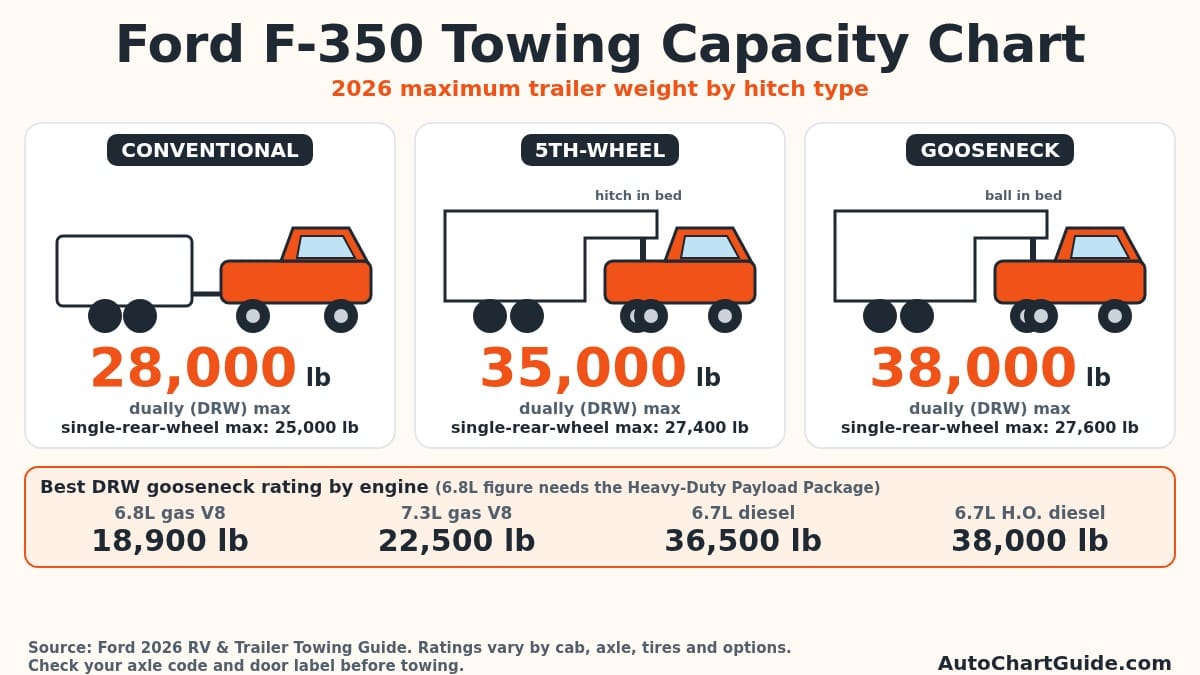
Short answer: the 2026 Ford F-350 tows up to 38,000 lb with a gooseneck hitch, up to 35,000 lb with a 5th-wheel hitch and up to 28,000 lb with a conventional ball hitch, according to Ford's 2026 RV & Trailer Towing Guide. All three maximums need a dual-rear-wheel (DRW) truck with the 6.7L High Output Power Stroke diesel and the 4.10 axle. The single-rear-wheel (SRW) F-350 tops out at 25,000 lb conventional and 27,600 lb gooseneck. The gas trucks are rated from 13,500 lb to 22,500 lb depending on engine, axle, cab and hitch.
Every rating on this page is copied from the F-350 trailer towing selector tables in Ford's 2026 RV & Trailer Towing Guide and cross-checked against Ford's 2026 Super Duty technical specifications dated February 27, 2026. We read both on November 1, 2026. Ford says the ratings are calculated with the SAE J2807 method and assume a properly equipped truck with a 150 lb driver and a 150 lb passenger. Where Ford prints two numbers in one cell, or where its two documents disagree, we show what Ford printed and say so.
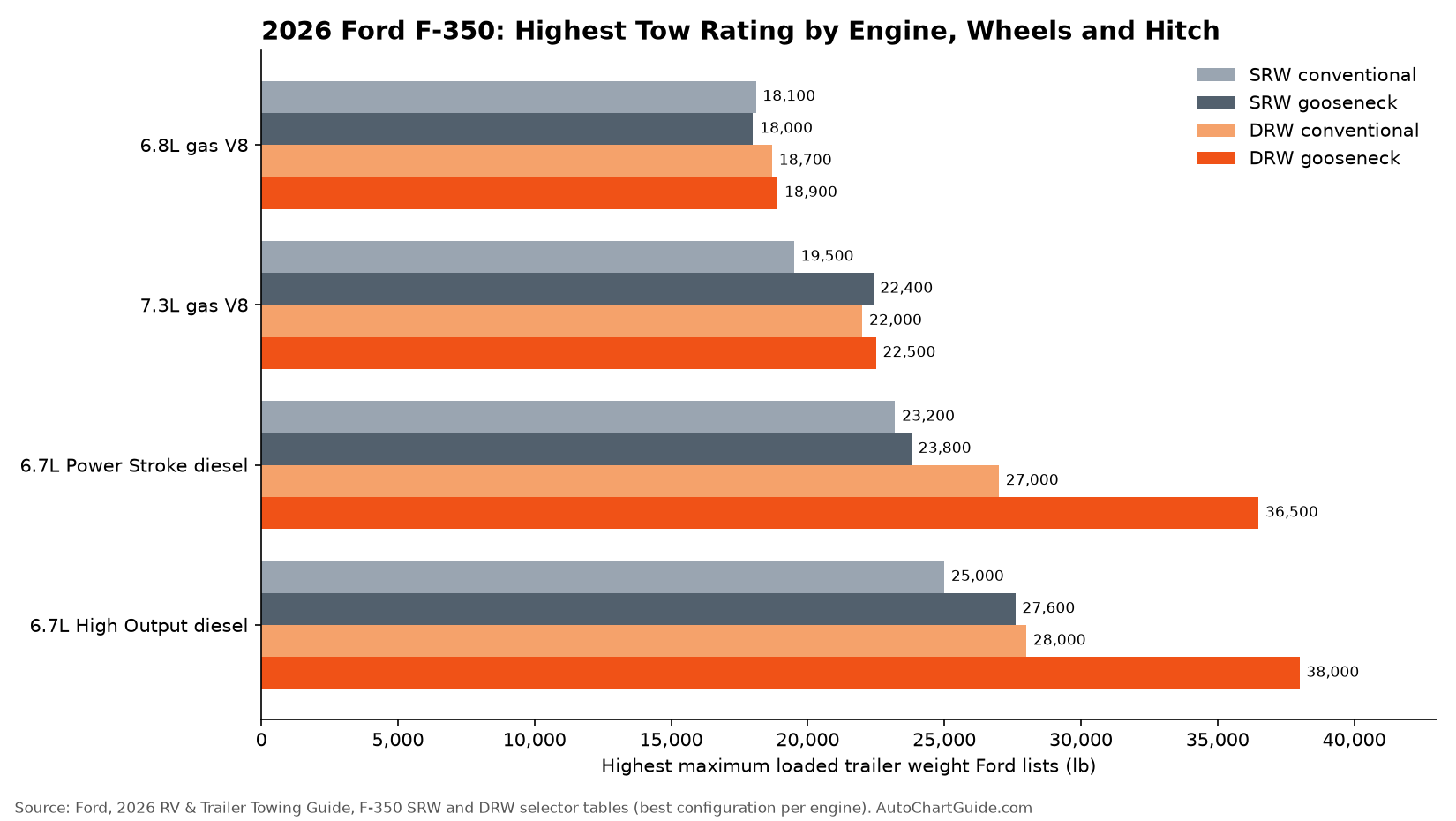
Ford F-350 towing capacity chart: maximum by engine
This is the quick version. Each cell is the single highest rating Ford lists for that engine, wheel setup and hitch type, with the configuration that earns it. Your truck may be rated lower. Use the detailed tables further down to find the row for your exact cab, box, drive and axle.
| Engine | SRW conventional | SRW 5th-wheel / gooseneck | DRW conventional | DRW 5th-wheel / gooseneck |
|---|---|---|---|---|
| 6.8L gas V8 | 18,100 | 17,900 / 18,000 | 18,700 | 18,700 / 18,900 |
| 7.3L gas V8 | 19,500 | 22,300 / 22,400 | 22,000 | 22,500 / 22,500 |
| 6.7L Power Stroke diesel | 23,200 | 23,700 / 23,800 | 27,000 | 35,000 / 36,500 |
| 6.7L High Output diesel | 25,000 | 27,400 / 27,600 | 28,000 | 35,000 / 38,000 |
Pounds. Best configuration for each: SRW 6.8L and 7.3L = Regular Cab 4x2 with 4.30 axle (7.3L SRW conventional 19,500 lb is listed for most cabs); SRW 6.7L diesel = SuperCab 4x4 8-ft or Crew Cab 4x4 6.75-ft (conventional) and Regular Cab 4x2 (5th/gooseneck), 3.31 or 3.55 axle; SRW 6.7L H.O. = Crew Cab 4x4 8-ft (conventional) and Regular Cab 4x4 with all-terrain tires (5th/gooseneck), 3.55 axle; DRW gas = Regular Cab 4x2, 4.30 axle (6.8L 5th/gooseneck figures need the Heavy-Duty Payload Package 68F); DRW diesel = Crew Cab with 4.10 axle (conventional) and Regular Cab 4x2 with 4.10 axle (5th/gooseneck; the standard-diesel cell is printed 35,000/35,000 and 36,300/36,500). Source: Ford, 2026 RV & Trailer Towing Guide, F-350 trailer towing selector; cross-checked with Ford 2026 Super Duty technical specifications (02/27/26).
Three patterns stand out. First, the dually matters most for the diesels. A DRW F-350 with the standard 6.7L diesel is rated for 36,500 lb with a gooseneck, while the best SRW diesel gets 23,800 lb. Second, the gas engines gain little from the dually: the best 6.8L SRW conventional rating is 18,100 lb and the best 6.8L DRW rating is 18,700 lb. Third, the High Output diesel adds the most at the very top. On the DRW, it lifts the best gooseneck rating from 36,500 lb to 38,000 lb and the best conventional rating from 27,000 lb to 28,000 lb.
F-350 engines and what Ford rates them for
Ford offers four engines in the 2026 F-350 pickup. All of them use a 10-speed TorqShift automatic. Ford's spec sheet lists the TorqShift-G 10R100 for the 6.8L and 7.3L gas engines and the heavy-duty 10R140 for the 7.3L and the 6.7L diesel.
| Engine | Horsepower (hp @ rpm) | Torque (lb-ft @ rpm) |
|---|---|---|
| 6.8L gas V8 | 405 @ 5,000 | 445 @ 4,000 |
| 7.3L gas V8 | 430 @ 5,500 | 485 @ 4,000 |
| 6.7L Power Stroke diesel | 475 @ 2,600 | 1,050 @ 1,600 |
| 6.7L High Output Power Stroke diesel | 500 @ 2,600 | 1,200 @ 1,600 |
Source: Ford 2026 Super Duty technical specifications and 2026 RV & Trailer Towing Guide.
Ford's footnote matters here: horsepower, torque, payload and towing "are independent attributes and may not be achieved simultaneously." The engine sets the ceiling, but the axle ratio and the gross combined weight rating (GCWR) decide where a given truck lands. That is why the same 6.7L diesel can be rated anywhere from 19,800 lb (an SRW Crew Cab 4x4 with a 5th-wheel) to 36,500 lb (a DRW Regular Cab 4x2 with a gooseneck). Our Ford F-150 payload capacity chart explains how GCWR, GVWR and payload appear on a Ford label; the terms are the same on a Super Duty.
F-350 DRW (dually) conventional towing chart
The dually is where the F-350's biggest numbers come from. Ford builds the 2026 F-350 DRW pickup as a Regular Cab or Crew Cab, both with an 8-foot box. The 6.8L gas engine is not offered on the Crew Cab 4x2 DRW, so those cells are blank. Ratings are maximum loaded trailer weight in pounds for a conventional (ball or receiver) hitch.
| Engine | Axle | GCWR (lb) | Regular Cab 4x2 | Regular Cab 4x4 | Crew Cab 4x2 | Crew Cab 4x4 |
|---|---|---|---|---|---|---|
| 6.7L Power Stroke diesel | 3.55 | 40,000 | 24,800/18,200 | 24,800 | 27,000 | 27,000 |
| 6.7L Power Stroke diesel | 4.10 | 43,900 | 24,800/18,200 | 24,800 | 27,000 | 27,000 |
| 6.7L High Output diesel | 3.55 | 40,500 | 24,800 | 24,800 | 27,000 | 27,000 |
| 6.7L High Output diesel | 4.10 | 45,600 | 24,800 | 24,800 | 28,000 | 28,000 |
| 6.8L gas V8 | 4.30 | 25,400 | 18,700/18,200* | 18,300 | — | 17,700 |
| 7.3L gas V8 | 3.73 | 25,700 | 18,900 | 18,500 | — | 17,900 |
| 7.3L gas V8 | 4.30 | 29,500 | 22,000 | 22,000 | — | 21,700 |
F-350 DRW, 8-ft box (Regular Cab 141.6-in WB, Crew Cab 176.0-in WB). Pounds. — = configuration not offered. * Ford footnote: Heavy-Duty Payload Package (68F). Source: Ford, 2026 RV & Trailer Towing Guide, F-350 trailer towing selector; cross-checked with Ford 2026 Super Duty technical specifications (02/27/26).
The conventional ceiling for the dually is 28,000 lb, which matches the weight-carrying and weight-distributing limit Ford lists for the F-350 DRW receiver. The Crew Cab is rated higher than the Regular Cab here (27,000 or 28,000 lb against 24,800 lb). Ford does not say why. One clue is in its hitch notes: the F-350 DRW Crew Cab with the High Output diesel and 4.10 axle is the only F-350 that gets a 3-inch receiver. Every other F-350 gets a 2.5-inch receiver.
Two cells in the Regular Cab 4x2 column carry a second figure. For the standard diesel, Ford prints "24,800/18,200" without a footnote explaining the split. For the 6.8L, Ford prints "18,700/18,200" with its footnote for the Heavy-Duty Payload Package (68F). If your truck matches one of those cells, ask a Ford dealer which figure applies to your build. Until you know, plan around the lower one.
F-350 DRW 5th-wheel and gooseneck towing chart
A 5th-wheel or gooseneck hitch carries the trailer's pin weight in the truck bed instead of on a rear receiver, and Ford rates the F-350 for its heaviest trailers this way. Each cell shows the 5th-wheel rating first and the gooseneck rating second.
| Engine | Axle | GCWR (lb) | Regular Cab 4x2 | Regular Cab 4x4 | Crew Cab 4x2 | Crew Cab 4x4 |
|---|---|---|---|---|---|---|
| 6.7L Power Stroke diesel | 3.55 | 40,000 | 32,300/32,400 / 32,400/32,600 | 31,900 / 32,000 | 31,600 / 31,800 | 31,200 / 31,400 |
| 6.7L Power Stroke diesel | 4.10 | 43,900 | 35,000/35,000 / 36,300/36,500 | 35,000 / 35,900 | 35,000 / 35,700 | 35,000 / 35,300 |
| 6.7L High Output diesel | 3.55 | 40,500 | 32,800 / 32,900 | 32,300 / 32,500 | 32,100 / 32,300 | 31,700 / 31,800 |
| 6.7L High Output diesel | 4.10 | 45,600 | 35,000 / 38,000 | 35,000 / 37,600 | 35,000 / 37,400 | 34,900 / 35,900 |
| 6.8L gas V8 | 4.30 | 25,400 | 18,500/18,700* / 18,600/18,900* | 18,100 / 18,200 | — | 17,400 / 17,600 |
| 7.3L gas V8 | 3.73 | 25,700 | 18,700 / 18,800 | 18,200 / 18,400 | — | 17,600 / 17,800 |
| 7.3L gas V8 | 4.30 | 29,500 | 22,500 / 22,500 | 22,000 / 22,200 | — | 21,400 / 21,600 |
Each cell: 5th-wheel / gooseneck, pounds. Slashes inside one figure (e.g. 32,300/32,400) are printed that way by Ford. * Heavy-Duty Payload Package (68F). Source: Ford, 2026 RV & Trailer Towing Guide, F-350 trailer towing selector; cross-checked with Ford 2026 Super Duty technical specifications (02/27/26).
The 38,000 lb headline comes from one cell: the Regular Cab 4x2 with the 6.7L High Output diesel and 4.10 axle, gooseneck. The 5th-wheel ratings stop at 35,000 lb no matter how the truck is built. That cap shows up in every 4.10 diesel row except one: the High Output Crew Cab 4x4, which Ford rates at 34,900 lb. So if you are shopping for a heavy 5th-wheel camper, cab and drive make little difference with the 4.10 axle. Gooseneck ratings spread out more: with the High Output diesel and 4.10 axle, the Regular Cab 4x2 is rated 2,100 lb higher than the Crew Cab 4x4 (38,000 lb against 35,900 lb).
The 3.55 axle costs a lot here. With the standard diesel, moving from 4.10 to 3.55 drops the Crew Cab 4x4 gooseneck rating from 35,300 lb to 31,400 lb. That is a 3,900 lb difference from gearing alone, before you change anything else on the truck.
F-350 SRW conventional towing chart
The single-rear-wheel F-350 comes in many more configurations: Regular Cab, SuperCab and Crew Cab, two box lengths, and 4x2 or 4x4. Ford's SRW conventional table has ten columns for each engine and axle. Ratings can differ by several thousand pounds within one row, so the table below gives the lowest and highest figure Ford lists in each row and where the top number comes from.
| Engine | Axle | GCWR (lb) | Lowest rating | Highest rating | Where the highest rating applies |
|---|---|---|---|---|---|
| 6.7L Power Stroke diesel | 3.31 or 3.55 | 31,000 | 20,000 | 23,200 | 23,200: SuperCab 4x4 8-ft box or Crew Cab 4x4 6.75-ft box, 18-in all-season tires |
| 6.7L High Output diesel | 3.31 | 31,800 | 20,000 | 23,900 | 23,900: SuperCab 4x4 8-ft box or Crew Cab 4x4 6.75-ft box (tire-dependent) |
| 6.7L High Output diesel | 3.55 | 35,200 | 20,000 | 25,000 | 25,000: Crew Cab 4x4 8-ft box (tire-dependent) |
| 6.8L gas V8 | 3.73 | 21,000 | 13,700 | 14,700 | 14,700: Regular Cab 4x2, 18-in all-season tires |
| 6.8L gas V8 | 4.30 | 24,400 | 17,100 | 18,100 | 18,100: Regular Cab 4x2, 18-in all-season tires |
| 7.3L gas V8 | 3.73 | 25,200 | 17,800 | 18,200 | 18,200: most Regular Cab, SuperCab and Crew Cab 4x2 columns |
| 7.3L gas V8 | 4.30 | 29,000 | 18,200 | 19,500 | 19,500: every column except Regular Cab 4x2 and SuperCab 4x2 6.75-ft box (18,200) |
| Tremor Off-Road Package (diesel or 7.3L) | — | 28,600–31,200 | 18,200 | 18,200 | Crew Cab 4x4 6.75-ft box only |
F-350 SRW conventional towing, pounds, across Regular Cab, SuperCab and Crew Cab, 4x2 and 4x4, 6.75-ft and 8-ft boxes. Several cells depend on Ford's 18-in all-season or 18/20-in all-terrain tire footnotes. Tremor GCWR: 31,200 lb (diesel) or 28,600 lb (7.3L). Source: Ford, 2026 RV & Trailer Towing Guide, F-350 trailer towing selector; cross-checked with Ford 2026 Super Duty technical specifications (02/27/26).
Tire choice moves several of these ratings. Ford footnotes many SRW cells to "18" All-Season Tires" or "18" and 20" All-Terrain Tires," and some cells show two figures, one for each tire package. The two figures differ by as little as 100 lb and, in one High Output Crew Cab 4x4 cell, by 1,500 lb (23,500 and 25,000 lb). Either way, it can decide whether a trailer is within the rating. Check the tire size listed on your door jamb sticker before reading across the row.
The Tremor Off-Road Package is the outlier. With either the diesel or the 7.3L, Ford rates the Tremor F-350 at 18,200 lb conventional, and the receiver limit for a Tremor is also 18,200 lb. Ford's 5th-wheel and gooseneck table rates the High Output Tremor at 22,900 lb and 23,000 lb, and the 7.3L Tremor at 21,000 lb for both, so a Tremor owner with a heavier trailer needs one of those hitches.
F-350 SRW 5th-wheel and gooseneck maximums
Ford's SRW 5th-wheel and gooseneck table is crowded. Many cells hold two or three figures tied to different tire packages. Rather than reproduce all of them, here is the best rating for each engine and the configuration Ford lists it for.
| Engine | Axle | GCWR (lb) | Best 5th-wheel | Best gooseneck | Configuration |
|---|---|---|---|---|---|
| 6.8L gas V8 | 4.30 | 24,400 | 17,900 | 18,000 | Regular Cab 4x2, 18-in all-season tires |
| 7.3L gas V8 | 4.30 | 29,000 | 22,300 | 22,400 | Regular Cab 4x2, 18-in all-season tires |
| 6.7L Power Stroke diesel | 3.31 or 3.55 | 31,000 | 23,700 | 23,800 | Regular Cab 4x2, 18-in all-season tires |
| 6.7L High Output diesel | 3.55 | 35,200 | 27,400 | 27,600 | Regular Cab 4x4, 18/20-in all-terrain tires |
Pounds. Source: Ford, 2026 RV & Trailer Towing Guide, F-350 trailer towing selector; cross-checked with Ford 2026 Super Duty technical specifications (02/27/26).
The jump from 23,800 lb to 27,600 lb between the standard diesel and the High Output diesel comes from GCWR. Ford rates the High Output SRW with the 3.55 axle at a 35,200 lb GCWR, against 31,000 lb for the standard diesel. The 3,800 lb higher trailer rating lines up with that 4,200 lb higher GCWR. The 27,400 lb and 27,600 lb figures also carry Ford's all-terrain tire footnote, so a Regular Cab 4x4 on the base tires is rated lower.
Hitch receiver limits, frontal area and tailgate clearance
The trailer rating is not the only ceiling. Ford's factory receiver has its own weight limit, and Ford says the receiver capacities "may exceed the maximum loaded trailer weight for the vehicle specified." Read the receiver label as an upper bound, then use the trailer rating for your exact truck.
| Truck | Max trailer, weight-carrying or weight-distributing (lb) | Max tongue load (lb) |
|---|---|---|
| F-350 SRW | 25,000 | 2,500 |
| F-250/F-350 Tremor | 18,200 | 1,820 |
| F-350 DRW | 28,000 | 2,800 |
| F-450 DRW (for comparison) | 30,000 | 3,000 |
Ford lists the same capacity for weight-carrying and weight-distributing use. Source: Ford 2026 RV & Trailer Towing Guide, Hitch Receiver Weight Capacity.
Ford also limits trailer frontal area to 75 sq ft for all 5th-wheel and gooseneck applications on Super Duty pickups, and 60 sq ft for everything else. Ford defines frontal area as "the total area in square feet that a moving vehicle and trailer exposes to air resistance." A tall, wide enclosed trailer can reach that limit before it reaches the weight limit, and Ford warns that exceeding it "may significantly reduce the performance of your towing vehicle."
For 5th-wheel and gooseneck trailers, check clearance as well. Ford gives a maximum closed-tailgate height of 57.9 to 59.7 inches for the F-350 SRW and 58.0 to 59.7 inches for the F-350 DRW, measured at base curb weight. Ford also notes that shorter boxes, such as the 6.75-foot F-350 box, leave less room between the cab and a 5th-wheel or gooseneck trailer.
How to find your F-350's axle ratio
Almost every rating above depends on the axle ratio, and many owners do not know theirs. Ford says to look at the Safety Compliance Certification Label on the driver's door lock facing or latch pillar. Below the bar code is the word AXLE and a two-digit code. Ford's code chart for Super Duty pickups:
| Axle ratio | Non-limited slip | Limited slip | Electronic locking |
|---|---|---|---|
| 3.31 | 31 | Not available | 3H |
| 3.55 | 35 | 3K | 3J |
| 3.73 | 37 | 3L | 3E |
| 4.10 | Not available | 4N | Not available |
| 4.30 | Not available | 4L | 4M |
Code shown after AXLE on the Safety Compliance Certification Label. Source: Ford 2026 RV & Trailer Towing Guide, Rear Axle Ratio Codes.
If the label is missing or hard to read, the original window sticker also lists the axle ratio. Our guide on how to get a window sticker by VIN explains how to request one. Federal rules in 49 CFR 567.4 require the certification label on the hinge pillar, door-latch post or the door edge next to the driver, and require it to show the GVWR.
Worked example 1: a dually and a 5th-wheel camper
The trailer rating assumes an empty truck with two 150 lb occupants. In practice, payload often runs out first. Here is the math for an F-350 DRW Crew Cab 4x4 with the 6.7L High Output diesel and 4.10 axle, using Ford's own figures.
- Ford's 5th-wheel rating for this truck is 34,900 lb.
- Ford's guide says 5th-wheel king pin weight is 15% of loaded trailer weight. 34,900 x 0.15 = 5,235 lb on the hitch.
- Add the two 150 lb occupants Ford assumes: 5,235 + 300 = 5,535 lb.
- Ford's spec sheet gives this configuration a maximum payload of 5,850 lb (14,000 lb GVWR). That leaves 315 lb.
Those 315 lb must also cover the 5th-wheel hitch itself, any options beyond the base truck, tools and anything else in the cab or bed. A truck with a few options can be over its GVWR while still under its trailer rating. The combined check is easier: Ford lists a base curb weight of 8,085 lb for this truck, so 8,085 + 300 + 34,900 = 43,285 lb, under the 45,600 lb GCWR. In this example, payload is the limit you hit first, not GCWR.
Worked example 2: an SRW diesel and a conventional trailer
Now take an F-350 SRW Crew Cab 4x4 with the 6.75-foot box, the standard 6.7L diesel and 18-inch all-season tires. Ford rates it for 23,200 lb conventional with a 31,000 lb GCWR.
- Tongue weight at Ford's 10%: 23,200 x 0.10 = 2,320 lb, under the 2,500 lb receiver limit for the F-350 SRW.
- Add 300 lb for two occupants: 2,620 lb.
- Ford's spec sheet payload for this configuration is 3,957 lb, so about 1,337 lb is left for the hitch, cargo and options.
- Combined: Ford's base curb weight is 7,430 lb. 7,430 + 300 + 23,200 = 30,930 lb, just 70 lb under the 31,000 lb GCWR.
Here GCWR is the tight limit. Any cargo in the bed, added options or a third passenger pushes the combination over 31,000 lb, so the trailer has to get lighter by the same amount. This is why Ford says the weight of options, passengers, cargo and hitch "must be deducted" from the maximum loaded trailer weight.
Payload, GVWR and GCWR: what each number limits
Ford's towing guide defines the terms you need. Payload is "the Gross Vehicle Weight Rating minus the Base Curb Weight," so it covers passengers, cargo and the trailer's tongue or king pin weight. GVWR is the most the loaded truck may weigh. GAWR is the most each axle may carry. GCWR is the most the truck and loaded trailer may weigh together. Ford also notes that the truck's brakes are rated for operation at GVWR, not GCWR, and that trailers over 1,500 lb loaded should have their own brakes.
Trailer tires are the other weak point. Most of a heavy gooseneck's weight rides on the trailer's own tires, and those tires have to be rated for the load at the pressure you run. Our trailer tire load range chart shows how ply rating, load range and pressure set a tire's capacity.
How the F-350 compares with other trucks
If you are deciding between a heavy-duty and a half-ton, the gap is large. Our Ford F-150 towing capacity chart shows the 2026 F-150 topping out at 13,500 lb. That is below the lowest conventional rating Ford lists for any 2026 F-350 (13,700 lb). Against Ram's three-quarter-ton, our Ram 2500 towing capacity chart lists a 20,000 lb maximum for 2026. That equals the low end of the SRW F-350 diesel's conventional range (20,000 to 25,000 lb). The dually F-350 competes with one-ton DRW trucks, not with 2500-class pickups. Ram's one-ton rival is covered in our Ram 3500 towing capacity chart, where the best 2027 dually is rated at 37,020 lb. Ford's own three-quarter-ton tops out at 22,000 lb conventional, as our Ford F-250 towing capacity chart shows.
Within Ford's own lineup, the F-450 sits above the F-350 DRW. Ford's 2026 Super Duty page lists line maximums of 40,000 lb gooseneck, 35,000 lb 5th-wheel and 30,000 lb conventional. The 40,000 lb gooseneck and 30,000 lb conventional figures belong to the F-450, not the F-350. Ford's guide ties the 40,000 lb rating to the F-450 Regular Cab 4x2 with the High Output diesel and the 40K Gooseneck Tow Package (535). For 5th-wheel towing, the F-350 DRW already reaches the 35,000 lb figure.
Where Ford's documents disagree
Ford's two 2026 documents agree on every F-350 figure we cross-checked, with one exception. For the SRW 6.8L with the 4.30 axle, Ford's spec sheet prints a 23,500 lb GCWR in its conventional towing table, while the towing guide and the spec sheet's own 5th-wheel table print 24,400 lb. The trailer ratings in both documents are the same. We use 24,400 lb because it appears twice. If that configuration matters to you, confirm the GCWR on your truck's documents.
The unexplained split figures noted above (for example "24,800/18,200" and "32,300/32,400") are printed the same way in both documents. We have not guessed what the second number means.
Ford F-350 towing capacity: frequently asked questions
What is the maximum towing capacity of a 2026 Ford F-350?
38,000 lb with a gooseneck hitch, per Ford's 2026 towing guide. That needs a DRW Regular Cab 4x2 with the 6.7L High Output diesel and 4.10 axle. The best 5th-wheel rating is 35,000 lb and the best conventional rating is 28,000 lb.
How much can a single-rear-wheel F-350 tow?
Ford rates the 2026 F-350 SRW at up to 25,000 lb conventional and up to 27,600 lb gooseneck (27,400 lb 5th-wheel), both with the 6.7L High Output diesel and 3.55 axle.
How much can a gas F-350 tow?
With the 7.3L V8 and 4.30 axle, a DRW F-350 is rated up to 22,500 lb 5th-wheel or gooseneck and 22,000 lb conventional. An SRW 7.3L is rated up to 22,400 lb gooseneck and 19,500 lb conventional. The 6.8L V8 tops out at 18,900 lb gooseneck with the Heavy-Duty Payload Package (68F).
Is a dually F-350 better for towing?
For diesel trucks, yes by a wide margin: the best DRW gooseneck rating is 38,000 lb against 27,600 lb for the SRW. For gas trucks the gain is small, for example 18,700 lb DRW against 18,100 lb SRW conventional with the 6.8L.
What axle ratio do I need for maximum F-350 towing?
The 4.10 axle on DRW diesel trucks. With the 3.55 axle the same DRW diesel trucks are rated about 2,200 to 5,100 lb lower for 5th-wheel and gooseneck towing. On gas trucks the 4.30 axle gives the highest ratings.
How do I find my F-350's axle ratio?
Read the two-character code after AXLE on the Safety Compliance Certification Label on the driver's door lock facing or latch pillar. For example, 4N is 4.10 limited slip and 3K is 3.55 limited slip.
What is the F-350 hitch receiver rating?
Ford lists 25,000 lb and 2,500 lb tongue load for the F-350 SRW receiver, 28,000 lb and 2,800 lb for the F-350 DRW, and 18,200 lb and 1,820 lb with the Tremor package.
How much tongue or king pin weight should I plan for?
Ford's guide uses 10% of loaded trailer weight for conventional trailers and 15% for 5th-wheel trailers. That weight counts against the truck's payload and GVWR.
Does the F-350 tow 40,000 lb?
No. Ford's 40,000 lb Super Duty gooseneck rating applies to the F-450 with the 40K Gooseneck Tow Package (535). The F-350 maximum is 38,000 lb.
Why is my F-350 rated lower than the chart?
Options, passengers, cargo and the hitch all reduce what you can tow, because Ford's ratings assume a truck with only mandatory options and two 150 lb occupants. Your payload label and GCWR are the limits to check.
Before you tow
Ford's own instruction is simple: do not exceed the maximum loaded trailer weight, and do not let the combined weight go past the GCWR. Find your exact row by engine, axle code, cab, box, drive and tires. Then check payload and axle ratings on the door label, weigh the loaded truck and trailer on a scale, and take the lowest limit as your real capacity. Ford's ratings follow SAE J2807, the industry practice for setting GCWR and trailer weight ratings on vehicles up to 14,000 lb GVWR. It tests acceleration, grade climbing, handling, sway and braking at those weights. Staying inside every rating keeps you within what was actually tested.
Sources
- Ford Motor Company, 2026 Ford RV & Trailer Towing Guide — F-350 SRW and DRW trailer towing selector, required equipment, receiver capacity, axle codes, weight definitions. Read November 1, 2026.
- Ford Motor Company, 2026 F-Series Super Duty Pickup Technical Specifications (02/27/26, V1.0) — engines, transmissions, curb weights, payload, towing tables. Read November 1, 2026.
- Ford.com, 2026 Ford Super Duty — line maximum towing figures. Read November 1, 2026.
- SAE International, J2807_202411 Performance Requirements for Determining Tow-Vehicle GCWR and Trailer Weight Rating. Read November 1, 2026.
- eCFR, 49 CFR 567.4 Requirements for manufacturers of motor vehicles. Read November 1, 2026.