Steel vs Alloy Wheel Torque: One Car, Two Specs
A vehicle supplied with both wheel types can carry two torque figures. Why the material changes the joint, and where the second spec hides.

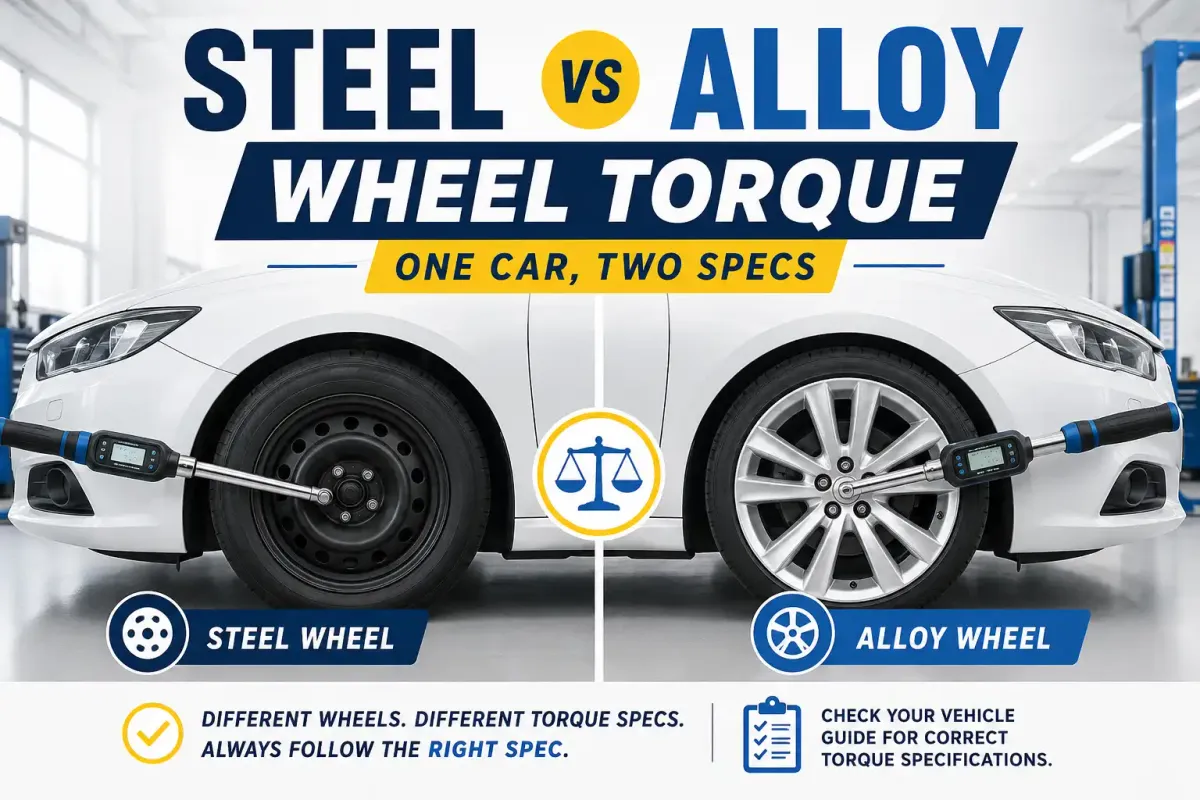
Short answer: not necessarily the same number, and this is one of the most commonly missed forks in the whole subject. A vehicle supplied with both steel and alloy wheels can carry two different wheel torque specifications, one for each. The owner who runs steel wheels through winter and alloys the rest of the year is the person this most often catches, because they have one figure in their head and two joints on their car.
Why the material changes the joint
Torque is not the goal. Clamping force is the goal, and torque is a way of getting there.
The relationship between the two depends on the joint: what is being clamped, how stiff it is, how the bearing surfaces behave under load, and how much the clamped material relaxes as it settles. Steel and cast aluminium alloy are not the same material and do not behave identically under a clamping load.
That is enough on its own for a manufacturer to specify differently. It is engineering rather than caution, and it is why the second figure exists when it exists.
We are deliberately not putting numbers or directions on this. Which way the two figures differ, and by how much, is a property of your specific vehicle, and stating a general direction would be exactly the unsourced figure this site refuses to publish.
Where the second specification is documented, and why people never see it
The reason this gets missed is structural rather than anyone's fault.
Wheel torque usually appears inside the roadside wheel changing procedure of the owner's manual, and that procedure is written for one event: you have a flat, you are fitting the spare. In that context there is one wheel type in play, so the figure often appears once.
Where a manufacturer does specify per wheel type, the second figure tends to live in service information rather than in the owner's manual, or in a footnote to the procedure that reads as a caveat rather than as a fork.
Where the figure hides in the owner's manual, and the four places to look: where your wheel torque spec actually lives.
The seasonal wheel swap, which is where this bites
Someone with a winter set and a summer set changes wheels twice a year, at home, with a torque wrench, doing everything else right.
They looked the figure up once, years ago. They apply it to both sets. If their vehicle specifies per wheel type, one of those two swaps is being done to the wrong specification every single time, and it has been for years.
Nothing about this announces itself. The wheels go on, the wrench clicks, and the vehicle drives normally afterward, which is exactly the profile of the errors this site keeps returning to.
The check is one lookup: confirm whether your vehicle specifies per wheel type, and if it does, write both figures down somewhere you will find them in six months.
What happens when the wrong one of the two is used
Both directions are a problem, and neither is dramatic at first.
Under-tightening leaves the joint with less clamping force than it needs, which allows relative movement between wheel and hub. That movement damages the seats and progressively loses more clamping force, which is the mechanism behind wheels loosening in service.
Over-tightening puts more load into the studs than intended and can deform the seat area of the wheel. A deformed seat also loses clamping force, arriving at a similar destination by a different route.
In both cases the failure develops over time rather than at the moment of assembly. That is why "it was fine when I did it" is not evidence.
The seat type question, which often changes with the wheel too
Worth flagging because it travels with this and is a separate specification.
Steel and alloy wheels frequently take different fasteners, because the seat geometry machined into the wheel differs. Someone swapping between two sets needs to swap fasteners with them, and a fastener with the wrong seat does not clamp properly at any torque: lug seat types, and why the wrong nut fails.
If you keep two sets of wheels, keep the correct fasteners with each set rather than in a single tin in the garage. That is a five-minute organizational decision that removes an entire class of error.
How to establish which figure applies to the wheels on your car today
Three steps, in order.
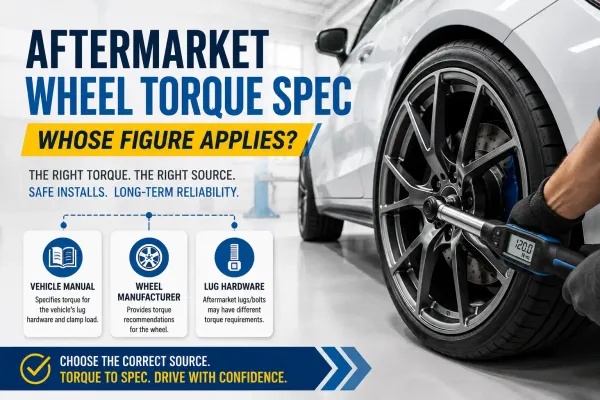
Establish which wheels are actually on the car. Original steel, original alloy, or aftermarket. If they are aftermarket, this article's fork is superseded by a different one: aftermarket wheels, whose torque spec applies.
Check whether your vehicle specifies per wheel type. The owner's manual procedure first, then manufacturer service information, which is where a second figure most often lives: owner's manual vs service manual vs repair database.
If you cannot establish it, ask. A dealer service department has the manufacturer's information for your VIN. This is a two-minute question with a definite answer, and it is a better use of your time than a search that will return charts we would not trust either.
The wider structure of what a torque specification consists of: how to find the torque spec for any fastener.
Frequently asked questions
Do steel and alloy wheels have different torque specs?
They can, on a vehicle supplied with both. The materials behave differently under clamping load, which is enough for a manufacturer to specify separately. Check your own vehicle rather than assuming either way.
Which figure is higher, steel or alloy?
We do not publish a general direction, because it is a property of the specific vehicle and stating one would be an unsourced claim. Your vehicle's documentation is the source.
I use winter wheels. Do I need two figures?
If your vehicle specifies per wheel type, yes, and this is the single most common situation in which the wrong figure gets used for years without anyone noticing.
Where is the second figure documented?
Usually in manufacturer service information rather than the owner's manual, or as a footnote to the wheel changing procedure.
Do I need different lug nuts for steel and alloy wheels?
Often yes, because the seat geometry differs. Keep the correct fasteners with each set rather than mixing them, since the wrong seat does not clamp properly at any torque.