Aftermarket Wheel Torque Spec: Whose Figure Applies?
Your car says one thing and the wheel maker says another. Here is the reasoning that settles it, and what to do when the wheel maker publishes nothing.


Short answer: the joint changed, so the specification may have changed with it, and the wheel manufacturer generally has the stronger claim on their own wheel. The vehicle manufacturer specified a figure for an assembly that included their wheel and their fastener. Replace the wheel and you have replaced one of the components that figure was derived for.
This is a genuine conflict with no obvious authority, and it deserves reasoning rather than a rule handed down. Here is the reasoning.
What the vehicle manufacturer's figure was specified for
A wheel torque figure is a way of achieving a particular clamping force in a particular joint.
That joint has several components: the hub, the studs, the fastener, and the wheel itself. The wheel contributes its material, its thickness at the mounting face, and the geometry of its lug seats. All of that feeds into how much clamping force a given torque produces.
The vehicle manufacturer derived their figure with their own wheel in that joint. Their figure is authoritative for that assembly, and it remains authoritative whenever that assembly is what is on the car.
What the wheel manufacturer is specifying
When you fit a different wheel, one component of the joint has changed, and the party that knows most about the new component is the party that made it.
A wheel manufacturer publishing a torque specification is telling you what their wheel needs, given its material, thickness and seat geometry. That is a legitimate specification about a real thing, and it is not marketing.
It is also why reputable wheel manufacturers publish one, and why a wheel supplied with no specification at all is a wheel you know less about than you should.
Why the fastener is part of the joint too
A point that gets lost in the two-way framing.
Aftermarket wheels frequently require different fasteners, because the seat geometry differs from the vehicle's original wheels. So changing the wheel often means changing the fastener as well, which is a second component of the joint replaced.
That matters here because a torque figure assumes a bearing surface. Change the seat and you have changed how the load is transmitted, which changes the relationship between torque and clamping force: lug seat types, and why the wrong nut fails.
So the question is not really "car or wheel maker." It is "which specification describes the joint that is actually on my car."
Which figure governs, and the reasoning behind it
The general position that follows from the above:
Where the wheel manufacturer publishes a figure for their wheel with their specified fastener, that figure describes the assembly you actually have, and it is the one to work to.
Where they do not, the vehicle manufacturer's figure is the best available reference, and it is being applied to a joint slightly different from the one it was derived for. That is a compromise, and it should be recognized as one rather than treated as equivalent.
The vehicle's studs remain a constraint in both cases. They are the vehicle manufacturer's component and they were sized for their loading. A wheel manufacturer's figure that would substantially exceed what the vehicle's studs were specified for is a conflict to resolve rather than a number to apply, and that resolution is a conversation with a professional.
What to do when the wheel manufacturer publishes nothing
More common than it should be, particularly with used wheels of unclear origin.
Ask the manufacturer directly. Many will answer, and it costs an email.
Establish what the wheel actually is. Casting marks on the back usually give size and offset and sometimes the maker: will these used wheels fit.
Treat the absence as information. A wheel nobody can identify, with no published specification and no known correct fastener, is an assembly you cannot verify. That is a reason to have a professional look at it before it goes on, not a reason to proceed on the vehicle's figure and hope.
Why a general chart is the wrong tie-breaker
The instinct when two sources conflict is to find a third. In this case the third source is worse than either.
A general torque chart does not know what wheel is on your vehicle, what fastener it takes, or what its seats look like. It is aggregating vehicle manufacturer figures for original assemblies, which is precisely the assembly you no longer have.
Reaching for a chart here is looking up an answer to a question you are not asking, and the copying between such sources means agreement between three of them proves nothing: why two websites give your car two different numbers.
When to have a professional settle it
Three triggers.
The two published figures differ substantially and you cannot tell why. That is a real conflict, not a rounding difference.
You cannot identify the wheel or its correct fastener. The assembly is unverified.
The wheels also changed the fastener seat type and you are not certain the current fasteners are correct. Two unknowns compounding.
A tire and wheel professional can identify the wheel, confirm the fastener, and work from the manufacturer's information for your vehicle. For where the vehicle's own data lives: owner's manual vs service manual vs repair database. And for the four places the vehicle's own figure hides: where your wheel torque spec actually lives.
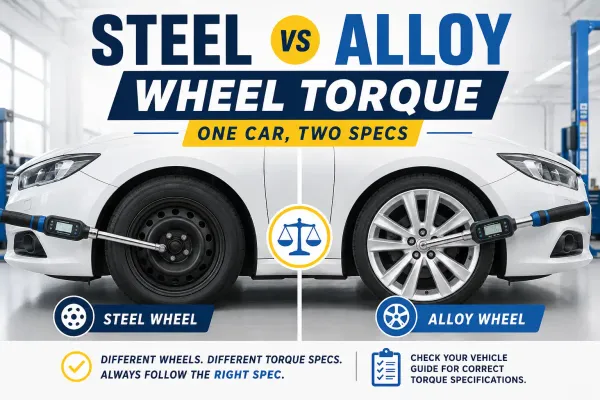
There is a related fork even on original wheels, worth checking at the same time: steel vs alloy wheel torque.
Frequently asked questions
Should I use the car's torque spec or the wheel manufacturer's?
Where the wheel manufacturer publishes a figure for their wheel with their specified fastener, that describes the assembly you actually have. The vehicle's figure was derived for the original wheel.
What if the wheel manufacturer publishes nothing?
Ask them directly. Failing that, the vehicle manufacturer's figure is the best available reference, applied to a slightly different joint, which is a compromise rather than an equivalent.
Do aftermarket wheels need different lug nuts?
Often yes, because the seat geometry differs. That is a second component of the joint changing, and it affects the relationship between torque and clamping force.
Can I just use a general torque chart?
No. A chart aggregates figures for original assemblies, which is exactly the assembly you no longer have once the wheel is changed.
What if the two figures are very different?
Treat that as a conflict to resolve with a professional rather than a number to pick between. The vehicle's studs remain a constraint regardless of what the wheel maker specifies.