CVT Fluid: Why Universal Is Usually Wrong Here
A CVT transmits torque through friction at a belt or chain contact, so the fluid's friction behavior is part of how the transmission works, not incidental.

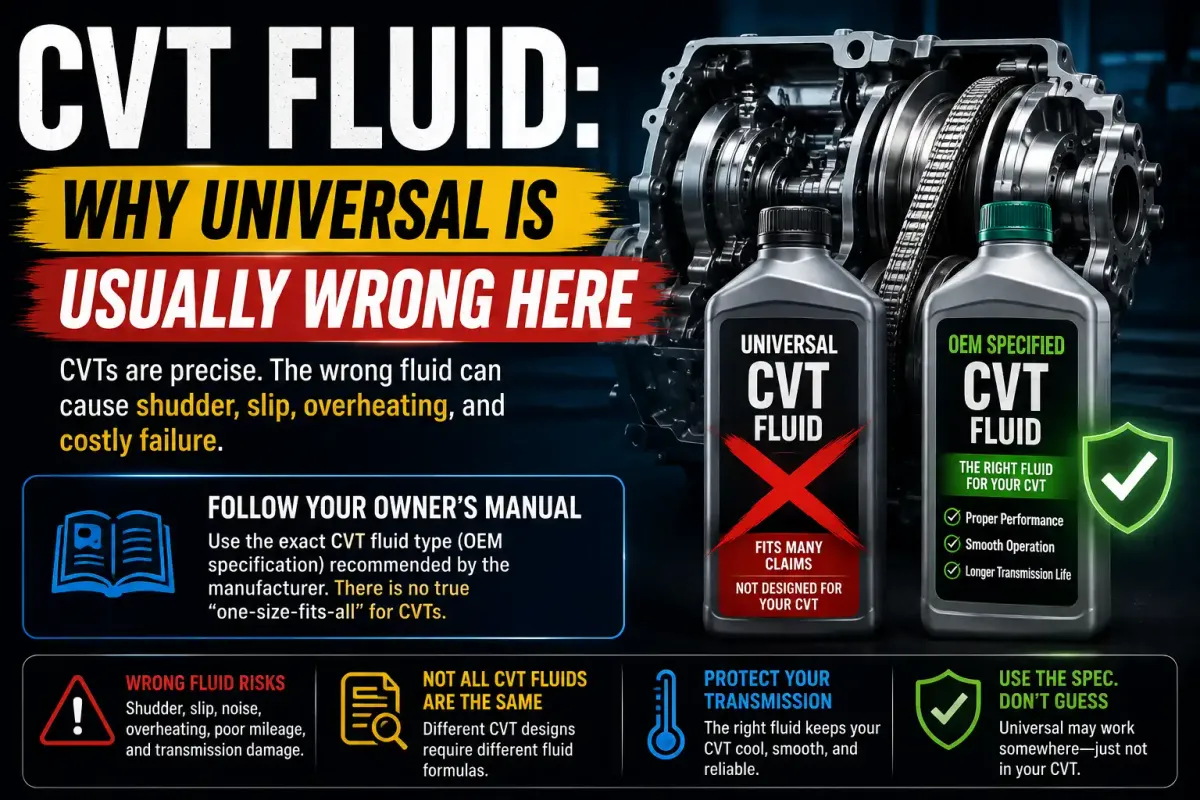
Short answer: no, and the reason is that in a CVT the fluid is part of how torque gets transmitted rather than something present while it happens. In a conventional automatic, fluid friction characteristics matter for how clutches engage. In a continuously variable transmission they matter for whether the belt or chain grips the pulleys at all. That is a step change in how specification-critical the fluid is.
The specification names and product categories here are discussed as a system, not as recommendations.


As an Amazon Associate we earn from qualifying purchases.
How a CVT transmits torque
A continuously variable transmission works by running a belt or chain between two pulleys whose effective diameters can change. Varying those diameters varies the ratio continuously rather than in steps.
The belt or chain does not mesh with the pulleys the way gear teeth mesh. It is clamped between conical pulley faces, and torque passes across that contact.
So the whole drive path runs through a clamped friction contact, under pressure, with fluid present. That is the design.
Why friction behavior is a design parameter, not a side effect
Follow the consequence.
If the contact between belt and pulley cannot transmit the torque being asked of it, the belt slips. Slip in a CVT is not a shift quality issue; it is contact surfaces moving against each other under high clamping pressure, which damages both.
The fluid is present in that contact. Its friction behavior therefore determines, in part, how much torque the contact can carry at a given clamping pressure. The transmission's control system is calibrated around that behavior when it decides how much clamping pressure to apply.
That is why CVT fluid specifications are tight. The fluid is not lubricating a mechanism that would work without it. It is a component of the torque path.


As an Amazon Associate we earn from qualifying purchases.
What a universal CVT fluid is claiming
A universal or multi-vehicle CVT fluid is claiming suitability across a range of transmissions.
The same distinction applies here as with conventional ATF: a licensed specification is verifiable and a coverage claim is an assertion by the fluid's maker: automatic transmission fluid specs.
What makes the claim harder to sustain in the CVT case is that the friction behavior is calibrated against by the transmission's control system. A fluid claiming to suit many CVTs is claiming to match a friction characteristic that several different manufacturers calibrated independently, which is a stronger claim than matching a lubrication performance level.
That does not make every such product wrong. It means the claim deserves more scrutiny here than elsewhere, and the way to scrutinize it is to check whether the product names your vehicle's specification as one it carries, with an identifier where one is issued.
Dual-clutch transmissions, wet and dry
DCTs get bracketed with CVTs in conversation and they are a different situation again, with an internal split that matters.
A wet clutch DCT runs its clutches immersed in fluid, so the fluid is the friction medium in the clutches in the same way it is in a conventional automatic, with the additional demands of the transmission's own lubrication and hydraulic needs.
A dry clutch DCT has clutches that do not run in fluid, so the transmission fluid is doing gear lubrication and hydraulic duty rather than acting as a clutch friction medium.
Those are genuinely different requirements, and a fluid appropriate to one is not necessarily appropriate to the other. A reader who knows only that their car has a dual-clutch transmission does not yet know which situation they are in, and that is worth establishing from the vehicle's documentation before anything else.
Why the failure is slow rather than sudden
Consistent with the rest of this cluster.
A CVT running on a fluid whose friction behavior does not match its calibration may operate normally under most conditions. The control system applies clamping pressure according to its calibration, and if that pressure is marginally insufficient for the actual contact behavior, the result is a small amount of slip under load.
Small amounts of slip damage the pulley and belt surfaces gradually. Damaged surfaces grip less well, which produces more slip.
Nothing about that announces itself early. By the time the behavior is obvious, the damage has accumulated, and CVT internal repair is expensive.
This is the same shape as the wrong coolant chemistry: quiet, cumulative, and expensive: OAT, HOAT and IAT coolants and what mixing them does.


As an Amazon Associate we earn from qualifying purchases.
Where your vehicle's specification is written
The specifications section of the owner's manual, alongside the other fluids: how to find every fluid spec your vehicle requires.
Where the manual is not enough, manufacturer service information resolves to your VIN: owner's manual vs service manual vs repair database.
For a transmission of this kind, a dealer parts department is a particularly good source, because the specification is usually a manufacturer one and they stock the product that carries it.
When a specification genuinely has no aftermarket equivalent
Sometimes there is not one, and that is a legitimate outcome rather than a failure of searching.
Where a manufacturer's specification is proprietary and no aftermarket product has been licensed against it, the manufacturer's own product is the product that meets the specification. That is not a marketing situation; it is what the specification says.
The reasonable response is to establish whether that is actually the case, by asking a dealer parts department, rather than either assuming it or dismissing it. And where a manufacturer approval system is involved, the approval-versus-claim distinction is the thing to check: OEM oil approvals and what they mean.
We do not tell you which fluid to use, we publish no capacities, and we publish no change intervals. When a transmission should be serviced is a maintenance question and belongs with your manual's schedule and a qualified technician.

As an Amazon Associate we earn from qualifying purchases.
Frequently asked questions
Is a universal CVT fluid OK?
It is making a suitability claim across transmissions whose manufacturers calibrated independently, which is a stronger claim than a lubrication performance level. Check whether it names your vehicle's specification as one it carries.
Why is CVT fluid so specific?
Because a CVT transmits torque across a clamped friction contact between belt and pulleys, with fluid present. The fluid's friction behavior partly determines how much torque that contact carries, and the control system is calibrated around it.
Is DCT fluid the same as CVT fluid?
No, and dual-clutch transmissions split further into wet clutch and dry clutch designs with different fluid requirements. Establish which your vehicle has from its documentation.
What happens if I use the wrong CVT fluid?
Potentially small amounts of slip under load, which damages the pulley and belt surfaces gradually. It is a quiet, cumulative and expensive failure rather than an immediate one.
What if only the manufacturer's fluid meets the spec?
That is a legitimate outcome. Where no aftermarket product has been licensed against a proprietary specification, the manufacturer's product is the one that meets it. Confirm with a dealer parts department.