GM RPO Codes: Where to Find and How to Read Them
The RPO sticker is your vehicle's factory build list. Here is where it hides, how a code is structured, and how to use it to answer one specific question.

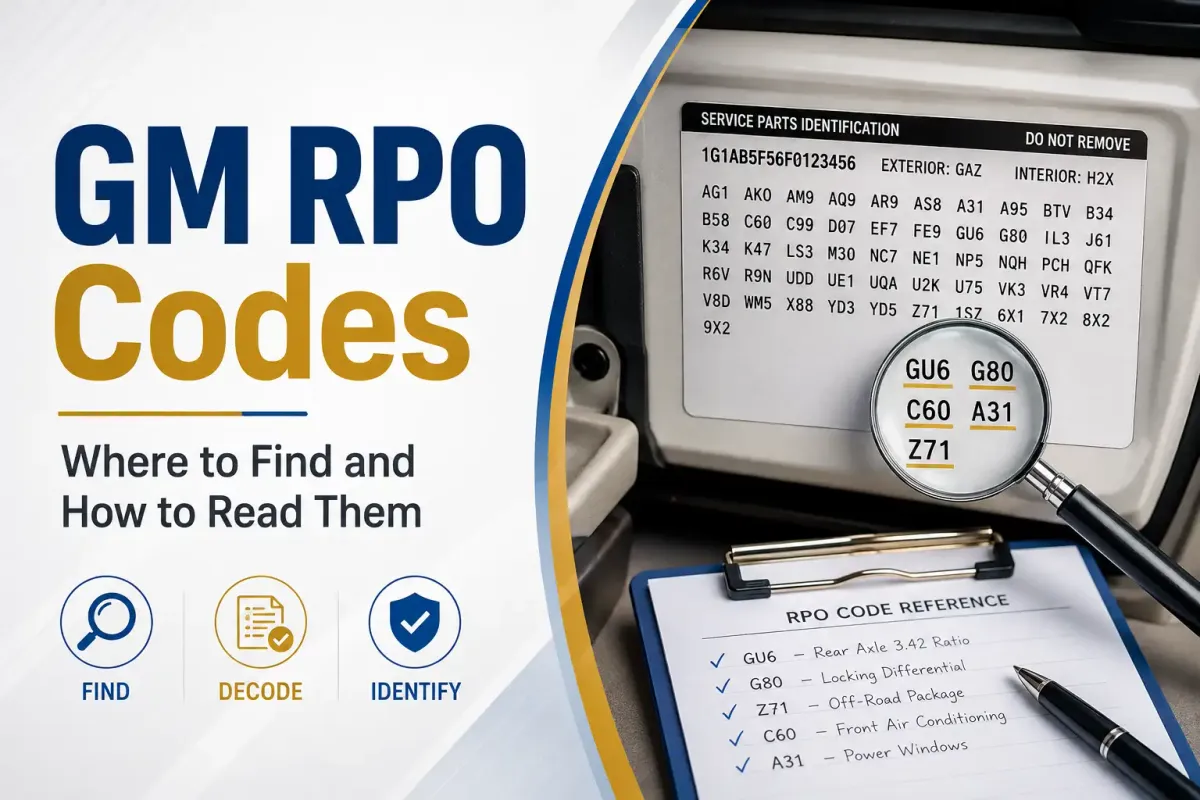
Short answer: RPO stands for Regular Production Option, and the sticker listing them is the most complete factory build record physically attached to your vehicle. It is a list of short codes, one for each option the vehicle was built with. You do not need to decode all of them. You need to find the two or three that answer the question you actually have, which is usually about paint, axle, transmission or trim.
That reframing is the useful part of this page. Search results for RPO codes are code-list databases, and staring at a database while holding a sticker with forty codes on it is not a plan. Working backward from your question is.
Where the sticker is, and where it moved to over the years
On General Motors vehicles the RPO sticker, sometimes called a service parts identification label, is most commonly found in the glovebox on newer vehicles.
On older vehicles it turns up in other places: the trunk lid underside, the spare wheel well, the center console lid, or occasionally the door jamb area. There is no single answer, because unlike the federal certification label and tire placard, this label is not required by regulation. It exists because dealers and service departments need it, so its placement follows the manufacturer's convenience rather than a rule.
If it is not in the glovebox, check the trunk area next, then the console. On a vehicle that has had interior work done, it may have been removed entirely.
How a code is structured
RPO codes are short alphanumeric identifiers, typically three characters. They are not mnemonic. There is no logic that lets you read a code and infer what it means without a reference.
What the sticker usually gives you alongside the codes is the VIN and, on many versions, the paint and interior trim codes called out separately from the general option list. Those called-out fields are the reason most people go looking for this label in the first place.
The codes worth finding first
Rather than decoding the whole list, look for the categories that decide real questions:
- Paint. Frequently the reason someone hunts down this label. It is the input to ordering touch-up or matching a panel.
- Interior trim. The equivalent for anything inside the vehicle.
- Axle. This is the one that most often decides which of two listed parts applies to a vehicle, and it is not visible from the outside.
- Transmission. Same reasoning.
- Engine. Worth cross-checking against other sources rather than relying on alone. See reading your engine code.
Using RPO codes to answer a parts question instead of decoding everything
Here is the workflow that actually works.
Start with the question. "There are two brake pad sets listed for my vehicle and I do not know which is mine" is a question. "What do all these codes mean" is not.
Then take the sticker to whoever can act on the question. A dealer parts counter deals in RPO codes routinely, and reading them a code is more precise than describing your vehicle. This is the single fastest way to resolve a two-options-listed problem, and it costs nothing.
Photograph the sticker while you are at the vehicle. It is small, the print is dense, and you will want it again.
Where to verify a code you cannot identify
We do not republish RPO code tables here, for the same reason we do not publish specification charts: we cannot verify them across every model year and division, and a wrong code identification sends someone to the wrong part.
The sources worth using are General Motors documentation and a franchised dealer's parts system. A dealer can look up what a code means for your specific VIN, which is stronger than any general table, because it accounts for the code being used differently across divisions or eras.
Third-party code lists are widely available and frequently correct. They are also frequently copied from one another, which means agreement between two of them is not independent confirmation. If a code decision has cost or safety attached to it, verify it through the manufacturer side.
Vehicles from other manufacturers: the equivalent systems
RPO is a General Motors term, but the concept is not unique to GM. Most manufacturers attach some form of option or configuration code label to the vehicle, under their own names and in their own places.
The general skill transfers exactly. Find the label, photograph it, work backward from your question, and verify the specific code through the manufacturer or a dealer rather than through a general chart.
Where no such label exists or it has been removed, the fallback documents are the window sticker and the build sheet.
Frequently asked questions
What does RPO stand for?
Regular Production Option. It is General Motors' term for a factory-installed option, and each one carries a short code.
Where is the RPO sticker on my vehicle?
Most commonly the glovebox on newer GM vehicles. On older ones, check the trunk lid underside, the spare wheel well or the console lid. It is not required by regulation, so its location is not standardized.
Can I look up RPO codes online?
Many lists exist. They are frequently copied from one another, so agreement between sites is not independent confirmation. For a decision with cost or safety attached, verify through GM documentation or a dealer parts system.
Does the RPO sticker have my paint code?
On most versions of the label, yes, usually called out separately from the general option list along with the interior trim code.
Do non-GM vehicles have RPO codes?
Not under that name, but most manufacturers use an equivalent option code system with its own label. The approach to finding and using it is the same.