Can I Trust AI for Car Specs? When to Check the Manual
Can I trust AI for car specs? Learn why chatbot figures go wrong, which uses are safe, and how to verify a torque or fluid spec before you use it.

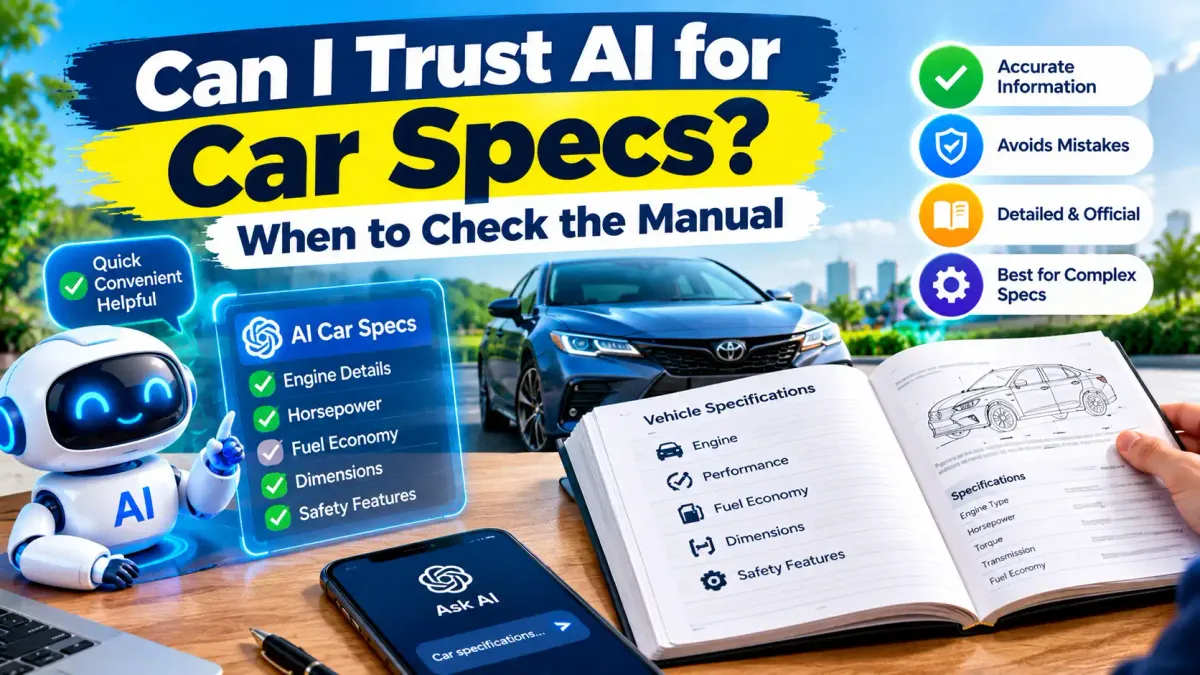
Short answer: you can trust an AI chatbot to explain what a spec means and where to find it, but you should not trust it to give you the number itself for anything safety-related. Wheel torque, brake fluid type, tire pressure, load ratings and oil specifications must come from your owner's manual, your vehicle's labels, the manufacturer's service information or the dealer. A chatbot answers instantly and sounds certain, but it does not know your exact vehicle, and it can state a wrong figure just as confidently as a right one.
So if an AI gave you a lug nut torque figure, do not torque your wheels to it until you have matched it against your own documentation.


As an Amazon Associate we earn from qualifying purchases.
Why a chatbot's number can be wrong even when it sounds right
General-purpose AI chatbots produce text that fits the pattern of what they were trained on. They do not look your car up in a manufacturer database. When you ask for a spec, the answer is built from whatever similar text the model absorbed, which may include forum posts, spec sites, service documents and other chatbots' output.
That matters for car specs in particular, because vehicle figures are narrow. The same model name can cover several generations, engines, wheel packages and markets, each with its own values. A chatbot can blend them, pick the most common one, or produce something plausible that belongs to no vehicle at all. The widely used term for that last case is a "hallucination": a confident answer that is simply not true.
Nothing in the tone of the answer tells you which kind you got. A correct figure and an invented one read the same.
What the AI does not know about your car
Even a well-sourced answer is a guess about your specific vehicle, because the chatbot is missing information that decides the correct figure:
- Your trim and package. Towing, payload, tire size and sometimes wheel torque differ by trim. See our guide to how to tell what trim your car is.
- Your build date. Specs can change partway through a model year, so two cars sold as the same year may differ.
- Your engine code. The same model can carry several engines with different oil, coolant and fastener specs.
- Your market. A figure for a European or Japanese version may not apply to a US car.
- What has been changed since the factory. Aftermarket wheels, lug nuts or studs can carry their own torque figure. Our article on aftermarket wheel torque specs explains whose number applies.
Unless you supply all of that, and the AI actually has reliable data for that exact combination, the number it returns is an average or an assumption.


As an Amazon Associate we earn from qualifying purchases.
Common ways AI spec answers go wrong
These are patterns worth watching for, not a measured error rate.
| Failure | What it looks like | Why it matters |
|---|---|---|
| Wrong generation | A figure for an older or newer body style of the same model | Fasteners, fluids and wheels often change between generations |
| Units swapped or missing | Newton-meters presented as foot-pounds, or no units at all | A torque figure off by the conversion factor is badly wrong |
| Agreeing with the question | You ask "is it X?" and it confirms X | Leading questions pull the answer toward your guess |
| Blended sources | One figure from a forum, another from a spec site, merged | The result may match neither source nor your car |
| Missing procedure | A single torque figure where the maker specifies torque plus angle, a sequence, or a re-torque | The number alone is not the whole spec |
| Invented citation | A manual page or document that does not exist | A source you cannot find is no source |
The unit problem deserves its own warning. If an answer gives torque without units, or you are not sure which system it used, read our guide to converting ft-lb to Nm without getting it wrong before you pick up a wrench.
Can I trust AI for car specs that are not safety-related?
For some tasks, a chatbot is genuinely useful, as long as you treat the output as a lead. A practical way to sort it:
Reasonable uses:
- Explaining what a term means, such as load index, offset, torque-to-yield or a fluid specification standard.
- Telling you where a figure is usually printed, such as the door jamb, the tire placard or a section of the owner's manual.
- Helping you phrase a question for a dealer or a shop.
- Summarizing a manual section you paste in yourself, then checking the summary against the page.
Use only as a starting point, then verify:
- Dimensions, curb weight and cargo volume for comparing vehicles.
- Engine options offered in a given year.
- Fuel economy, which you can confirm against official ratings.
Do not act on without your own documentation:
- Wheel, brake, suspension and steering fastener torque.
- Brake fluid, coolant, transmission fluid and oil specifications.
- Tire pressure, load index and speed rating.
- Towing, payload and weight ratings.
The line is simple: if a wrong number could loosen a wheel, damage a component or overload the vehicle, the source must be one that knows your exact vehicle.


As an Amazon Associate we earn from qualifying purchases.
A torque figure from AI: what to do before you use it
The question behind this page is usually some version of "the AI gave me a torque figure instantly; can I torque my wheels to it?" Here is the check:
- Find the figure in your owner's manual. Most manuals list wheel nut torque in the specifications or tire-changing section. Our guide to where your wheel torque spec actually lives shows where to look.
- Confirm the units. Make sure you are reading ft-lb or Nm consistently between the manual and your wrench.
- Check for extra steps. The manual may specify a tightening pattern and a re-check after a set distance.
- Account for changes. If the wheels or lug nuts are not factory, check the wheel or hardware maker's figure too.
- If sources disagree, stop. Call a dealer service or parts desk with your VIN, or ask a qualified shop. Do not split the difference.
If the AI's number matches your manual, good: you now have a verified figure, and the manual is your source. If it does not match, the manual wins.
Wheels, brakes, steering and suspension are safety systems. If you are not confident doing the job with the correct tools and the correct figure, have a qualified technician do it.
How to use a chatbot more safely for spec questions
If you do use AI to research a spec, a few habits reduce the risk:
- Give it everything. Year, make, model, trim, engine, drivetrain, market and, if relevant, whether the wheels are factory. The more specific the question, the less room for blending.
- Ask where the figure comes from. Then go and find that source yourself. If you cannot, treat the figure as unsourced.
- Do not lead it. Ask "what is the specification and where is it published?" rather than "is it 100?"
- Check against a primary record. For what your VIN actually decodes to, the NHTSA vPIC decoder (read September 28, 2026) presents manufacturer-reported data and says it covers vehicles intended for sale or importation into the United States, from model year 1981 onward. It confirms year, engine and plant details, which helps you ask for the right figures. It does not list maintenance specs.
- Keep the verified number. Once you have confirmed a figure from your own documentation, write it down with its source so you do not have to ask again.
AI-powered tools built into dealer, repair-database or manufacturer systems may work differently from a general chatbot, because they can draw on the maker's data for a specific VIN. Even then, check which vehicle the answer was matched to before you rely on it.


As an Amazon Associate we earn from qualifying purchases.
Frequently asked questions
Can I trust AI for car specs like lug nut torque?
Not on its own. Use the AI answer as a prompt to check your owner's manual or the manufacturer's service information, and use the documented figure. A wrong wheel torque can damage studs or let a wheel loosen.
Why does AI give different specs each time I ask?
Chatbots generate answers rather than retrieving a fixed record, and they may blend figures from different model years, engines or markets. Different wording in your question can produce a different figure.
Is AI accurate for fluid types, like brake fluid or coolant?
Treat any fluid specification from a chatbot as unverified. Your owner's manual, and often a label on the reservoir or cap, give the correct specification for your vehicle.
What is the safest way to use AI for car maintenance?
Use it to understand terms and learn where a specification is printed, then take the actual figure from your own vehicle's documentation or a dealer. For safety systems, rely on a qualified technician if you are unsure.
Should I trust an AI answer that cites a source?
Only after you have found and read that source yourself. Chatbots can cite documents inaccurately or cite ones that do not exist.