Are Car Spec Websites Accurate? Where the Data Comes From
Are car spec websites accurate? See where aggregator data comes from, which figures hold up, and how to check a number before you rely on it.

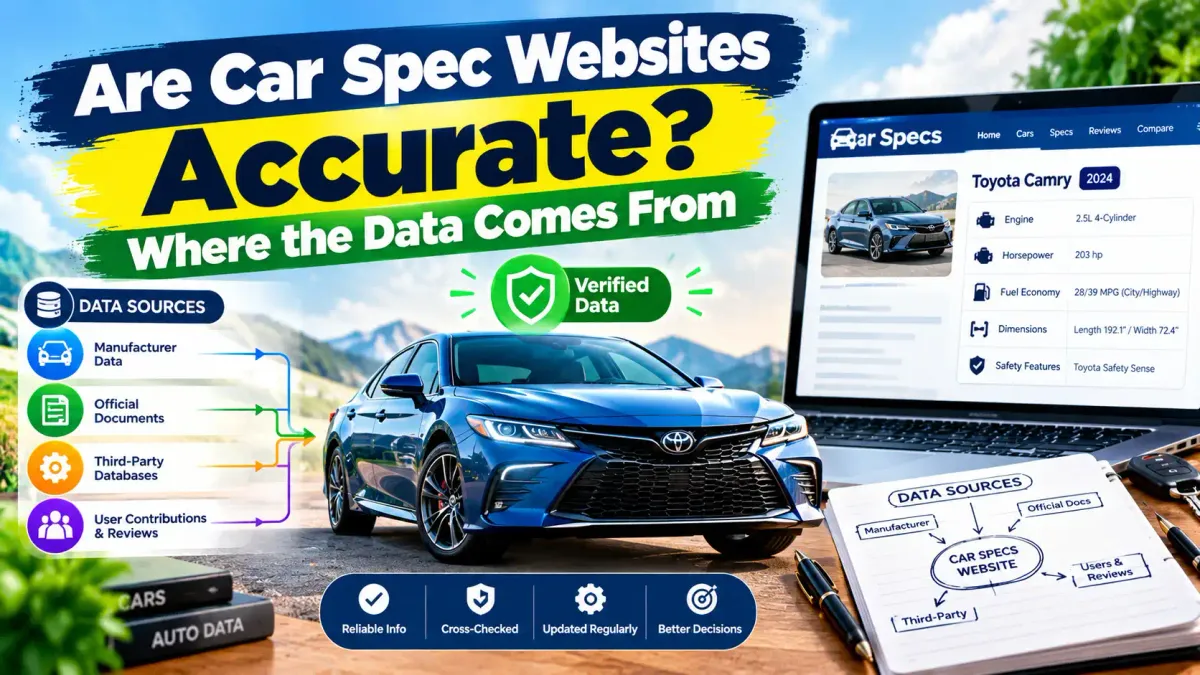
Short answer: car spec websites are usually close on broad figures like dimensions, engine size and advertised horsepower, and least reliable on the numbers that matter most for maintenance and safety, such as torque values, fluid specifications, tire pressures and load ratings. Most aggregators do not measure anything. They collect figures from manufacturer releases, government datasets, licensed databases and, often, from each other. So treat a spec site as a starting point, then confirm any number you will act on against your own vehicle's labels, owner's manual or the manufacturer.
This page explains where that data actually comes from, where errors creep in, and a quick way to judge whether a figure on screen deserves your trust.


As an Amazon Associate we earn from qualifying purchases.
Why a site can list every spec for every car
A site with tens of thousands of vehicle pages did not have people check each one. It could not. The scale is the clue: large spec sites are built by importing data in bulk and publishing it through templates, one page per model, trim and year.
That is not a criticism by itself. Bulk data can be good data. The question is what went into the import, and whether anyone checked that each figure landed on the right vehicle. Aggregated data usually comes from some mix of the five sources below, and each carries its own kind of error.
The five places aggregator data comes from
1. Manufacturer press releases and brochures
Automakers publish specifications for new models in press kits, brochures and their own websites. This is the closest thing to an original source for most advertised figures, such as horsepower, torque, dimensions and cargo volume. Even these need care: our SUV cargo space comparison chart shows makers printing two different cargo figures for the same space.
The catch is timing and scope. Press figures often appear before production starts and describe the model in general terms, sometimes for the best-equipped version. When a figure changes later in the model year, the brochure may be updated while copies of the old number live on elsewhere. We cover that problem in our guide to model year vs build date.
2. Government datasets
In the US, some vehicle data is reported to federal agencies and published. The National Highway Traffic Safety Administration runs vPIC, the Product Information Catalog and Vehicle Listing. NHTSA's vPIC home page (read September 28, 2026) describes it as a consolidated platform presenting manufacturer-reported data collected under 49 CFR Parts 551 through 595. The same page says its data "represents vehicles intended for sale or importation into the United States" and that the system is intended for model years 1981 and forward.
That makes vPIC a strong source for what a VIN decodes to: make, model, year, body, engine and plant information the manufacturer reported. It is not a maintenance manual. It will not give you a lug nut torque or a coolant specification.
Fuel economy is similar. The EPA's explanation of how vehicles are tested on FuelEconomy.gov (read September 28, 2026) says that manufacturers test their own vehicles, usually pre-production prototypes, and report the results to EPA, which reviews them and confirms about 15% to 20% through its own tests at an EPA laboratory. A spec site that shows EPA ratings is usually reusing this public data, which is fine, as long as it matches the right engine and drivetrain.
3. Licensed commercial databases
Many larger sites and apps license vehicle data from companies that compile it for dealers, insurers and parts retailers. These databases can be detailed and well maintained, but the site displaying the data rarely tells you which provider it uses, which fields came from where, or when the data was last refreshed.
4. Other spec sites
This is the one nobody advertises. Smaller sites often fill their tables by copying from larger ones, by hand or by automated scraping. When that happens, an error on one site gets reproduced across several. Three sites agreeing can mean three independent confirmations, or one mistake copied twice. You cannot tell which from the outside.
5. Users and forums
Some sites accept reader submissions or pull figures from owner forums. Owners can be right about their own car and wrong about everyone else's. A torque figure that worked on one person's truck may belong to a different axle, wheel or model year.


As an Amazon Associate we earn from qualifying purchases.
Where the errors come from
Most wrong numbers on spec sites are not invented. They are real numbers attached to the wrong vehicle. The common patterns:
| Error type | What happens | Figures most affected |
|---|---|---|
| Wrong market | A European or Canadian figure shown for a US car | Power, fuel economy, equipment |
| Wrong trim or engine | A figure for one version applied to the whole model | Towing, payload, tire size, gear ratio |
| Wrong year | Last year's figure carried forward after a change | Fluids, torque values, ratings |
| Unit mix-up | kW, PS and hp, or Nm and ft-lb, treated as the same | Power, torque |
| Rating standard | Different test methods compared as if equal | Horsepower, fuel economy |
| Template default | A blank field filled with a placeholder or nearby value | Anything the source did not supply |
If you have ever found two sites disagreeing about the same car, one of these is usually the reason. Our article on why two websites give your car two different numbers walks through the patterns of disagreement in more detail.
Are car spec websites accurate for the figures you actually need?
It depends heavily on which figure. A rough guide to how much weight each kind of number can bear when it comes from an aggregator:
Usually fine for comparison: overall length, width, height, wheelbase, engine displacement, number of cylinders, body styles offered, EPA fuel economy for the matching powertrain.
Check before relying on it: horsepower and torque output (rating standard and market), curb weight (varies by trim and options), tire size (varies by trim and package), fluid capacities.
Never take from an aggregator alone: wheel and fastener torque values, brake fluid and coolant types, oil specifications, tire pressure and load ratings, towing and payload capacity. These are the figures where a wrong number means a damaged part or an unsafe vehicle, and they are also the ones most likely to vary by trim, engine and build date.
That last group is the reason this site teaches the lookup instead of printing tables. For the wheel side of it, our guide to where your wheel torque spec actually lives shows where the authoritative figure is printed.
A five-question check for any spec page
Before you use a number from a spec site, ask:
- Does it name its source? A page that says where a figure came from, such as the manufacturer, EPA or NHTSA, can be checked. A page that says nothing cannot.
- Is it specific to your vehicle? Look for the exact model year, trim, engine and drivetrain. A figure listed for "the model" is a guess about yours.
- Does it say which market? If it does not, assume nothing about whether it applies to a US car.
- Are the units stated? A torque figure without units, or a power figure that does not say hp, kW or PS, is not usable.
- Does it agree with your own documents? Your door jamb label, owner's manual and window sticker outrank any website.
If a figure fails any of the first four, it is a lead, not an answer.


As an Amazon Associate we earn from qualifying purchases.
What to use instead for the numbers that matter
The sources that actually describe your car, in rough order of authority:
- The labels on the vehicle. The door jamb certification label and the tire and loading placard carry figures for your specific vehicle.
- The owner's manual for your model year and market. Many manufacturers post these free online.
- The original window sticker. It lists the engine, transmission and factory options your car was built with.
- A VIN decode from NHTSA vPIC. Useful for confirming year, engine and plant, as described above.
- The dealer parts or service desk. They can look up figures against your VIN in the manufacturer's own system.
Our overview of where to find vehicle specs for your car lists each of these sources and what it can and cannot tell you.
How to tell a careful spec site from a careless one
Some aggregators are more careful than others. Signs of care:
- Figures are tied to a specific trim, engine and year, not just the model.
- Sources are named, even generally.
- The site shows when data was updated.
- Figures that vary by configuration are shown as varying, not as one number.
- The site tells you to confirm safety-related values against the manufacturer.
Signs of carelessness: identical text across many models, blank fields quietly filled, figures with no units, and pages for trims or engines that were never sold in your market.
None of these signs makes a figure correct. They only tell you how much checking you should expect to do.


As an Amazon Associate we earn from qualifying purchases.
Frequently asked questions
Are car spec websites accurate enough to buy a car?
For comparing size, engine options and fuel economy, they are usually a reasonable start. Before buying, confirm the exact trim and equipment on the window sticker or with the seller's VIN, since spec sites often blur differences between trims.
Where do car spec websites get their information?
Usually from a mix of manufacturer press material, government data such as NHTSA vPIC and EPA fuel economy ratings, licensed commercial databases, other spec sites and user submissions. Most do not say which source each figure came from.
Why do spec sites show different numbers for the same car?
Most often because the figures belong to different markets, trims, engines or model years, or use different units or rating standards. The numbers can each be right for some vehicle and still be wrong for yours. Towing figures are a good example: our Toyota Tundra towing capacity chart shows how one truck's rating ranges from 8,300 to 12,000 lb by configuration.
Can I use a torque spec from a spec website?
Treat it as unverified. Take wheel and fastener torque values from your owner's manual, service information or the dealer, because a wrong figure can damage parts or loosen a wheel.
Is the NHTSA VIN decoder more reliable than a spec site?
For what a VIN decodes to, generally yes, because NHTSA says vPIC presents manufacturer-reported data for vehicles intended for the US market. It does not cover maintenance figures like torque or fluid types.