SUV Cargo Space Comparison Chart 2026: Official Figures
Manufacturer-listed cargo space behind each row for 26 two-row, three-row and full-size SUV configurations, and why the figures differ.

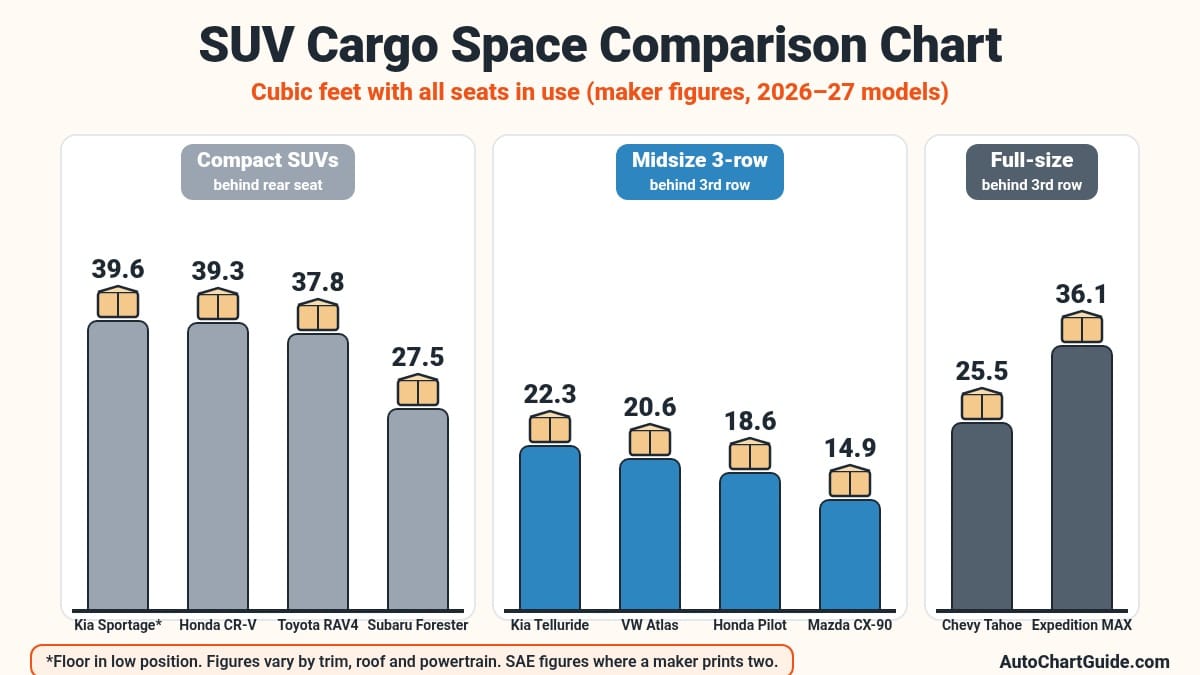
Short answer: most 2026 compact SUVs list between about 27 and 40 cubic feet of cargo space behind the rear seat and roughly 66 to 77 cubic feet with it folded. Midsize three-row SUVs list about 15 to 22 cubic feet behind the third row, which is less than a compact SUV's trunk. Full-size SUVs are in a different league: the Chevrolet Tahoe lists 25.5 cubic feet behind its third row and 122.7 cubic feet behind the front seats, and the long Ford Expedition MAX lists 36.1 and 123.1. The charts below compare 26 configurations using only the figures their manufacturers print.
Every number in this article comes from the manufacturer's own specification sheet, press kit, brochure, trim comparison or model page, linked in the Sources list at the end. We read them on October 30–31, 2026. We did not load or measure any vehicle ourselves. Where a maker prints two figures for the same space, uses its own measuring method, or publishes only a Canadian document, the table says so instead of picking the most flattering number.
SUV Cargo Space Comparison Chart: Two-Row SUVs (2026)
| SUV | Model year | Class | Behind 2nd row (cu ft) | Behind 1st row (cu ft) | Configuration notes | Source |
|---|---|---|---|---|---|---|
| Toyota 4Runner (5-seat) | 2026 | Midsize off-road | 48.4 | 80.2 | Toyota Canada 5-seat figures; Toyota U.S. brochure says "up to 90.2" with all seats folded | [16], [17] |
| Kia Sportage | 2026 | Compact | 39.6 | 74.1 | Dual-level floor low; 36.6 / 69.3 with floor high | [6] |
| Honda CR-V | 2026 | Compact | 39.3 | 76.5 | Gas LX, EX, EX-L; hybrids 36.3 / 71.8 (Sport Touring 34.7 behind 2nd row) | [3] |
| Hyundai Tucson | 2026 | Compact | 38.7 | 74.8 | SAE figures, gas; Hyundai "max" method 41.2 / 80.3; Plug-in Hybrid 31.9 / 66.3 | [5] |
| Toyota RAV4 | 2026 | Compact | 37.8 | 70.4 | Solid roof or moonroof; 36.6 behind 2nd row with panoramic roof (Toyota Canada) | [4] |
| Jeep Grand Cherokee | 2026 | Midsize | 37.7 | 70.8 | Two-row model | [13] |
| Ford Bronco 4-door | 2026 | Off-road | 35.6 | 77.6 | Hard top; soft top 38.3 / 83.0; Raptor 72.9 behind 1st row | [15] |
| Subaru Outback | 2026 | Midsize | 34.6 | 80.5 | All six trims | [12] |
| Mazda CX-5 | 2026 | Compact | 33.7 | 66.5 | All seats upright / 2nd row down | [8] |
| Jeep Wrangler 4-door | 2026 | Off-road | 31.7 | 72.4 | Stellantis fleet sheet (Rubicon-based) | [14] |
| Nissan Rogue | 2026.5 | Compact | 31.6 | 74.1 | S, SV, Dark Armor, Rock Creek; Platinum 36.5 with Divide-N-Hide floor low | [7] |
| Subaru Forester | 2026 | Compact | 27.5 | 69.1 | Premium and above, incl. hybrids; Base 29.6 / 74.4 | [9] |
| Ford Bronco 2-door | 2026 | Off-road | 20.6 | 52.0 | Hard top | [15] |
| Subaru Crosstrek | 2026 | Small | 19.9 | 54.7 | Base, Premium, Sport, Limited; Hybrid 18.6 / 50.6; Wilderness 20.0 / 54.9 | [10] |
Manufacturer figures as printed, sorted by space behind the second row. "Behind 1st row" is the maximum with the rear seat folded. Source numbers refer to the Sources list. Checked October 30–31, 2026.
Read this table in two columns. "Behind 2nd row" is the space you have with every seat in use, which is the figure that matters for a family road trip or a weekly shop. "Behind 1st row" is the maximum, with the rear seat folded, which matters when you move furniture or haul bikes. The ranking changes between the two columns. The Kia Sportage leads the compacts behind the rear seat, but the Honda CR-V lists more space with the seat folded, and the Subaru Outback's 80.5 cubic feet folded beats every compact in the chart.
SUV Cargo Space Comparison Chart: Three-Row SUVs (2026)
| SUV | Model year | Class | Behind 3rd row (cu ft) | Behind 2nd row (cu ft) | Behind 1st row (cu ft) | Configuration notes | Source |
|---|---|---|---|---|---|---|---|
| Ford Expedition MAX | 2026 | Full-size, long | 36.1 | 75.4 | 123.1 | 37.4 with 3rd row full upright | [27] |
| Chevrolet Tahoe | 2026 | Full-size | 25.5 | 72.5 | 122.7 | Chevrolet comparison page | [28] |
| Kia Telluride | 2027 | Midsize | 22.3 | 48.7 | 89.3 | Includes lower storage area; Turbo-Hybrid 21.3 / 47.7 / 88.3 | [18] |
| Ford Expedition | 2026 | Full-size | 21.6 | 60.8 | 108.5 | 22.9 with 3rd row full upright; 69.9 behind 2nd row with seats full forward | [27] |
| Toyota Grand Highlander | 2026 | Midsize | 20.6 | 57.9 | 97.5 | Toyota Canada product information | [19] |
| Volkswagen Atlas | 2026 | Midsize | 20.6 | 55.5 | 96.6 | 2.0T FWD and AWD | [20] |
| Hyundai Palisade | 2026 | Midsize | 19.1 | 46.3 | 86.7 | All nine listed configurations | [21] |
| Honda Pilot | 2026 | Midsize | 18.6 | 48.5 | 87.0 | SAE J1100 "standard" figures (86.5 behind 1st row on one trim); Honda "max" figures up to 22.4 / 60.1 / 113.7 | [22] |
| Subaru Ascent | 2026 | Midsize | 17.8 | 43.5 | 75.6 | Premium; Limited and above 42.1 / 72.8 (brochure: 72.8 maximum with moonroof) | [23], [24] |
| Nissan Pathfinder | 2026 | Midsize | 16.6 | 45.0 | 80.5 | All grades | [25] |
| Mazda CX-90 | 2026 | Midsize | 14.9 | 40.0 | 74.2 | 15.9 / 40.8 / 75.2 in the other seating configuration | [26] |
| Toyota 4Runner (7-seat) | 2026 | Midsize off-road | 12.1 | 44.8 | 84.1 | Toyota Canada 7-seat figures | [16] |
Manufacturer figures as printed, sorted by space behind the third row. Source numbers refer to the Sources list. Checked October 30–31, 2026.
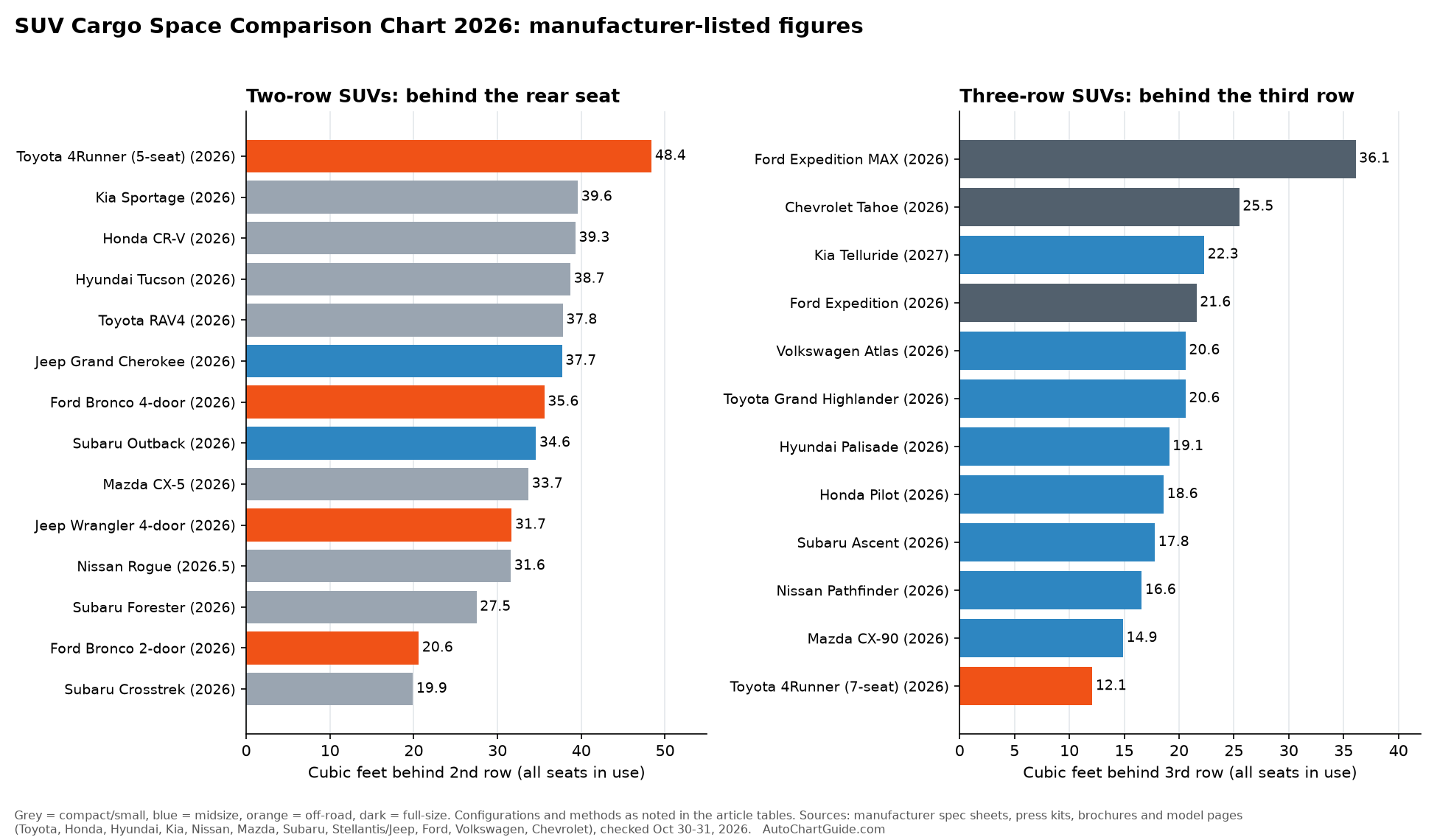
With three rows, there are three numbers to compare. The figure behind the third row is the one buyers most often overlook, and it is where the midsize three-row SUVs are closest to each other: from 14.9 cubic feet for the Mazda CX-90 to 22.3 for the 2027 Kia Telluride among the midsize three-row crossovers (the 7-seat Toyota 4Runner lists 12.1). Fold the third row and the gap widens, from 40.0 cubic feet for the CX-90 to 57.9 for the Toyota Grand Highlander.
How Cargo Volume Is Measured
A cargo figure looks like a measured quantity, like filling the space with water. It is not. The standard behind most of these numbers is SAE J1100, the SAE recommended practice for motor vehicle dimensions. A General Motors technical paper published by SAE, "Interpretation of SAE J1100 Cargo Volume Indices", explains the split. A closed compartment, such as a sedan trunk, is measured by stacking a set of simulated luggage pieces. An open compartment, which includes station wagons, minivans, multi-purpose vehicles and hatchbacks, "is estimated by multiplying the compartments representative length, width and height."
That word "estimated" is the important one. An SUV's cargo figure is a box-shaped estimate built from a few measured dimensions, not a count of how much luggage fits. The same paper says open compartments are "more challenging to quantify" because the space can carry either people or cargo, which is why its stated aim is "more accurate and uniform reporting."
U.S. federal rules use the same family of measurements. The EPA's rule on classes of comparable automobiles, 40 CFR 600.315-08, calculates a station wagon's cargo volume index by multiplying an average cargo width, a cargo height and a cargo length and dividing by 1,728 to get cubic feet. It also says cargo dimensions are taken with the second seat "in the upright position" and head restraints stowed. SUVs, though, fall under the rule's light-truck classes, which are split by gross vehicle weight rating rather than interior volume, so an SUV's EPA class says little about its cargo space.
The practical consequence: a cubic-foot figure is good for comparing two vehicles measured the same way, and poor at telling you whether a particular object will fit. For that, you need the length, width and height of the opening and the floor, which some makers publish and many do not. We come back to that below.
Compact SUVs: The Closest Race
The seven compact SUVs in the chart sit within about 12 cubic feet of each other behind the rear seat, from 27.5 to 39.6, and small details decide the order.
Kia Sportage (2026): 39.6 cu ft. Kia's specifications list two sets of figures for gas models because of the dual-level cargo floor: 39.6 cubic feet behind the second row and 74.1 behind the first with the floor in its low position, and 36.6 and 69.3 with it raised. The two figures describe the same vehicle with the floor panel in different positions, so make sure you compare the low-floor number with rivals' standard numbers.
Honda CR-V (2026): 39.3 cu ft. Honda's specification release lists 39.3 cubic feet behind the second row for the gas LX, EX and EX-L, and gives 76.5 cubic feet as the maximum behind the first row. The hybrid trims drop to 36.3 and 71.8, and the top Sport Touring Hybrid lists 34.7 behind the second row. That is a 4.6 cubic foot spread inside one nameplate, more than the gap between the CR-V and the RAV4. Honda attaches the same kind of footnote it uses for the Pilot, describing its figures as SAE J1100 "plus, where applicable, floor space between seating rows," so part of the CR-V's edge over some rivals may be method rather than space. Our guide to how to tell what trim your car is helps when you are looking at a used one.
Hyundai Tucson (2026): 38.7 cu ft (SAE). Hyundai is unusually open about method. Its U.S. spec table prints two numbers side by side: 41.2 cubic feet with the rear seats up and 80.3 folded, followed by "SAE 38.7" and "SAE 74.8." The larger pair is Hyundai's own maximum measurement; the smaller pair is the SAE figure. We use the SAE pair in the chart so the Tucson is not flattered against makers that print only one number. The Tucson Plug-in Hybrid lists 31.9 and 66.3 (SAE).
Toyota RAV4 (2026): 37.8 cu ft. The redesigned RAV4's product information from Toyota Canada lists 1,070 litres (37.8 cubic feet) behind the second row with the solid roof or moonroof, 1,036 litres (36.6 cubic feet) with the panoramic roof, and 1,994 litres (70.4 cubic feet) behind the front seats. In Toyota's figures the panoramic roof costs 1.2 cubic feet. Toyota does not explain why, but height is one of the three dimensions multiplied in an open-compartment estimate, so anything that lowers the headliner can show up in the result.
Mazda CX-5 (2026): 33.7 cu ft. The new third-generation CX-5 lists 33.7 cubic feet with all seats upright and 66.5 cubic feet with the second row down. Mazda's spec deck labels the first figure "EPA" and the second "SAE," a reminder that even one document can mix sources. It also publishes the cargo-area dimensions most makers leave out, which we use in the worked example further down.
Nissan Rogue (2026.5): 31.6 cu ft. Nissan lists 31.6 cubic feet behind the second row for the S, SV, Dark Armor and Rock Creek, and 36.5 for the Platinum, measured "w/ Divide-N-Hide in low position." Both versions list 74.1 cubic feet with the second row folded. Nissan ties the 4.9 cubic foot difference behind the rear seat to the floor position, not to a bigger body.
Subaru Forester (2026): 27.5 cu ft. Subaru's 2026 trim comparison lists 27.5 cubic feet behind the rear seat and 69.1 folded for every trim from Premium up, including the hybrids, but 29.6 and 74.4 for the Base trim. The Base is the roomiest Forester on paper.
Subaru Crosstrek (2026): 19.9 cu ft. The Crosstrek is a raised hatchback and it shows: 19.9 cubic feet behind the rear seat and 54.7 folded for most trims, 18.6 and 50.6 for the hybrids, and 20.0 and 54.9 for the Wilderness. Subaru's Crosstrek-versus-Forester comparison page quotes "up to 54.9 cubic feet" in one paragraph and "up to 54.7 cubic feet" a few lines later, so even a maker's own page can disagree with itself by a trim.
Midsize Two-Row and Off-Road SUVs
Subaru Outback (2026): 34.6 and 80.5 cu ft. Subaru's 2026 trim comparison lists the Outback at 34.6 cubic feet behind the rear seat and 80.5 with it lowered, the same on all six trims. That folded figure is more than any compact in the chart and close to some three-row SUVs with both rear rows folded.
Jeep Grand Cherokee (2026): 37.7 and 70.8 cu ft. Stellantis's 2026 fleet specification sheet for the two-row Grand Cherokee lists 37.7 cubic feet behind the second-row seats and 70.8 behind the first. That is roughly what the larger compact SUVs in this chart list. If towing matters as much as space, our midsize SUV towing capacity chart lists the Grand Cherokee's 6,200 lb rating.
Ford Bronco (2026): 20.6 to 38.3 cu ft. Ford's 2026 Bronco technical specifications split the figures by body: 20.6 cubic feet behind the second row and 52.0 behind the first for the two-door hard top, 35.6 and 77.6 for the four-door hard top, and 38.3 and 83.0 for the four-door soft top. The Raptor lists 72.9 behind the first row. The same Ford document lists ground clearance by tire size, which our SUV ground clearance comparison chart breaks down.
Jeep Wrangler 4-door (2026): 31.7 and 72.4 cu ft. Stellantis's fleet sheet, which bases its dimensions on the Rubicon, lists 31.7 cubic feet behind the second row and 72.4 with the second row folded on the four-door.
Toyota 4Runner (2026): up to 48.4 cu ft. The 4Runner has the largest behind-the-rear-seat figure of any two-row SUV in this chart, but the number depends on the document. Toyota Canada's product information lists 48.4 cubic feet behind the second row and 80.2 behind the first row for the 5-seat version, and 12.1, 44.8 and 84.1 for the 7-seat version. Toyota's U.S. brochure says "up to a generous 90.2 cu. ft. of cargo space with all the seats folded down." We could not match 90.2 to a configuration in the Canadian table, so treat it as Toyota's U.S. maximum claim and check the figure for the exact version you are considering. Our explainer on why the same car can have different specs by country covers why U.S. and Canadian documents sometimes disagree.
Three-Row SUVs: Where the Space Really Goes
A three-row SUV sounds like the cargo choice, and with the third row folded it usually is. With the third row in use, six of the ten midsize three-row configurations in the chart have less space behind the last row than a Subaru Crosstrek's 19.9 cubic feet, the smallest two-row figure here. That is the single most useful thing a cargo chart can tell a family shopper.
Kia Telluride (2027): 22.3 cu ft. Kia's launch material for the new-generation Telluride gives 22.3 cubic feet behind the third row, 48.7 with the second row upright and 89.3 maximum, with 21.3, 47.7 and 88.3 for the Turbo-Hybrid. Kia's footnote says the figures include the lower storage area under the cargo floor. That is a legitimate space, but it is not part of every rival's figure, so the Telluride's lead over the Atlas and Grand Highlander is partly a matter of what is counted.
Toyota Grand Highlander (2026): 20.6 cu ft. Toyota Canada's product information lists 20.6 cubic feet with all seats up, 57.9 behind the second row and 97.5 behind the front seats. Its behind-second-row figure is the largest of any midsize SUV in the chart.
Volkswagen Atlas (2026): 20.6 cu ft. Volkswagen's technical specifications list 20.6 cubic feet behind the third row, 55.5 behind the second and 96.6 with the rear seats folded, the same for FWD and AWD.
Hyundai Palisade (2026): 19.1 cu ft. Hyundai USA's 2026 Palisade spec table lists 19.1 cubic feet behind the third row, 46.3 behind the second and 86.7 behind the front seats for all nine configurations in the table.
Honda Pilot (2026): 18.6 cu ft (SAE). Honda's spec release prints each Pilot figure as "Standard / Max." The standard figures are 18.6 cubic feet behind the third row, 48.5 behind the second and 87.0 behind the first (86.5 on one trim). The max figures run up to 22.4, 60.1 and 113.7. Honda's footnote explains the method: SAE J1100 "plus, where applicable, floor space between seating rows and seats in their forward-most and upright position." In other words, the max figure adds the floor space between the rows. The 26.7 cubic foot gap behind the first row is the largest method difference in this article, and it is why we use the standard figures in the chart.
Subaru Ascent (2026): 17.8 cu ft. Subaru's 2026 Ascent brochure lists 17.8 cubic feet behind the third row and 75.6 with the rear seatbacks folded, or 72.8 with the moonroof. The trim comparison lists 43.5 cubic feet behind the second row for the Premium and 42.1 for the Limited, Limited Bronze Edition, Touring and Onyx Edition Touring, the same trims that list 75.6 and 72.8 cubic feet maximum.
Nissan Pathfinder (2026): 16.6 cu ft. Nissan's press kit lists 16.6 cubic feet behind the third row, 45.0 behind the second and 80.5 behind the first. It also publishes the cargo dimensions: 79.8 inches from the first row to the back door, 48.8 inches between the wheelhouses at the floor, and 33.3 inches of maximum height.
Mazda CX-90 (2026): 14.9 cu ft. Mazda's spec deck lists 14.9 cubic feet behind the third row, 40.0 with the third row folded and 74.2 with the second and third rows folded in one seating configuration, and 15.9, 40.8 and 75.2 in the other. Its third-row figure is the smallest among the midsize three-row crossovers here.
Full-Size SUVs: Tahoe vs. Expedition
The full-size SUVs are the only ones in the chart that offer real cargo space with all three rows in use. Chevrolet's comparison page lists the 2026 Tahoe at 25.5 cubic feet behind the third row, 72.5 behind the second and 122.7 behind the first. Ford's 2026 Expedition specifications list 21.6, 60.8 and 108.5 for the standard Expedition, and 36.1, 75.4 and 123.1 for the long Expedition MAX.
| Cargo area | Chevrolet Tahoe (2026) | Ford Expedition (2026) | Ford Expedition MAX (2026) |
|---|---|---|---|
| Behind 3rd row | 25.5 | 21.6 (22.9 seats full upright) | 36.1 (37.4 seats full upright) |
| Behind 2nd row | 72.5 | 60.8 (69.9 seats full forward) | 75.4 (84.5 seats full forward) |
| Behind 1st row | 122.7 | 108.5 | 123.1 |
Cubic feet. Sources: Chevrolet Tahoe vs. Ford Expedition comparison page; Ford 2026 Expedition technical specifications (cargo area volume table).
The comparison also shows how much a rival's description of a competitor can differ from the competitor's own sheet. Chevrolet's page lists the Expedition at 22.9 cubic feet behind the third row, 69.6 behind the second and 108.5 behind the first. Ford's own table gives 22.9 only for the third row "seats full upright," with 21.6 as its main figure, and gives 60.8 behind the second row, or 69.9 with the second-row seats "full forward." We could not find 69.6 in Ford's sheet. None of this means anyone is lying. It means two sources measured or chose different seat positions, which is the most common reason cargo numbers disagree.
Why Cargo Numbers Disagree Between Sources
Across 26 configurations, we found the same handful of causes again and again. If you are comparing figures from different websites, check these first. Our wider guide to why car specs differ between websites covers the general pattern.
- Measuring method. Honda and Hyundai both print an SAE figure and a larger "max" figure. Honda's larger figure adds floor space between the seat rows. Comparing one maker's max figure against another's SAE figure can create a gap of several cubic feet that does not exist.
- What is counted. Kia's Telluride figures include the lower storage area. The Sportage and the Rogue Platinum list figures with a movable floor in its low position. A sealed under-floor bin may not be in another maker's number.
- Seat position. Sliding second rows and reclining third rows change the space behind them. Ford prints separate figures for third-row seats "full upright" and second-row seats "full forward"; the EPA rule measures with the second seat upright.
- Roof. Moonroofs and panoramic roofs lower the effective height. The RAV4 loses 1.2 cubic feet behind the second row with the panoramic roof; the Ascent loses 2.8 cubic feet of maximum space with the moonroof.
- Powertrain. Hybrid and plug-in versions often list less space than the gas version. The CR-V hybrid gives up 3.0 cubic feet behind the rear seat, the Crosstrek Hybrid 1.3, and the Tucson Plug-in Hybrid 6.8.
- Trim and body. The Bronco ranges from 20.6 to 38.3 cubic feet behind the rear seat depending on doors and roof. A single "Bronco cargo space" number is meaningless without the body style.
- Market and model year. The 4Runner's U.S. and Canadian documents give different maximums. Model-year changes matter too: a redesign such as the 2026 RAV4 or the third-generation CX-5 changes every figure, so a chart built from last year's brochure can be wrong for this year's vehicle.
Cargo Space Lost to Options and Powertrains
Subtracting one printed figure from another for the same model shows how much each choice costs. This is arithmetic on the manufacturers' numbers, not a measurement of our own.
| Model | Comparison | Behind rear seat (cu ft) | Maximum (cu ft) | Type of difference |
|---|---|---|---|---|
| Hyundai Tucson | Plug-in Hybrid vs. gas (SAE) | 31.9 vs. 38.7 (−6.8) | 66.3 vs. 74.8 (−8.5) | Powertrain |
| Honda CR-V | Hybrid vs. gas | 36.3 vs. 39.3 (−3.0) | 71.8 vs. 76.5 (−4.7) | Powertrain |
| Subaru Crosstrek | Hybrid vs. gas | 18.6 vs. 19.9 (−1.3) | 50.6 vs. 54.7 (−4.1) | Powertrain |
| Kia Telluride (2027) | Turbo-Hybrid vs. gas, behind 3rd row | 21.3 vs. 22.3 (−1.0) | 88.3 vs. 89.3 (−1.0) | Powertrain |
| Toyota RAV4 | Panoramic roof vs. solid roof or moonroof | 36.6 vs. 37.8 (−1.2) | Not split by Toyota | Roof |
| Subaru Ascent | With vs. without moonroof | Not split in brochure | 72.8 vs. 75.6 (−2.8) | Roof |
| Subaru Forester | Premium and above vs. Base | 27.5 vs. 29.6 (−2.1) | 69.1 vs. 74.4 (−5.3) | Trim |
| Kia Sportage | Floor high vs. floor low | 36.6 vs. 39.6 (−3.0) | 69.3 vs. 74.1 (−4.8) | Movable floor |
| Nissan Rogue | S–Rock Creek vs. Platinum (floor low) | 31.6 vs. 36.5 (−4.9) | 74.1 vs. 74.1 (0) | Movable floor |
| Hyundai Tucson | SAE vs. Hyundai "max" method (gas) | 38.7 vs. 41.2 (−2.5) | 74.8 vs. 80.3 (−5.5) | Measuring method |
| Honda Pilot | SAE "standard" vs. Honda "max", behind 1st row | — | 87.0 vs. up to 113.7 (−26.7) | Measuring method |
Arithmetic on the manufacturers' printed figures. "Behind rear seat" means behind the last row of seats in use.
The pattern is consistent. Hybrid and plug-in powertrains cost the most, roof glass costs a little, and movable floors and footwell-counting methods can make a figure look several cubic feet better without changing the body at all.
Cargo Volume Is Not Cargo Capacity
A big cubic-foot number tells you about space, not about weight. Every vehicle also has a maximum load in pounds, covering passengers and cargo together, and that limit is printed on the Tire and Loading Information placard in the driver's door jamb. Filling all 122.7 cubic feet of a Tahoe with dense items such as tiles, books or water would be a weight question long before it became a space question. Our guide to the tire and loading information placard shows where that limit is and how to read it.
Two more limits apply. Kia's Telluride material reminds owners that cargo should be "evenly distributed and properly secured and never piled higher than the seatback," and Nissan says cargo and load capacity are "limited by weight and distribution." Loose items piled above the seatback can move forward in a hard stop. Use the cargo cover, tie-down points and any cargo net your vehicle has, and follow your owner's manual.
How to Check Whether Your Stuff Will Fit
Cubic feet are a poor guide to whether one specific item fits, because an SUV cargo area is not a box. The wheel wells, the slope of the rear window and the liftgate opening usually decide it. Here is a practical way to check, using the dimensions some makers publish.
- Measure the item. Write down its length, width and height, and note whether it can be tilted or laid on its side.
- Find the opening size. Mazda's 2026 CX-5 spec deck lists a rear opening 42.8 inches wide and 30.7 inches high. An item that cannot pass through the opening will not fit, however many cubic feet are behind it.
- Find the narrowest floor width. The CX-5's width between the rear wheel housings is 41.3 inches, against 57.5 inches at the widest part of the floor. Nissan lists 48.8 inches between the Pathfinder's wheelhouses at the floor. A flat item wider than the wheelhouse figure has to ride above the wheel wells or not at all.
- Find the length. The CX-5 lists 39.1 inches from the back of the second row to the trunk end, and 75.0 inches at the floor behind the first row with the rear seat folded. The Pathfinder lists 79.8 inches from the first row to the back door. Remember that front seats may need to slide forward to reach the longer figure.
- Check the height. The CX-5 lists 33.7 inches from floor to roof and the Pathfinder 33.3 inches maximum. A tall item can block the rear view, so keep loads below the seatback where possible.
Worked example: a flat-packed box 40 inches wide, 60 inches long and 10 inches high. On paper it passes through the CX-5's 42.8-inch opening, fits between its 41.3-inch wheel housings, and lies flat on the 75.0-inch folded floor. A box 44 inches wide could not go in flat through the 42.8-inch opening and would be too wide to lie between the 41.3-inch wheel housings, even though the CX-5 lists 66.5 cubic feet with the seat folded. This is why a dealer test with your real item is worth more than any chart.
Cubic Feet and Litres
U.S. makers publish cubic feet. Canadian and European documents usually lead with litres. One cubic foot is about 28.3 litres, so Toyota Canada's 1,070 litres for the RAV4 appears next to its 37.8 cubic feet. When a maker prints both, use its pair. When you see only one, convert for a rough comparison but expect small rounding differences. Also check whether a European figure uses the same measuring method, since a figure from another market may not have been measured the same way as a U.S. one.
Which SUV Has the Most Cargo Space?
It depends which seats you need. Among the two-row SUVs in this chart, the 5-seat Toyota 4Runner lists the most space behind the rear seat (48.4 cubic feet, Toyota Canada). With the rear seat folded, the Ford Bronco 4-door soft top leads (83.0), followed by the Subaru Outback (80.5) and the 4Runner (80.2). Among compacts, the Kia Sportage leads behind the rear seat with its floor lowered (39.6) and the Honda CR-V gas models lead with the seat folded (76.5). With three rows in use, the Ford Expedition MAX leads at 36.1 cubic feet, and with everything folded, the Expedition MAX (123.1) and Chevrolet Tahoe (122.7) are nearly tied.
Before you rely on any of these, confirm the exact trim, roof and powertrain. As this chart shows, those three choices can move a figure by more than the gap between two brands.
Frequently Asked Questions
Which SUV has the most cargo space in 2026?
With every seat in use, the Ford Expedition MAX, at 36.1 cubic feet behind its third row. With all rear seats folded, the Expedition MAX (123.1 cubic feet) and Chevrolet Tahoe (122.7) are nearly tied. Among two-row SUVs, the 5-seat Toyota 4Runner lists the most behind the rear seat, 48.4 cubic feet in Toyota Canada's figures.
Which compact SUV has the most cargo space?
Behind the rear seat, the Kia Sportage at 39.6 cubic feet with its floor lowered, then the Honda CR-V gas models at 39.3 and the Hyundai Tucson at 38.7 (SAE). With the seat folded, the CR-V gas models lead at 76.5 cubic feet.
How much cargo space is behind the third row of a midsize SUV?
In this chart, from 14.9 cubic feet for the Mazda CX-90 to 22.3 for the 2027 Kia Telluride, with most between about 16 and 21. The 7-seat Toyota 4Runner lists 12.1. Full-size SUVs list more: 25.5 for the Tahoe and 36.1 for the Expedition MAX.
Is the RAV4 or CR-V bigger inside for cargo?
On paper the CR-V. Honda lists 39.3 cubic feet behind the rear seat and 76.5 folded for the gas CR-V, against 37.8 and 70.4 for the 2026 RAV4 in Toyota Canada's figures. The CR-V hybrid lists 36.3 and 71.8, slightly less than the RAV4 behind the rear seat.
Why do two websites list different cargo space for the same SUV?
Usually because of trim, roof, powertrain, seat position or measuring method. Honda and Hyundai each print an SAE figure and a larger maximum figure, and Kia counts an under-floor storage area. Check which version and method a figure describes.
What does SAE cargo volume mean?
It is cargo volume estimated under SAE J1100, the SAE motor vehicle dimensions practice. For open cargo areas such as SUVs, the volume is estimated by multiplying representative length, width and height, not by filling the space.
Does a sunroof reduce cargo space?
It can. Toyota lists 37.8 cubic feet behind the RAV4's second row with the solid roof or moonroof and 36.6 with the panoramic roof. Subaru lists the Ascent's maximum as 75.6 cubic feet, or 72.8 with the moonroof.
Do hybrid SUVs have less cargo space?
Often, in the figures in this chart. The CR-V hybrid lists 3.0 cubic feet less behind the rear seat than the gas CR-V, the Crosstrek Hybrid 1.3 less, and the Tucson Plug-in Hybrid 6.8 less (SAE).
How do I know if something will fit in my SUV?
Compare the item with the cargo opening width and height, the width between the wheel wells and the floor length, not just the cubic feet. Mazda and Nissan publish these dimensions; for other models, measure the vehicle or test-fit at a dealer.
Sources
All sources read October 30–31, 2026. Manufacturer figures can change during a model year; check the current document for the vehicle you are buying.
- eCFR: 40 CFR 600.315-08, Classes of comparable automobiles
- SAE Technical Paper 2011-01-0779: Interpretation of SAE J1100 Cargo Volume Indices
- Honda: 2026 CR-V specifications & features
- Toyota Canada: 2026 RAV4 product information (PDF)
- Hyundai USA: 2026 Tucson features & specs
- Kia America Media: 2026 Sportage specifications
- Nissan USA Newsroom: 2026.5 Rogue press kit
- Mazda USA: 2026 CX-5 spec deck (PDF)
- Subaru: 2026 Forester trim comparison (PDF)
- Subaru: 2026 Crosstrek trim comparison (PDF)
- Subaru: Crosstrek vs. Forester comparison
- Subaru: 2026 Outback trim comparison (PDF)
- Stellantis Fleet: 2026 Jeep Grand Cherokee specifications (PDF)
- Stellantis Fleet: 2026 Jeep Wrangler specifications (PDF)
- Ford: 2026 Bronco technical specifications (PDF)
- Toyota Canada: 2026 4Runner product information (PDF)
- Toyota: 2026 4Runner brochure (PDF)
- Kia America Media: 2027 Telluride launch release
- Toyota Canada: 2026 Grand Highlander product information (PDF)
- Volkswagen: 2026 Atlas technical specifications (PDF)
- Hyundai USA: 2026 Palisade specs
- Honda: 2026 Pilot specifications & features
- Subaru: 2026 Ascent brochure (PDF)
- Subaru: 2026 Ascent trim comparison (PDF)
- Nissan USA Newsroom: 2026 Pathfinder press kit
- Mazda USA: 2026 CX-90 spec deck (PDF)
- Ford: 2026 Expedition technical specifications (PDF)
- Chevrolet: 2026 Tahoe vs. Ford Expedition comparison