Model Year vs Build Date: Why Your Car Won't Match the Chart
Model year is a designation. Build date is a fact. Here is where each is recorded on your vehicle and why parts catalogues care about the second one.

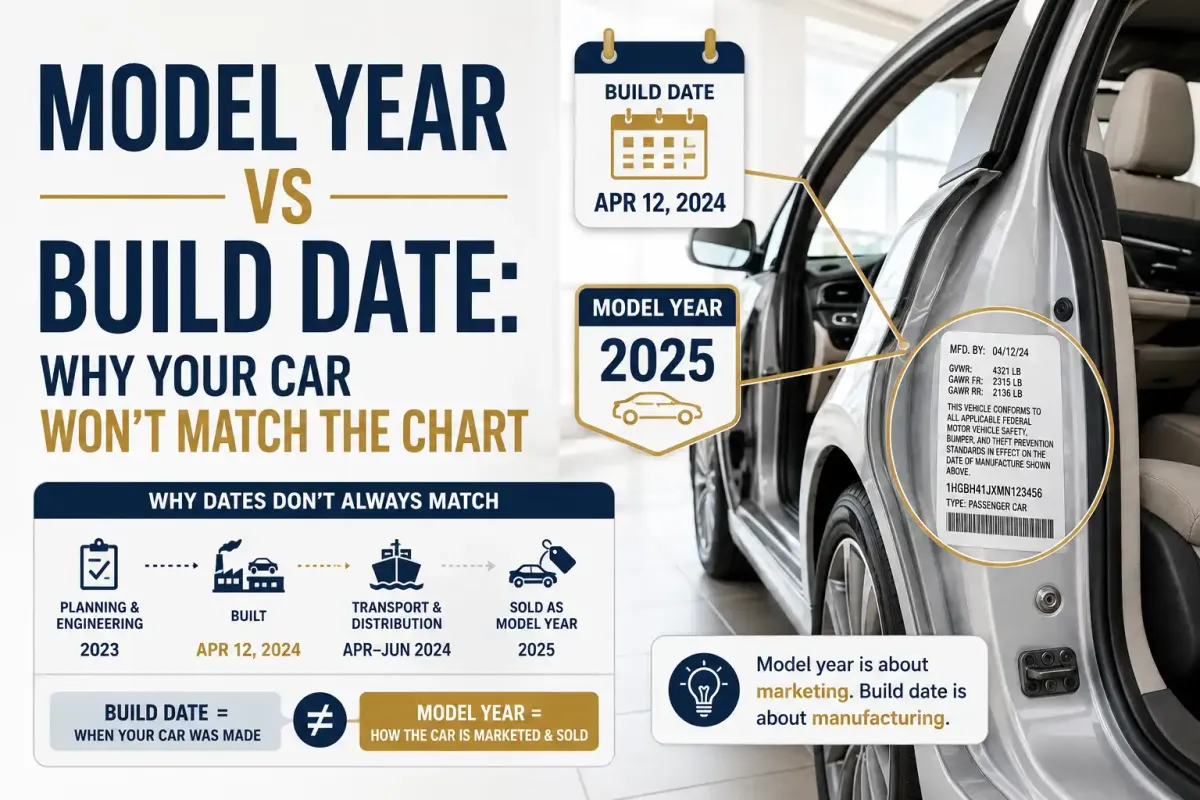
Short answer: model year is a designation the manufacturer assigns, and build date is a record of when the vehicle was physically made. They are frequently different, and the gap between them is one of the most common reasons a vehicle does not match a specification chart. When a parts catalogue splits its listings by build date rather than model year, this is why.
Written 2026-08-07. Model year conventions are stable, but how any particular manufacturer applies them can change; treat the principles here as durable and any specific example as worth checking.
Where each of the two dates is recorded on your vehicle
Both are on the car, in different places, and neither is hard to find.
Model year is encoded at position 10 of the VIN. The codes are specified in the regulation itself at 49 CFR Part 565.15, which is what makes this reliable across manufacturers rather than a per-brand convention. See what each VIN character encodes.
Build date is on the certification label in the driver's door jamb, normally as a month and year. That label exists under 49 CFR Part 567, and the date field is the manufacturer's record of when the vehicle was produced. See reading the door jamb label line by line.
Photograph both while you are at the vehicle. They are the two identifiers a parts department is most likely to ask for after the VIN.
Why model years start before the calendar year they name
Manufacturers begin building a model year before the calendar year it is named after. A vehicle designated for a given model year was very commonly built in the preceding calendar year.
That is normal, it is not a sign of anything wrong, and it is not a used-car warning. It simply means the two dates on your vehicle will often not match, and neither of them is an error.
What it does mean practically is that "my car is a 2019" is a less precise statement than it sounds. It identifies a designation, and the vehicle inside that designation could have been built across a span of many months.
Mid-year changes and why a chart cannot see them
Here is where the distinction stops being trivia.
Manufacturers change specifications during a production run. A supplier changes, a component is revised, a tolerance moves. When that happens the vehicles built before and after the change are genuinely different, and both carry the same model year.
A chart organized by model year cannot represent that. It has one row for your year, so it shows one answer, and roughly half of the vehicles it claims to describe may be on the other side of a change it does not know about.
This is one of the structural reasons published specification charts disagree with each other, and it is a good example of why this site does not publish them. The full set of reasons: why two websites give your car two different numbers.
How parts catalogues split by build date
Parts catalogues handle this properly, and the way they do it is a useful signal.
When a listing says something like "to build date" or "from build date," or splits one model year into two entries with a date boundary, that catalogue is telling you a running change happened. It is not being awkward. It is being more accurate than the model year alone permits.
The practical consequence: when you see a build date split in a catalogue, your model year does not resolve the question and you have to go and read the certification label. Guessing at that point has roughly even odds and produces a part that may physically fit while being the wrong revision.
What to give a parts desk so they can find the right part
Three things, in this order:
- The VIN. It is the most precise identifier and most systems key from it directly.
- The build date from the certification label, because some catalogues need it separately even when the VIN is available.
- The specific option or configuration code where the part depends on one, for example an axle or transmission code. On General Motors vehicles those are on the RPO sticker: reading GM RPO codes.
Photographs of the labels are better than transcriptions. Transcription errors in VINs and codes are extremely common and are exactly what the VIN check digit exists to catch.
When neither date resolves it: the next step
Occasionally you will have both dates, the catalogue still lists two options, and neither entry mentions a date split. That usually means the split is by something else, most often engine, axle, transmission or market.
At that point the answer is on the vehicle rather than in the catalogue. Identify the relevant component directly, or take the VIN to a dealer parts department, whose systems can resolve to the vehicle as built rather than to the model.
If the question is a specification rather than a part number, the tier that holds it is service information: owner's manual vs service manual vs repair database.
Frequently asked questions
Why is my car's build date a year before its model year?
Because manufacturers start building a model year before the calendar year it is named for. This is normal and is not a defect or a sign of anything wrong with the vehicle.
Which date should I give a parts department?
Give the VIN first, and the build date from the door jamb certification label as well. Some catalogues split listings by build date even when the VIN is available.
Where do I find my build date?
On the certification label in the driver's door jamb, usually shown as a month and year.
Why do parts catalogues split one model year in two?
Because a running change happened during production. Vehicles built before and after the change take different parts, and both carry the same model year.
Does the VIN contain the build date?
No. The VIN carries the model year at position 10, which is a designation rather than a production date. The build date is on the certification label.