Toyota Tundra Towing Capacity Chart 2026: Complete Guide
2026 Toyota Tundra towing capacity for every trim, cab, bed and drive from Toyota.com: 8,300 to 12,000 lb, plus payload, GCWR and how to find your exact rating.

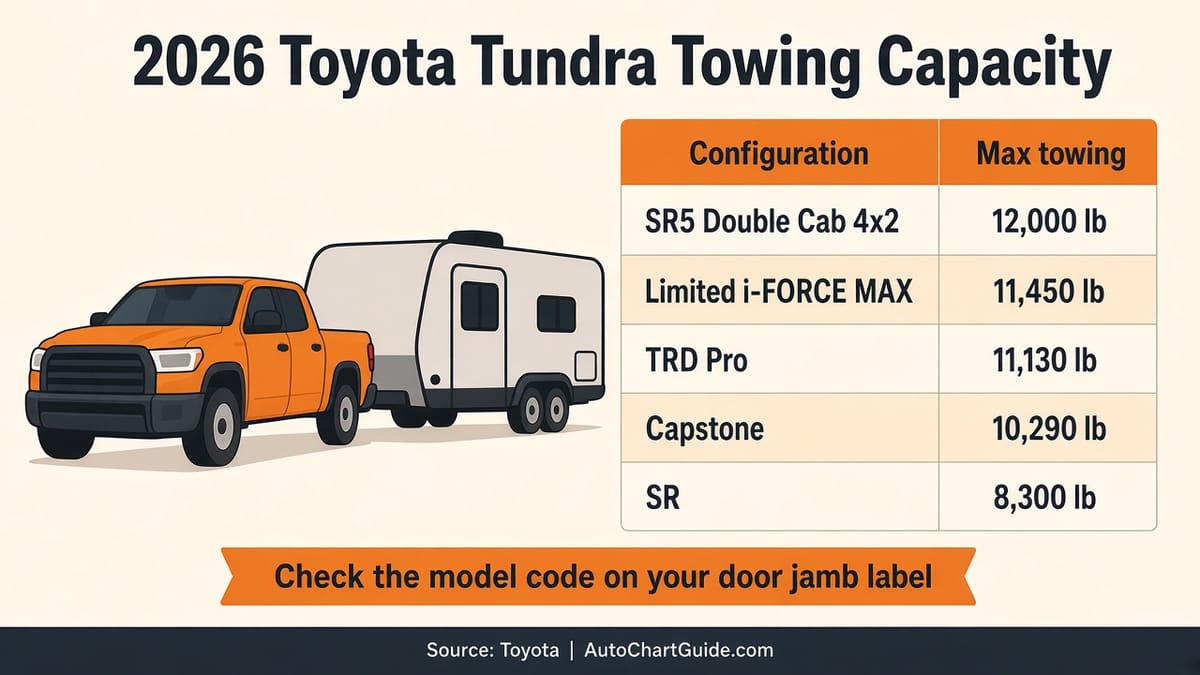
The Toyota Tundra towing capacity chart for 2026 runs from 8,300 lb to 12,000 lb. The 12,000 lb maximum Toyota advertises applies to one build only: the SR5 Double Cab 4x2 with the 6.5 ft bed and the standard i-FORCE twin-turbo V6. The i-FORCE MAX hybrid tops out at 11,450 lb (Limited CrewMax 4x2, 5.5 ft bed). Off-road and luxury trims rate lower, and any truck built with the SR Package is limited to 8,300 lb. Below are the rating for every published configuration, how Toyota calculates it, and how to find the exact figure for your own truck from its model code.
2026 Tundra towing capacity by trim (quick chart)
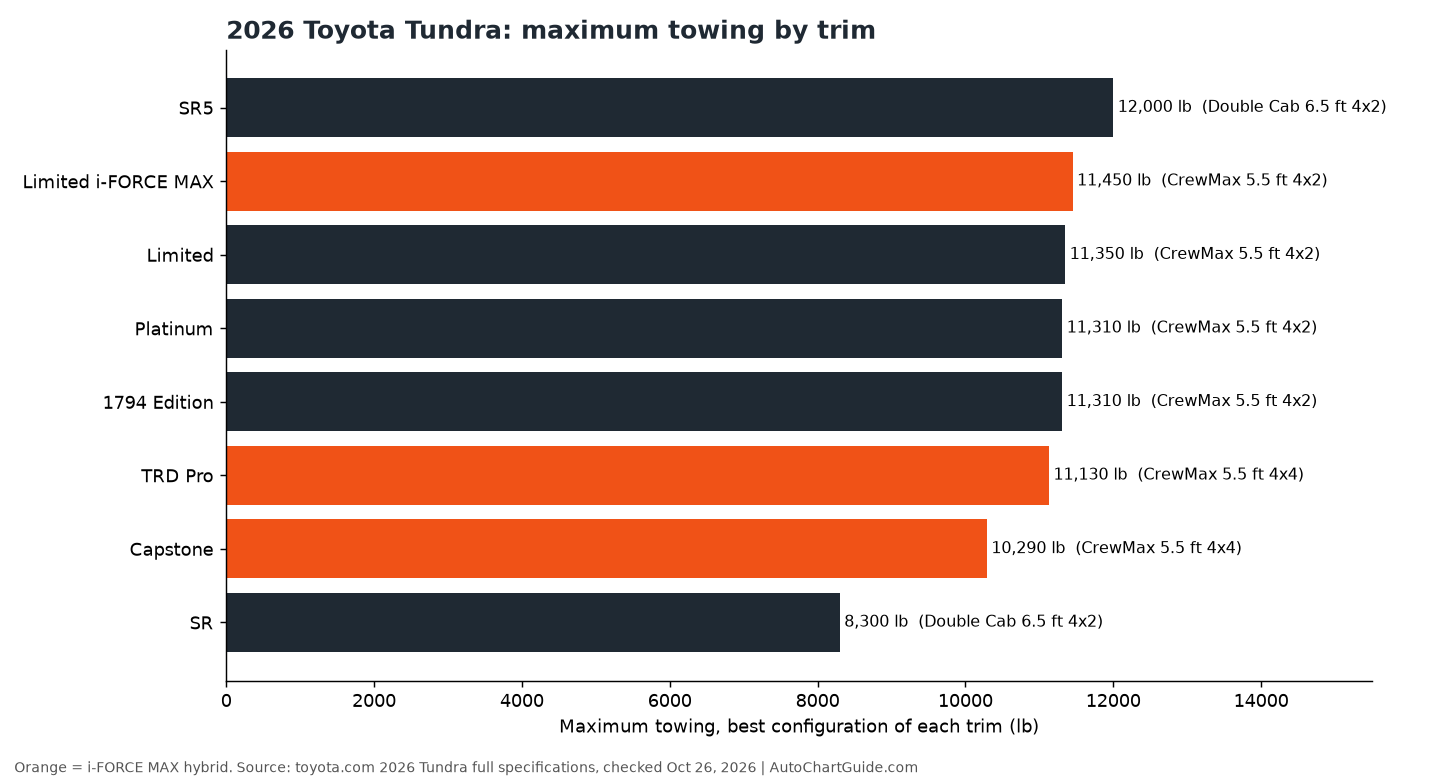
Every trim's maximum depends on cab, bed length and drive. A Limited ranges from 11,450 lb (hybrid CrewMax 4x2, short bed) down to about 10,970 lb (gas CrewMax 4x4, 6.5 ft bed). Find your exact configuration in the full table below.
Full 2026 Tundra towing capacity chart by configuration
Figures are maximum towing and payload ratings in pounds, taken from the full specifications on toyota.com (checked October 26, 2026). "4x2" is rear-wheel drive. The SR rows cover trucks built with the SR Package. The owner's manual lists them under the SR5 model codes with an 8,300 lb rating.
| Trim | Cab | Bed | Drive | Engine | Max towing (lb) | Max payload (lb) |
|---|---|---|---|---|---|---|
| SR5 | Double Cab | 6.5 ft | 4x2 | i-FORCE V6 | 12,000 | 1,830 |
| Limited | CrewMax | 5.5 ft | 4x2 | i-FORCE MAX hybrid | 11,450 | 1,630 |
| SR5 | CrewMax | 5.5 ft | 4x2 | i-FORCE V6 | 11,400 | 1,720 |
| Limited | CrewMax | 5.5 ft | 4x2 | i-FORCE V6 | 11,350 | 1,655 |
| Limited | CrewMax | 6.5 ft | 4x2 | i-FORCE MAX hybrid | 11,350 | 1,655 |
| Platinum | CrewMax | 5.5 ft | 4x2 | i-FORCE V6 | 11,310 | 1,575 |
| 1794 Edition | CrewMax | 5.5 ft | 4x2 | i-FORCE V6 | 11,310 | 1,575 |
| SR5 | CrewMax | 6.5 ft | 4x2 | i-FORCE V6 | 11,270 | 1,775 |
| Limited | CrewMax | 6.5 ft | 4x2 | i-FORCE V6 | 11,230 | 1,685 |
| SR5 | Double Cab | 6.5 ft | 4x4 | i-FORCE V6 | 11,200 | 1,775 |
| SR5 | CrewMax | 5.5 ft | 4x4 | i-FORCE V6 | 11,160 | 1,710 |
| TRD Pro | CrewMax | 5.5 ft | 4x4 | i-FORCE MAX hybrid | 11,130 | 1,580 |
| Limited | CrewMax | 5.5 ft | 4x4 | i-FORCE MAX hybrid | 11,130 | 1,575 |
| Limited | CrewMax | 5.5 ft | 4x4 | i-FORCE V6 | 11,120 | 1,640 |
| SR5 | Double Cab | 8.1 ft | 4x4 | i-FORCE V6 | 11,090 | 1,775 |
| Limited | CrewMax | 6.5 ft | 4x4 | i-FORCE MAX hybrid | 11,060 | 1,630 |
| Platinum | CrewMax | 5.5 ft | 4x4 | i-FORCE V6 | 11,050 | 1,545 |
| 1794 Edition | CrewMax | 5.5 ft | 4x4 | i-FORCE V6 | 11,050 | 1,545 |
| SR5 | CrewMax | 6.5 ft | 4x4 | i-FORCE V6 | 11,010 | 1,695 |
| Limited | CrewMax | 6.5 ft | 4x4 | i-FORCE V6 | 10,970 | 1,635 |
| Platinum | CrewMax | 6.5 ft | 4x4 | i-FORCE V6 | 10,870 | 1,545 |
| 1794 Edition | CrewMax | 6.5 ft | 4x4 | i-FORCE V6 | 10,870 | 1,545 |
| Capstone | CrewMax | 5.5 ft | 4x4 | i-FORCE MAX hybrid | 10,290 | 1,420 |
| SR | Double Cab | 6.5 ft | 4x2 | i-FORCE V6 | 8,300 | 1,830 |
| SR | Double Cab | 8.1 ft | 4x2 | i-FORCE V6 | 8,300 | 1,850 |
| SR | CrewMax | 5.5 ft | 4x2 | i-FORCE V6 | 8,300 | 1,720 |
| SR | Double Cab | 6.5 ft | 4x4 | i-FORCE V6 | 8,300 | 1,775 |
| SR | CrewMax | 5.5 ft | 4x4 | i-FORCE V6 | 8,300 | 1,710 |
Toyota.com lists four more i-FORCE MAX 4x4 CrewMax builds rated 10,990 lb (5.5 ft bed) and 10,960 lb (6.5 ft bed) without a clear grade label, so we left them out. Toyota.com also doesn't list an SR5 Double Cab 4x2 with the 8.1 ft bed for 2026. The Limited CrewMax 4x4 6.5 ft (10,970 lb) and Platinum CrewMax 4x4 6.5 ft (10,870 lb) figures also match the owner's manual towing table.
Why one truck has 40 different ratings
Towing capacity isn't a property of the engine. It's what's left after the truck's own weight is subtracted from its gross combination weight rating (GCWR), within the limits of the hitch, frame, cooling and brakes. Toyota's owner's manual defines GCWR as "the sum of the total vehicle weight (including the occupants, cargo and any optional equipment installed on the vehicle) and the weight of the trailer being towed." Anything that adds curb weight reduces the trailer rating:
- Cab: the CrewMax is heavier than the Double Cab. The top rating in each drive type belongs to a Double Cab.
- Bed: the 8.1 ft bed adds weight and length. An SR5 Double Cab 4x4 drops from 11,200 lb with the 6.5 ft bed to 11,090 lb with the 8.1 ft bed.
- Drive: 4x4 hardware usually costs 200-300 lb of rating. The SR5 CrewMax 5.5 ft goes from 11,400 lb (4x2) to 11,160 lb (4x4). The exception is the 12,000 lb build: the same SR5 Double Cab 6.5 ft drops 800 lb, to 11,200 lb, in 4x4 form, because only the 4x2 version gets the higher 17,770 lb GCWR.
- Trim and equipment: Platinum, 1794 Edition and Capstone carry more equipment and rate lower than a Limited in the same body.
- Hybrid: the i-FORCE MAX adds a motor-generator and battery. In the Limited CrewMax 4x2 short bed it still rates higher (11,450 lb vs 11,350 lb gas), because Toyota gives it a higher GCWR.
So you can't take the 12,000 lb headline and apply it to a CrewMax 4x4 Platinum. That truck is rated 10,870-11,050 lb depending on bed length, about 1,000 lb lower.
Engines and what they mean for towing
| Engine | Output | Where fitted | Max towing |
|---|---|---|---|
| i-FORCE 3.4L twin-turbo V6 (SR tune) | 348 hp / 405 lb-ft | SR | 8,300 lb |
| i-FORCE 3.4L twin-turbo V6 | 389 hp / 479 lb-ft | SR5, Limited, Platinum, 1794 | 12,000 lb |
| i-FORCE MAX 3.4L twin-turbo V6 hybrid | 437 hp / 583 lb-ft | Optional on Limited, Platinum, 1794; standard on TRD Pro and Capstone | 11,450 lb |
Toyota's 2026 press release lists 389 hp and 479 lb-ft for the i-FORCE and 437 hp at 5,200 rpm with 583 lb-ft at 2,400 rpm for the i-FORCE MAX, both with a 10-speed automatic that has Tow/Haul modes. The hybrid's extra torque makes a heavy trailer easier to pull up grades, but it doesn't raise the trailer rating, because the rating is limited by weight, not power. The SR's lower-output i-FORCE explains its much lower 8,300 lb rating.
Tongue weight, GCWR and payload: the limits that bite first
Hitting the trailer rating is rarely the first limit you reach. Three others usually come first:
Tongue weight
Conventional trailers should put about 10-15 percent of their weight on the hitch ball. That tongue weight counts against the truck's payload, and so does the weight of a weight-distributing hitch. A 10,000 lb trailer therefore puts roughly 1,000-1,500 lb on the truck before anyone gets in. Check the hitch receiver's label for its own tongue weight limit too.
Payload
Payload is the GVWR minus the truck's actual weight, and it must cover passengers, cargo, accessories and the tongue weight. Toyota.com lists a 2026 Tundra maximum payload of 1,850 lb, on the SR Double Cab with the 8.1 ft bed. Most configurations are lower, down to 1,420 lb on the Capstone. A CrewMax with four adults (around 700 lb), some gear and a 1,100 lb tongue weight can exceed payload long before the trailer reaches its rated weight. Our guide to a missing door jamb sticker explains where the payload and GVWR labels are and what to do if they're gone.
GCWR
The owner's manual towing table gives GCWR by model code. For the gas i-FORCE trucks it is 17,250 lb for most configurations and 17,770 lb for the SR5 Double Cab 4x2 6.5 ft bed, the 12,000 lb truck. SR Package trucks are rated 15,215-15,565 lb. Toyota notes that the trailer weight rating "is calculated assuming base vehicle with one driver, one front passenger, towing package (if available), hitch and hitch systems," and that "additional optional equipment, passengers and cargo in the vehicle will reduce the trailer weight rating so as not to exceed GCWR, GVWR and GAWR."
Worked example: a 9,000 lb travel trailer
Say you have a 2026 Tundra Limited CrewMax 4x4 with the 5.5 ft bed (gas), rated 11,120 lb, and a travel trailer with a loaded weight of 9,000 lb.
- Trailer rating: 9,000 lb is under 11,120 lb, so this check passes.
- Tongue weight: at 12 percent, 9,000 lb puts about 1,080 lb on the hitch, within normal limits for a properly rated hitch.
- Payload: the 1,080 lb tongue weight plus a weight-distributing hitch (about 100 lb), two adults (350 lb) and gear (150 lb) comes to roughly 1,680 lb. Toyota.com lists 1,640 lb maximum payload for this configuration (and that's for a base-equipped truck), so you're 40 lb over before adding any options. The trailer rating isn't the problem; payload is. Drop gear from the cab, use a lighter hitch, or choose a configuration with more payload, such as the SR5 CrewMax 4x4 at 1,710 lb.
- GCWR: a truck of about 6,000 lb loaded plus a 9,000 lb trailer is 15,000 lb, under the 17,250 lb GCWR.
In this example payload, not the trailer rating, is the real limit. Adding two kids and a generator would put the truck over its GVWR while still well within the "11,120 lb" trailer rating. Weigh the loaded combination at a certified scale before a long trip.
Choosing a Tundra configuration for your trailer
If you're buying a Tundra mainly to tow, work backward from the trailer. Use its loaded weight, not the brochure's dry weight. Travel trailers usually gain 1,000-1,500 lb once water, propane, batteries and gear are on board. Then leave margin. Many experienced towers aim to keep the loaded trailer at or below about 80 percent of the truck's rating. That's a rule of thumb, not a Toyota requirement, but it leaves room for wind, grades and heat.
- Trailers up to about 6,500 lb loaded: any non-SR configuration has generous margin. Pick the cab and bed for how you use the truck day to day.
- Trailers around 7,000-8,500 lb: still within every non-SR rating, but payload starts to matter. A Double Cab or a 4x2 CrewMax leaves more payload for passengers than a CrewMax 4x4 hybrid.
- Trailers around 9,000 lb or more: choose a high-rated configuration (SR5 or Limited 4x2, or a hybrid Limited CrewMax 4x2). Calculate payload carefully, because the tongue weight alone can take two-thirds of it.
- Fifth-wheel and gooseneck trailers: the kingpin weight on a half-ton bed is usually much higher than a conventional tongue weight. Check the manual's fifth-wheel/gooseneck section before considering one, since payload rarely allows it.
Also think about the trailer's frontal area. A tall, boxy travel trailer creates far more drag at highway speed than a flatbed of the same weight. The Tundra's ratings are set under J2807 test conditions, and real-world comfort with a big camper usually runs out before the numbers do.
Toyota's towing equipment rules
The Tundra owner's manual sets equipment thresholds that apply regardless of configuration:
- Trailers over the unbraked rating (1,000 lb) need their own service brakes.
- Over 2,000 lb, use a sway control device with sufficient capacity.
- Over 3,000 lb, a trailer with two or more axles is recommended.
- Over 5,000 lb, use a weight-distributing hitch with sufficient capacity.
Toyota's ratings are certified under SAE J2807, the industry standard that tests a truck's acceleration on grades, launch on a hill, braking and handling with a trailer at its rated weight. A J2807 rating can be compared directly with other brands' J2807 ratings, but it still assumes a properly equipped truck and trailer.
For 2026, Toyota made a tow hitch with a 7/4-pin connector and the 32.2-gallon fuel tank standard on every grade, according to its 2026 Tundra announcement. The bigger tank matters for range, since mileage drops sharply when towing.
How to find your Tundra's exact towing rating
- Read the Certification Label on the driver's door jamb. It shows GVWR, front and rear axle ratings (GAWR) and the model code, for example VXKA75L-PSULZA.
- Find that model code in the towing table of your owner's manual and read the GCWR and trailer weight rating (TWR). Toyota's manual says the model code "is indicated on the Certification Label."
- Check the window sticker for the SR Package, which caps towing at 8,300 lb.
- Read the tire and loading label for the maximum passenger and cargo weight. That is your payload.
- Keep the numbers on file. Our guide to keeping a record of your car's specifications covers what to note down.
Don't rely on a single "Tundra tows 12,000 lb" figure from a website. As our guide on whether car spec websites are accurate explains, aggregators often show the best case for a model rather than for your build. Ratings can also change during a model year. See mid-year model changes.
2026 vs earlier third-generation Tundras
The third-generation Tundra (2022 on) has always advertised a 12,000 lb maximum. The configuration ratings have shifted between years as equipment changed. Payload is the clearest example: Toyota listed a 1,940 lb maximum in earlier years and lists 1,850 lb for 2026. When you shop used, use the owner's manual for that model year rather than this chart. A 2027 update has been shown, but its ratings weren't published when we checked.
Common towing mistakes with the Tundra
- Assuming every Tundra is a 12,000 lb truck. Only one configuration is.
- Ignoring the SR Package. It drops the rating to 8,300 lb on SR5-coded trucks.
- Running out of payload. CrewMax 4x4 hybrids have the least payload, as low as 1,420 lb on a Capstone.
- Skipping the weight-distributing hitch above 5,000 lb, as the manual requires.
- Towing in normal mode. Use Tow/Haul so the 10-speed holds gears and uses engine braking on descents.
Frequently asked questions
What is the max towing capacity of a 2026 Toyota Tundra?
12,000 lb, on the SR5 Double Cab 4x2 with the 6.5 ft bed and the i-FORCE twin-turbo V6. Other configurations rate 8,300-11,450 lb.
How much can the Tundra hybrid tow?
The i-FORCE MAX hybrid rates up to 11,450 lb in the Limited CrewMax 4x2 with the 5.5 ft bed. The TRD Pro is rated 11,130 lb and the Capstone 10,290 lb.
Why is the Tundra SR rated only 8,300 lb?
The SR uses a lower-output i-FORCE (348 hp, 405 lb-ft) and a lower GCWR. In the owner's manual these trucks appear as SR5 model codes with the SR Package, rated 8,300 lb.
How much payload does a 2026 Tundra have?
Toyota.com lists 1,420-1,850 lb depending on configuration: 1,850 lb on the SR Double Cab 8.1 ft bed and 1,420 lb on the Capstone. Tongue weight, passengers and cargo all count against it.
Does the Tundra need a weight-distributing hitch?
Toyota's owner's manual requires a weight-distributing hitch of sufficient capacity for trailers over 5,000 lb, and a sway control device over 2,000 lb.
What is the GCWR of a 2026 Tundra?
Most gas i-FORCE configurations are rated 17,250 lb. The 12,000 lb SR5 Double Cab 4x2 is rated 17,770 lb, and SR Package trucks 15,215-15,565 lb. Check your model code in the owner's manual.
Where do I find my Tundra's model code?
On the Certification Label on the driver's door jamb. Look it up in the owner's manual towing table for your GCWR and trailer rating.
Can a Tundra CrewMax 4x4 tow 11,000 lb?
Several can. For example, the SR5 CrewMax 4x4 short bed is rated 11,160 lb and the Limited 11,120 lb. Payload and tongue weight will usually be tighter than the trailer rating.
Sources
- Toyota Newsroom: 2026 Toyota Tundra announcement
- Toyota.com: 2026 Tundra specs
- Toyota: 2026 Tundra eBrochure
- Toyota Tundra owner's manual: Trailer towing (reproduction)
- Toyota.com: 2026 Tundra full specifications (towing, payload, curb weight by model code)
- TowingIQ: 2026 Tundra owner's manual towing table, pp. 193-194
- Cars.com: 2026 Tundra towing guide