Can I Use ATF for Power Steering? Sometimes. Not Always.
The internet is right about some vehicles and wrong about others. Seal compatibility is the mechanism, and the failure is delayed rather than immediate.

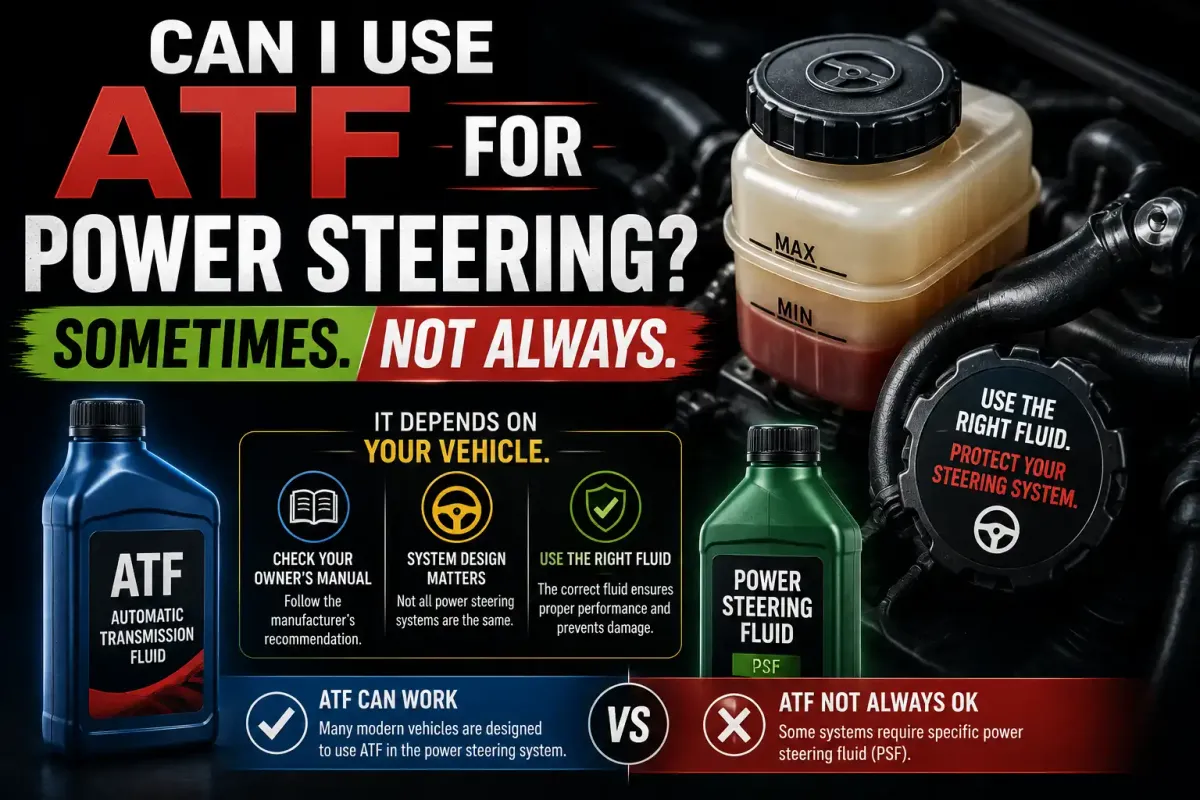
Short answer: sometimes yes and sometimes no, and only your vehicle's documentation settles which you are. The advice you have found is not wrong in general. Some manufacturers genuinely specify an automatic transmission fluid for their power steering systems. Others specify a dedicated power steering fluid that is not interchangeable with ATF, and on those vehicles following the general advice is a mistake that shows up months later.
This is the clearest article on this site for what the whole site is about. There is a widely repeated general answer, it is true of many vehicles, and it does not tell you about yours.


As an Amazon Associate we earn from qualifying purchases.
Why the ATF answer is so widely repeated
Because it is true often enough to feel like a rule.
Power steering systems are hydraulic systems, and hydraulic systems need a hydraulic fluid with appropriate viscosity and additive properties. ATF is a well-characterized hydraulic fluid, widely available, and several manufacturers concluded it was a suitable choice for their systems and specified it.
So a great many people have used ATF in power steering correctly, over decades, on manufacturer instruction. Their experience is real, and when they share it they are reporting something true.
What travels badly is the boundary. "My manual says ATF" becomes "ATF is what goes in power steering," and the qualifier disappears in transmission.
This is the general shape of the problem: why two websites give your car two different numbers.
Where it is genuinely correct
On vehicles whose manufacturer specifies an ATF for the power steering system.
Where the manual names a transmission fluid specification for the steering system, that is the specification, and using it is not a shortcut or an approximation. It is compliance.
Note that even here the specification is specific. "An ATF" is not a specification any more than "an oil" is; the manual names a particular one, and ATF specifications are not interchangeable with each other either: automatic transmission fluid specs.


As an Amazon Associate we earn from qualifying purchases.
Where it is genuinely wrong
On vehicles whose manufacturer specifies a dedicated power steering fluid.
Manufacturers who do this are not being awkward or protecting a revenue stream. They designed a system around a fluid with particular properties, including how it interacts with the seals and hoses in that system, and they specified accordingly.
Substituting ATF on such a vehicle means the system contains a fluid the components were not selected against. What follows is the next section.
Seal compatibility, which is the mechanism
This is why the two are not interchangeable in general, and it is the part that is usually left out.
A hydraulic system contains elastomer seals and hoses. Those materials are selected for compatibility with the fluid the system was designed to contain, because fluids interact with elastomers: they can cause swelling, shrinking, hardening or softening depending on the combination.
A seal that swells beyond its design is not sealing correctly. A seal that shrinks leaks. A seal that hardens loses the compliance it needs.
The seals in a power steering rack are not accessible components. When they fail, the repair is the rack or a rebuild of it, which is why this particular mistake is expensive rather than merely inconvenient.
The same class of problem appears wherever a system's components were selected against a specific chemistry: brake fluid DOT ratings and why DOT 5 is not a substitute.
Why the failure is delayed
Elastomer degradation is a gradual process.
Fill a system with an incompatible fluid and the steering works. It works the next day and the next month. The seals are changing dimension slowly, and the system tolerates a great deal of that before anything is noticeable.
By the time there is a leak or a change in behavior, the fluid has been in there long enough that most people no longer connect the two events. That disconnection is why the practice survives: the person who did it does not experience it as a consequence.
The honest implication: someone telling you they used ATF and it was fine is telling you it was fine so far, on their vehicle, which may be one that specifies ATF anyway.


As an Amazon Associate we earn from qualifying purchases.
Electric power steering, where the question does not arise
Worth stating because a growing number of readers are in this category and do not know it.
Many vehicles use electric power steering, in which assistance comes from an electric motor rather than a hydraulic system. Those vehicles have no power steering fluid, no reservoir and no fluid specification.
If you cannot find a power steering fluid specification in your manual and cannot find a reservoir, that may be why. It is a good reason to establish what system your vehicle has before looking for a fluid to put in it.
Where your vehicle's specification is written
The specifications section of the owner's manual, alongside the other fluids: how to find every fluid spec your vehicle requires.
Many vehicles also state it on or near the reservoir cap, which is a useful immediate check and usually a summary rather than the full specification.
Where the manual is not enough, manufacturer service information resolves to your VIN: owner's manual vs service manual vs repair database. And a dealer parts department can confirm it in a couple of minutes with your VIN, which on this question is the fastest route to certainty.
If you have already put the wrong fluid in, do not add more of anything, note what you added and roughly how much, and take that information to a qualified technician. Whether the system needs flushing is an assessment that requires seeing the vehicle, and it is not something we or any website can make for you.


As an Amazon Associate we earn from qualifying purchases.
Frequently asked questions
Can I use ATF as power steering fluid?
Only if your vehicle's manufacturer specifies an ATF for the power steering system. Some do and some specify a dedicated fluid instead, and the difference is not something to infer.
Why does the internet say ATF is fine?
Because it is correct on many vehicles whose manufacturers specified it, and the qualifier gets lost when the advice is repeated. The experience being reported is real; the generalization is not.
What actually goes wrong with the wrong fluid?
Seal and hose compatibility. Elastomers can swell, shrink or harden depending on the fluid, and power steering rack seals are not accessible components, so the repair is expensive.
Why does nothing happen straight away?
Elastomer degradation is gradual. The system tolerates a lot of change before anything is noticeable, which is why the person who did it usually never connects the two events.
My car has no power steering fluid reservoir. Why?
It may have electric power steering, which uses a motor rather than a hydraulic system and has no fluid at all.