VIN Decode: What Each of the 17 Characters Means
A VIN is a structure, not a full specification. Here is what each of the 17 positions encodes, and the questions a VIN genuinely cannot answer.

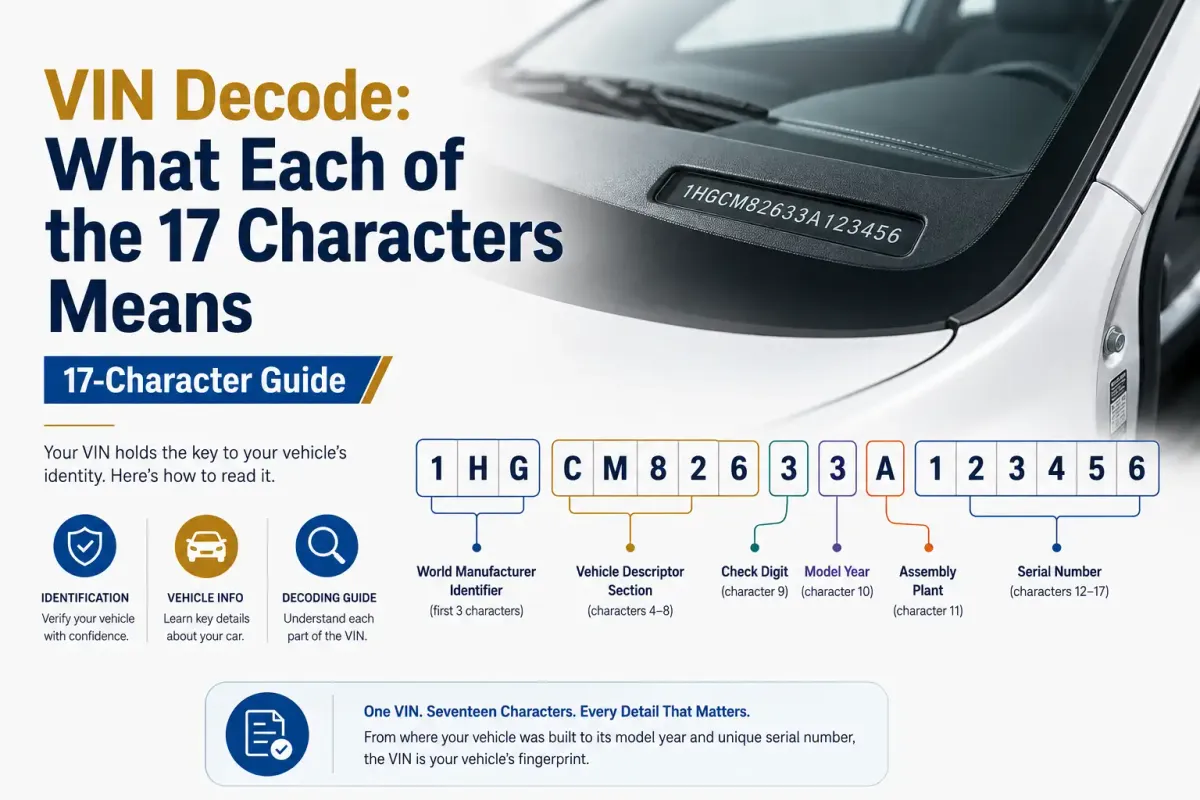
Short answer: a VIN is a structure, not a full specification, and you can decode most of it free. The 17 characters divide into three blocks that identify the manufacturer, describe the vehicle, and serialize it. NHTSA publishes a free decoder at vpic.nhtsa.dot.gov that returns what the manufacturer itself reported. What no VIN carries is your options, your trim as fitted, or anything that has happened to the vehicle since the plant.
That last point is why so many VIN searches end in frustration. People go looking for their exact configuration and find a decoder that returns the model and engine and stops. It stopped because that is where the VIN stops.
The rules that make VINs readable at all
In the United States, VIN content is set by 49 CFR Part 565. Internationally the equivalent framework is ISO 3779. Between them they are why a VIN from any manufacturer has the same length and the same block structure.
Three characters never appear anywhere in a VIN: the letters I, O and Q. They were excluded because they are too easily confused with the digits 1 and 0. If you are reading a VIN and think you see an O, it is a zero.
The three blocks
| Positions | Block | What it does |
|---|---|---|
| 1 to 3 | World Manufacturer Identifier | Identifies who built it and where |
| 4 to 9 | Vehicle Descriptor Section | Describes the vehicle, plus the check digit |
| 10 to 17 | Vehicle Identifier Section | Model year, plant, and serial number |
Positions 1 to 3: who built it and where
The first three characters are the World Manufacturer Identifier, assigned to the manufacturer rather than chosen by them.
The first character indicates the country or region of manufacture. The second and third narrow it to the manufacturer and often the vehicle type or division.
The practical use of this block is limited but real: it tells you where a vehicle was built, which is not always where the brand is headquartered. That matters when you are chasing a specification, because a vehicle built for and in a different market can be a genuinely different vehicle from the one the model name suggests.
Positions 4 to 8: the descriptor section
This is the block people most want to read, and it is the block where the universal structure runs out.
Positions 4 through 8 describe the vehicle: commonly body style, restraint system, engine and series. But the coding within those positions is the manufacturer's own. There is no single table that decodes position 5 across all manufacturers, because there is no rule requiring them to use it for the same thing.
This is exactly why generic VIN decoder sites disagree with each other. They are each applying an interpretation of a manufacturer-specific scheme. The NHTSA decoder is better than most on this, because it returns what the manufacturer submitted rather than a third party's guess.
If what you actually want out of this block is the engine, there are more reliable routes: reading your engine code off the block and off the VIN.
Position 9: the check digit
Position 9 is a check digit, and its purpose is narrow and useful: it exists so that a mistyped or misread VIN can be caught.
The digit is calculated from the other 16 characters. Change any one of them and the check digit no longer matches. That is the whole function. It carries no information about the vehicle.
Practically, this is why a VIN you typed into a form gets rejected as invalid. The form is not telling you the vehicle does not exist. It is telling you the number you typed is not internally consistent, which almost always means a transcription error. Read it again off the label rather than off your notes.
Position 10: model year
Position 10 encodes the model year, and the codes are specified in the regulation itself, at 49 CFR Part 565.15.
The coding runs on a cycle using letters and digits, and it repeats. That repetition is the trap: a code at position 10 identifies a model year within a cycle, not uniquely across all time. In practice the rest of the VIN and the vehicle's obvious age resolve it, but it is worth knowing that the character alone is ambiguous across a long enough span.
The letters U and Z and the digit 0 are not used in position 10.
Model year is a designation rather than a build date, and the two are frequently different. What that means when your vehicle does not match a chart: model year vs build date.
Positions 11 to 17: plant and serial number
Position 11 identifies the manufacturing plant. Positions 12 through 17 are the sequential serial number, which is what makes the VIN unique to your individual vehicle.
The plant code is more useful than it looks. Manufacturers build the same nameplate at multiple plants, and plants sometimes differ in supplier or in the point at which a running change was adopted. When a parts catalogue or a service bulletin distinguishes vehicles by assembly plant, position 11 is what it is asking about.
What a VIN cannot tell you, and what to use instead
Be clear about the limits, because this is where most VIN research goes wrong:
- It does not carry your options. Use the option or RPO sticker, or the window sticker.
- It does not reliably settle trim. Badges lie and VINs are coarse: how to tell what trim my car is.
- It describes the vehicle as built. A replaced engine or a repaired body is invisible to it.
- It is not a history report. For open recalls, the VIN is the search key but the manufacturer's records are the answer: how to check recalls by VIN.
Frequently asked questions
Is there a free VIN decoder that actually works?
NHTSA publishes one at vpic.nhtsa.dot.gov. It returns what the manufacturer reported for that VIN, which makes it more trustworthy than sites applying their own interpretation of manufacturer-specific coding.
Why do two VIN decoders give me different answers?
Because positions 4 through 8 use manufacturer-specific coding with no universal table behind it. Each decoder is applying an interpretation. Prefer the source closest to the manufacturer.
My VIN has an O in it. Is it fake?
No, it is a zero. The letters I, O and Q are excluded from VINs precisely because they are confused with 1 and 0.
Can the VIN tell me my exact trim level?
Usually not with confidence. Some manufacturers encode a series or line in the descriptor section, but it is coarse and it does not reflect optional equipment. Factory documentation is the reliable route.
A form says my VIN is invalid but I copied it correctly. What now?
Check it again character by character against the label rather than against your notes. The check digit at position 9 catches transcription errors, and that is almost always what has happened.