Weight Car Seat Age Chart: Limits by Stage, Not Birthday
Car seat age and weight chart from AAP, NHTSA and CDC: weight limits by seat type, when to move up, the 65 lb LATCH rule, and 2023 crash data by age.

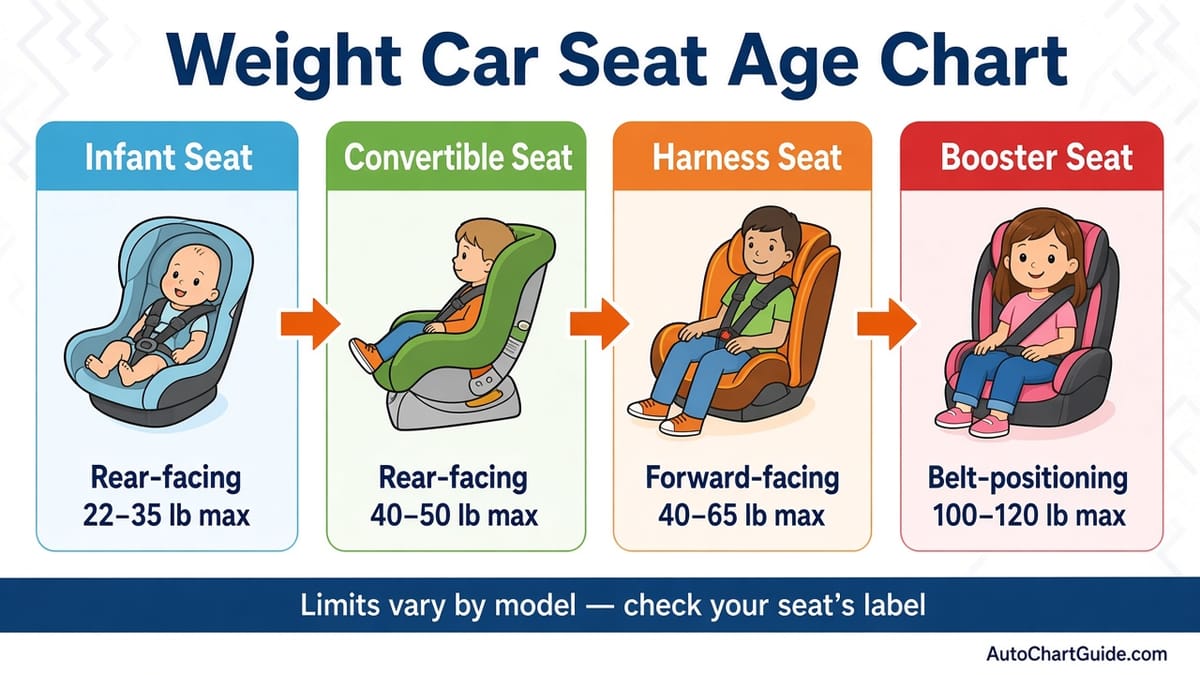
Short answer: a weight car seat age chart is really a chart of seat limits, not a schedule. The age bands from NHTSA and CDC tell you roughly when children tend to move between stages. The weight numbers come from the seat itself, and the American Academy of Pediatrics (AAP) lists them as wide ranges: rear-facing-only infant seats top out somewhere between 22 and 35 lb, convertible seats used rear-facing often reach 40 to 50 lb, harnessed combination seats reach 40 to 65 lb, and booster mode runs up to 100 to 120 lb, all depending on the model. Your child moves up a stage when they hit the weight or height limit on their seat's label, not on a birthday.
Figures here come from the AAP's HealthyChildren.org car seat guide (last updated April 16, 2026), NHTSA's car seat recommendations, CDC's child passenger safety page (April 22, 2026), and NHTSA's Traffic Safety Facts 2023 report on children, all read 2026-10-26. This is a summary of published guidance. It does not replace your seat's manual, your vehicle owner's manual, your state's law or a certified child passenger safety technician.
Car seat chart by age and weight
The table puts the official age guidance next to the weight ranges AAP reports. The age column is a rough guide. The weight column is the spread of limits across seat models on the market, so your own seat's number will sit somewhere in that range.
| Stage | Typical age guidance | Weight limits reported by AAP | Move on when |
|---|---|---|---|
| Rear-facing-only (infant) seat | From birth (NHTSA: every child under 1 rides rear-facing) | Up to 22–35 lb and 26–35 in, by model | Child hits the seat's weight or length limit. Then keep rear-facing in a convertible or all-in-one seat |
| Convertible or all-in-one, rear-facing | CDC: birth until age 2–4. AAP: most convertible seats allow 2 years or more | Many rear-facing limits up to 40–50 lb | Child reaches the rear-facing weight or height limit |
| Forward-facing with harness and top tether | CDC: after rear-facing, until at least age 5. AAP: harness at least to age 4 | Combination seats with harness: up to 40–65 lb | Top harness weight or height reached, shoulders above the top harness slots, or ear tops reach the top of the seat (AAP) |
| Belt-positioning booster | NHTSA: roughly 4–12 years. CDC: until belt fits, usually age 9–12 | Combination seats in booster mode: up to 100–120 lb | The adult belt fits without a booster, typically around 4 ft 9 in and age 8–12 (AAP) |
| Seat belt, back seat | When the belt fits. Back seat through age 12 (NHTSA, AAP, CDC) | No weight threshold; fit decides | Not applicable |
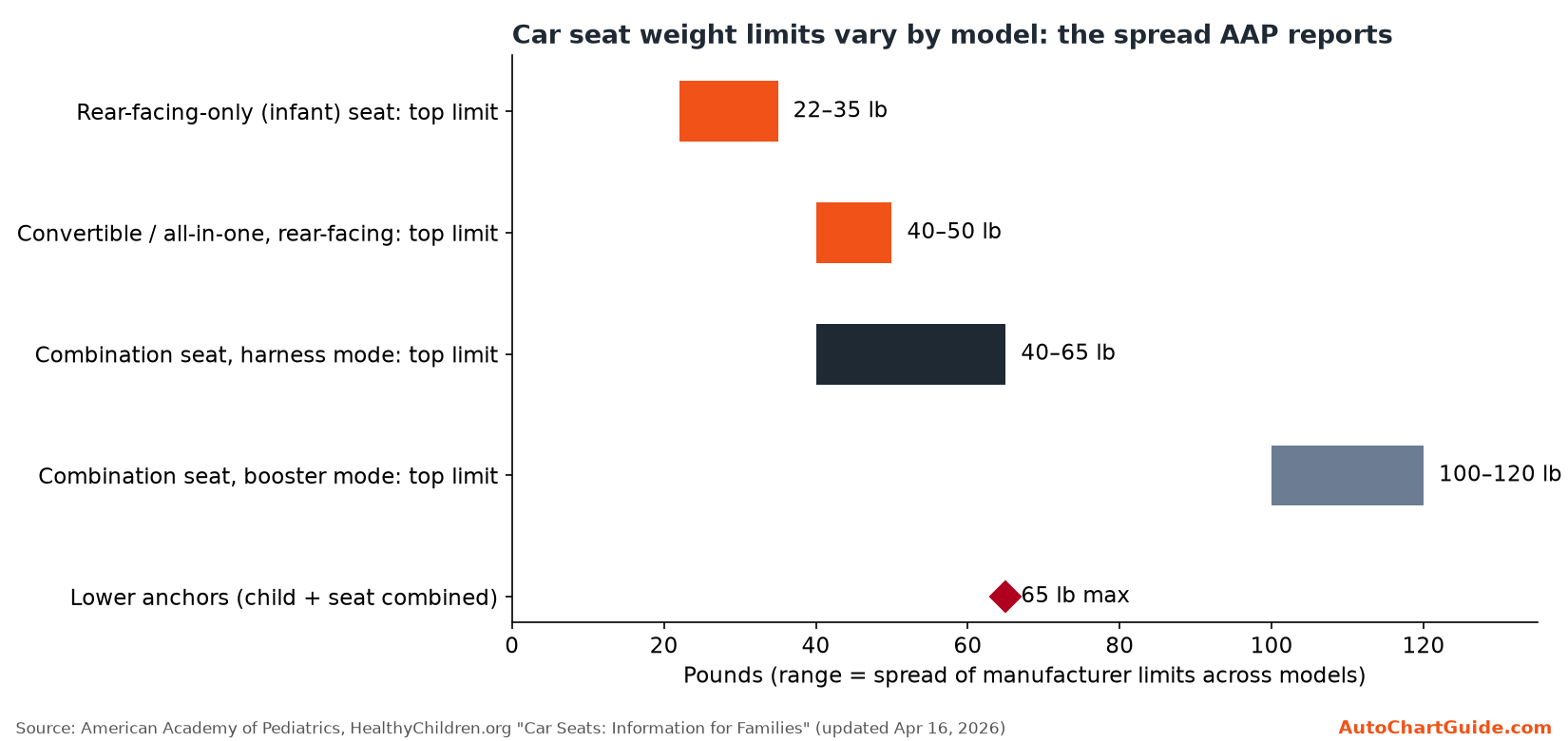
Why the weight column is a range, not one number
NHTSA's guidance is to "select a car seat based on your child's age and size" and to "always refer to your specific car seat manufacturer's instructions (check height and weight limits)." It does not publish one weight per stage, because the limits are set seat by seat.
That is why the AAP describes each category as a range. Two infant seats that look alike might top out at 22 lb and 35 lb. A child at 25 lb could have outgrown one and still have room in the other. A chart that gives a single weight per age can't hold both facts, so check your seat's label first and use the chart second.
Height limits work the same way, and a child can outgrow a seat on height before weight. AAP says a child has outgrown a forward-facing harness when any limit is reached: weight, height, shoulders above the top harness slots, or the tops of the ears at the top of the seat.
Rear-facing: how long, by weight
All three sources agree on the direction: rear-facing as long as the seat allows. NHTSA says a child under 1 "should always ride in a rear-facing car seat." For ages 1 to 3, it says to keep the child rear-facing "until he or she reaches the top height or weight limit allowed by your car seat's manufacturer."
If you start with an infant seat, its limit is the first one you hit. AAP is explicit that outgrowing the infant seat is not the cue to turn forward: "When children reach the highest weight or length allowed by the manufacturer of their rear-facing-only seat, they should continue to ride rear facing in a convertible or all-in-one seat." Those seats often allow 40 to 50 lb rear-facing.
A common worry is the child's feet touching the vehicle seat back. AAP says this "should cause them no worry" and that leg injuries are "very rare" for rear-facing children.
Forward-facing harness: the 65 lb number that is easy to misread
Forward-facing harnessed seats commonly run up to 40 to 65 lb. A separate 65 lb figure applies to the lower anchors (the LATCH system), and it means something else.
AAP says: "All lower anchors are rated for a maximum weight of 65 pounds (total weight includes car safety seat and child)." That total includes the seat. A heavy convertible seat can hit the anchor limit while the child is still well under the seat's own harness limit. AAP's instruction then is to switch to a seat belt installation: "If the child weighs too much, caregivers must use the seat belt to install." AAP adds that new seats print the maximum child weight for lower-anchor use on their label.
The top tether is separate again. AAP says the tether should always be used with a forward-facing seat, and that the vehicle owner's manual gives the top weight for the tether anchor. If you no longer have the manual, our guide to free owner's manuals by manufacturer lists where to get one.
Booster seat to seat belt: fit, not weight
Weight matters less at the booster stage. The booster raises the child so the adult belt fits, and the move to a plain seat belt depends on that fit. AAP gives 4 ft 9 in and age 8 to 12 as typical, and says most children won't fit a seat belt alone until 10 to 12. CDC puts proper fit usually at age 9 to 12.
AAP and CDC describe a belt that fits:
- The lap belt lies low and snug across the upper thighs, not the belly.
- The shoulder belt crosses the middle of the chest and shoulder, not the neck or face.
- The child can sit against the seat back with knees bent over the seat edge, without slouching, for the whole trip (AAP).
Two details catch people out. Boosters need a lap-and-shoulder belt. AAP says lap belts "can never be used with a booster seat." And all children under 13 belong in the back seat.
What the 2023 crash data shows by age
NHTSA's Traffic Safety Facts on children (DOT HS 813 712) reports that 1,019 children 14 and younger died in U.S. traffic crashes in 2023. Of the 700 killed as passenger vehicle occupants, restraint use was known for 620, and 264 of them (43%) were unrestrained.
The report's Table 1 splits this by age. We charted the share of unrestrained children (counting only cases where restraint use was known) among those killed and those who survived fatal crashes:
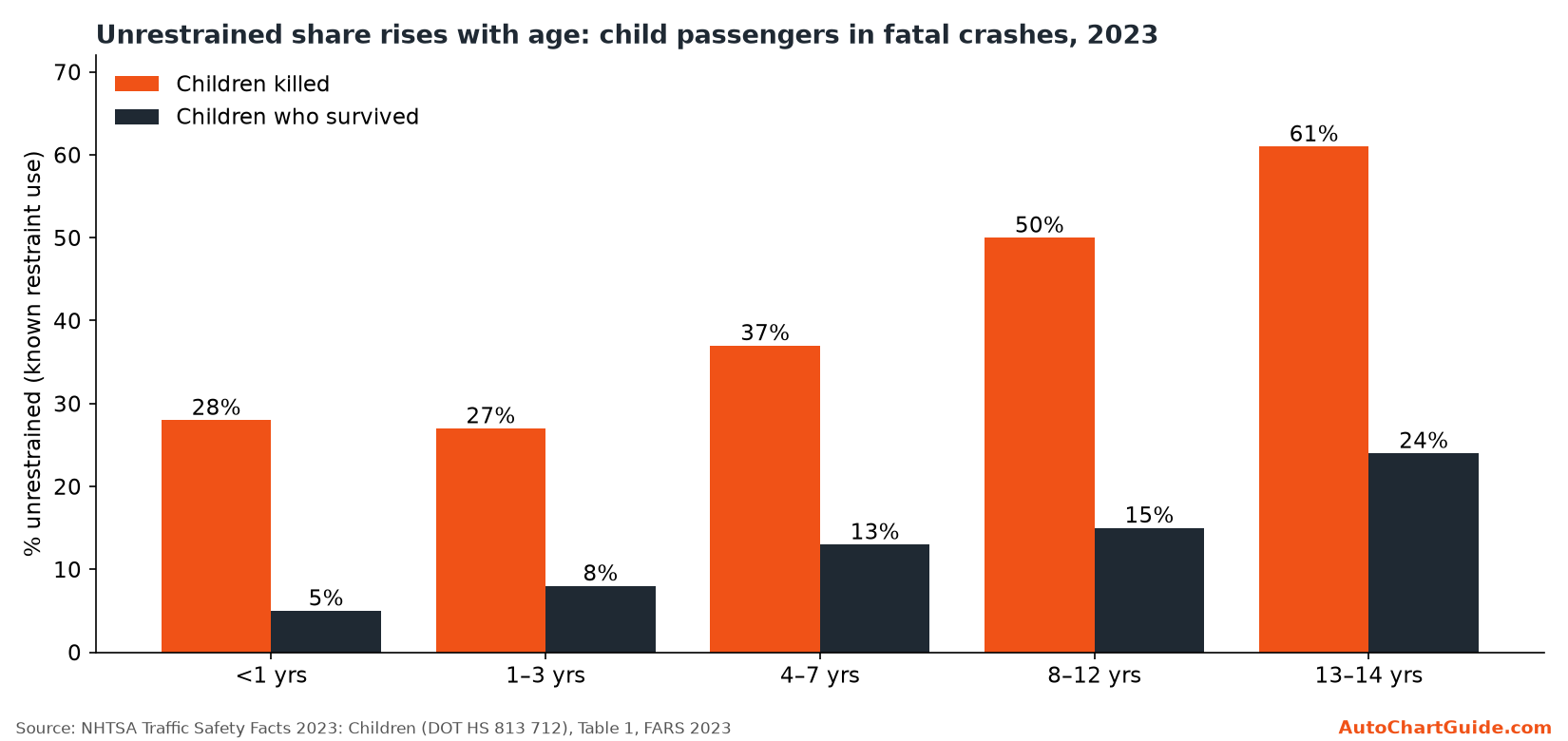
The pattern is clear in the published numbers. Among children killed, the unrestrained share stays near 27–28% through age 3. It rises to 37% at 4–7, 50% at 8–12 and 61% at 13–14. The climb lines up with the booster and seat-belt years, when the guidance starts to rely on fit and habit instead of an obvious seat. This data shows correlation only. It does not show why individual children were unrestrained, and it does not compare seat types.
The same report cites an older NHTSA estimate (Hertz, 1996) that child safety seats reduce fatal injury by 71% for infants under 1 and by 54% for toddlers 1 to 4 in passenger cars. In light trucks the figures are 58% and 59%.
How much car seats reduce the risk
The chart above tells you which seat to use. NHTSA's 2023 fact sheet on children (DOT HS 813 712) shows why it matters. It reports that child safety seats "reduce fatal injury by 71 percent for infants under 1 year old and by 54 percent for toddlers 1 to 4 years old in passenger cars." In light trucks, which include pickups, SUVs and vans, the reductions are 58 percent for infants and 59 percent for toddlers.
Seat belts also make a big difference once a child is big enough for one. The same fact sheet says lap and shoulder belts, used correctly, cut the risk of fatal injury for front-seat occupants aged 5 and older in passenger cars by 45 percent. They cut the risk of moderate-to-critical injury by 50 percent. In light trucks, the figures are 60 percent and 65 percent. These reductions assume the belt fits, which is why the booster stage exists.
| Restraint (NHTSA, DOT HS 813 712) | Passenger cars | Light trucks |
|---|---|---|
| Child safety seat, infants under 1: fatal injury reduction | 71% | 58% |
| Child safety seat, toddlers 1 to 4: fatal injury reduction | 54% | 59% |
| Lap/shoulder belt, front seat, age 5+: fatal injury reduction | 45% | 60% |
| Lap/shoulder belt, front seat, age 5+: moderate-to-critical injury reduction | 50% | 65% |
Child crash deaths by age group, 2014 vs 2023
In 2023, 1,019 children aged 14 and younger died in U.S. traffic crashes. That's 2 percent of all 40,901 traffic deaths, and it averages out to about 3 children killed and 442 injured every day. Overall, child deaths fell 5 percent between 2014 and 2023, but the trend wasn't the same for every age group:
| Age group (matches seat stages) | 2014 deaths | 2023 deaths | Change |
|---|---|---|---|
| Under 1 (rear-facing) | 53 | 65 | +23% |
| 1 to 3 (rear-facing / harness) | 207 | 192 | −7% |
| 4 to 7 (harness / booster) | 310 | 210 | −32% |
| 8 to 12 (booster / belt) | 305 | 314 | +3% |
| 13 and 14 (seat belt) | 198 | 238 | +20% |
Ages 4 to 7 saw the biggest drop, a 32% decrease. Deaths rose among infants and among 13- and 14-year-olds, and the 13 to 14 group also had the highest share of unrestrained deaths in the data shown earlier (61%). The age where children "graduate" to the adult belt is the age where restraint use drops off. The figures are counts from FARS and aren't adjusted for how many children were on the road, so read them as a pattern rather than a precise risk comparison.
Lower anchors or seat belt, and the tether
NHTSA's installation guidance is direct: every car seat is installed "using either the lower anchors or a seat belt to secure it in place, never both." If you use the seat belt, check your vehicle's owner's manual for how to lock it. For forward-facing seats, NHTSA recommends always using the top tether when both the car seat and vehicle manufacturers allow it, whichever way the seat is installed.
- Lower anchors are two small bars in the gap between the vehicle seat's back and bottom cushion. Vehicles have them in at least two rear seating positions.
- Tether anchors are usually in at least three positions. In sedans they're often on the rear shelf. In vans, pickups and SUVs they may be on the seat back, floor or ceiling. NHTSA warns not to confuse them with cargo tie-downs, so check the owner's manual.
- Lower anchor limit: if the seat has no label, NHTSA's formula is 65 lb minus the weight of the car seat. Once your child is past that limit, reinstall the seat with the vehicle seat belt.
Not every seat fits every vehicle, so NHTSA suggests trying a seat in your car before you buy it. Certified technicians at car seat inspection stations will check an installation, in most cases for free, and some offer virtual inspections.
Register the seat and check for recalls
Car seats get recalled just like vehicles, but a VIN search won't find a car seat recall. NHTSA asks parents to register each seat with its manufacturer, using the card in the box or the maker's website, so the manufacturer can contact you directly. You can also sign up for NHTSA's car seat recall emails or use its SaferCar app. For the vehicle itself, use our guide on how to check recalls by VIN. If a seat has been in a crash, NHTSA has separate guidance on reusing a seat after minor versus moderate or severe crashes.
Checklist before you move a child up a stage
- Read the weight and height limits on the seat's label and in its manual for the mode you are using (rear-facing, forward-facing, booster).
- Check which limit your child reaches first. It can be height rather than weight.
- For a lower-anchor install, add the seat's weight to the child's and compare against the label's lower-anchor limit.
- Check the vehicle owner's manual for tether anchor limits and seating positions. Our explainer on owner's manual vs service manual covers which document has what.
- Check your state's law. It can differ from AAP and NHTSA best practice.
- If you're unsure, a certified child passenger safety technician can check the install. AAP and CDC both point to technician and inspection-station locators.
Frequently asked questions
What weight should a child be to face forward?
No official weight applies to every child. AAP and NHTSA say to keep a child rear-facing until they reach the top rear-facing weight or height limit of their seat. AAP notes that many convertible seats allow 40 to 50 lb rear-facing.
Is age or weight more important for car seats?
The seat's weight and height limits decide when to move up. Age is a rough guide to when children usually get there, and some steps have age floors too. NHTSA keeps every child under 1 rear-facing, and AAP advises a harness at least to age 4.
What weight is a booster seat for?
AAP reports booster mode on combination seats running up to 100 to 120 lb depending on the model. The minimum is set by each booster's manufacturer. A child should only move to a booster after outgrowing the forward-facing harness.
When can a child stop using a booster?
When the adult lap-and-shoulder belt fits on its own. AAP says that is typically about 4 ft 9 in and age 8 to 12. CDC says usually age 9 to 12.
How long should a child ride in the back seat?
NHTSA says to keep your child in the back seat at least through age 12, and the AAP advises the back seat for all children under 13.
Should I use lower anchors and the seat belt together?
No. NHTSA says to use one or the other, never both, unless your car seat's manual specifically allows it. For a forward-facing seat, also use the top tether when it's allowed.
How much do car seats reduce deaths?
According to NHTSA, child safety seats reduce fatal injury by 71% for infants and 54% for toddlers aged 1 to 4 in passenger cars, and by 58% and 59% in light trucks.
Sources
- American Academy of Pediatrics, HealthyChildren.org: Car Seats: Information for Families (updated Apr 16, 2026)
- NHTSA: Car Seats and Booster Seats
- NHTSA: Car Seat Recommendations for Children (PDF)
- CDC: Child Passenger Safety (Apr 22, 2026)
- NHTSA: Traffic Safety Facts 2023 Data, Children (DOT HS 813 712)