How to Get a Build Sheet for Your Car
A build sheet is the assembly record, not the window sticker. Here is what it holds, the four routes to getting one, and what to do when none exists.

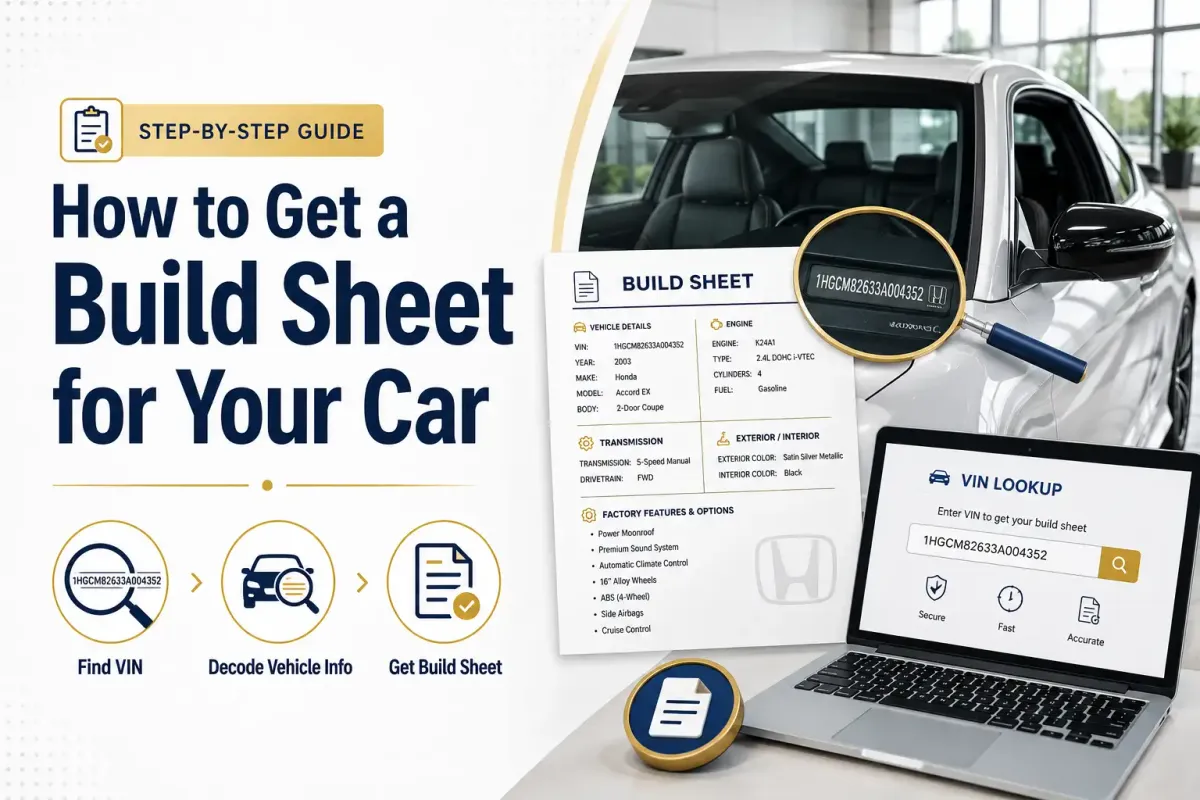
Short answer: a build sheet is the assembly record for your specific vehicle, and it is a different document from the window sticker. The window sticker was produced to sell the car. The build sheet was produced to build it, which is why it is often more granular and why it uses internal codes rather than marketing language. Availability varies enormously by manufacturer and era, and for some vehicles no obtainable build sheet exists at all.
Being honest about that last point up front saves a lot of searching. This is not a document every vehicle has a retrievable copy of.
Build sheet versus window sticker: what each one is for
The distinction is the whole reason to read this page.
| Window sticker | Build sheet | |
|---|---|---|
| Produced for | The buyer, at the point of sale | The assembly plant |
| Language | Marketing option names | Internal codes |
| Typical content | Standard equipment, options, pricing | Component and configuration codes for assembly |
| Availability | Often hosted by the manufacturer for recent years | Highly variable, frequently unavailable |
If your question is "what options does this car have," the window sticker usually answers it more readably. See how to get the original window sticker by VIN.
If your question is "what exact component was fitted," the build sheet is the better document, because it describes the vehicle at the level of the parts that went into it.
Where physical copies were historically left in the vehicle
This is the part that sounds like folklore and is not.
Build sheets travel with the vehicle down the assembly line, and historically they were frequently left inside it rather than removed at the end. Owners have found them under carpet, above headliners, inside seat frames, behind door panels and in similar cavities.
Two honest caveats. Whether this happened at all depends on the manufacturer, plant and era, so there is no general rule that your vehicle has one hidden in it. And retrieving one means dismantling interior trim, which risks damaging the vehicle in pursuit of a document. It is a reasonable thing to look for opportunistically while trim is off for another reason. It is not a reasonable thing to disassemble a car for.
Asking a dealer to pull one from the manufacturer system
The most practical route on a modern vehicle is a franchised dealer for the brand.
Dealer-facing manufacturer systems generally hold build information by VIN in a form the public portal does not expose. What a dealer can retrieve differs by brand, but a parts department in particular deals in exactly this kind of configuration data every day, because getting the right part requires it.
Ask at the parts counter rather than the sales floor, bring your VIN, and be specific about what you actually need to establish. "I need to know which of the two listed axle codes my vehicle has" is a question a parts department can answer in a minute. "Can I have my build sheet" is a request they may have no process for.
Manufacturer and brand owner portals
Some manufacturers expose configuration information through their owner portals, sometimes labeled as vehicle information or original equipment rather than as a build sheet.
The search pattern is the same as for window stickers: the manufacturer's owner site rather than its marketing site, VIN required, and often an account with the vehicle registered to it. Coverage skews heavily toward recent model years.
Enthusiast and marque registries, and how much to trust them
For older and enthusiast vehicles, marque clubs and registries sometimes hold decoding resources and, occasionally, archives of production records.
These vary from excellent to unreliable. The way to judge one is to look at what it says about its own sources. A registry that explains where its data came from, and is explicit about what it does not have, is worth taking seriously. One that presents a decode with no provenance is a secondary source dressed as a primary one, and the fact that it agrees with another site tells you nothing, because sites in this space copy each other constantly. That failure mode is general enough to be worth its own page: why two websites give your car two different numbers.
What to do when no build sheet exists for your vehicle
Most of the time the build sheet is not the goal. It is a route to a specific fact, and there are other routes to the same fact.
Start with the option code list physically attached to the vehicle, which is the closest thing to a build record most cars carry: reading GM RPO codes covers the most structured version of that system, and other manufacturers run equivalents.
Then verify physically. For most questions a used vehicle actually raises, what is fitted now matters more than what was fitted originally, and that is something you can check. See trim badge vs actual trim.
Frequently asked questions
Is a build sheet the same thing as a window sticker?
No. The window sticker is the sales document produced for the buyer. The build sheet is the assembly record produced for the plant, and it uses internal codes rather than option names.
Can I get a build sheet by VIN online?
Sometimes, depending on manufacturer and model year. Manufacturer owner portals are the place to check, and coverage is generally limited to recent years. There is no universal lookup.
Is it true build sheets are hidden inside cars?
It is true that they were often left in the vehicle during assembly, depending on the manufacturer, plant and era. It is not true that every vehicle has one, and dismantling interior trim to hunt for one risks damaging the car.
Will a dealer give me my build information?
Often yes, particularly the parts department, and particularly if you ask a specific question rather than making an open-ended request. Bring your VIN.
What if I only need one fact from it?
Then you probably do not need the build sheet. The option code sticker on the vehicle, or a physical check of the component itself, usually answers a specific question faster.