Call Dealer for Part Number: When It Beats Searching
Know when to call dealer for part number help, what to have ready and what to ask, so you get the right OEM number for your VIN on the first call.

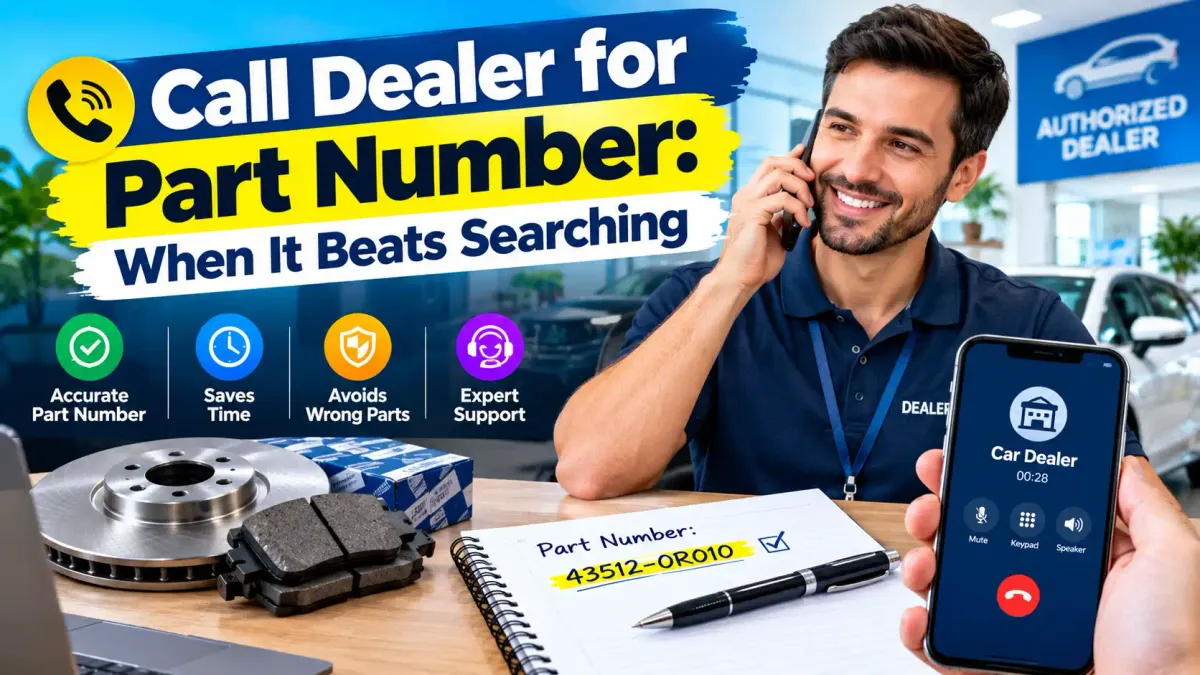
Short answer: call the dealer parts desk for a part number once online searching has given you more than one answer, when the part varies by trim, engine, build date or factory options, or when the part is safety-related. The parts desk can look up the part against your VIN in the manufacturer's own catalog, which is the one source that knows how your specific car was built. Have your VIN, the part's location and any number printed on the old part ready, and the call is usually short.
You do not have to buy from the dealer. The point of the call is the correct part number. What you do with it afterward is up to you.


As an Amazon Associate we earn from qualifying purchases.
Signs it is time to stop searching
Online parts catalogs, forums and spec sites solve a lot of lookups. They also run out. These are the signals that more searching will not help:
- You have three answers for one part. Different sites listing different numbers usually means the part changed across trims, engines or production dates, and none of them can tell which applies to your car.
- The catalog asks a question you cannot answer. "With or without tow package?" "Built before or after a given month?" "Which option code?" If you do not know, a guess is a coin toss.
- The part is listed as "fits" a range that includes your car, with notes. Notes like "check VIN", "see dealer" or "mid-year change" mean the catalog itself is telling you it cannot be sure.
- The part number has been superseded. An old number replaced by a new one, sometimes more than once, is hard to follow from the outside.
- The part is safety-related. Brake, steering, suspension, restraint and fuel-system parts are not the place for a best guess.
- You have spent longer searching than the call would take. That alone is a fair reason.
Why the dealer can answer what the internet cannot
The value of the parts desk is not that the staff know more about cars than everyone online. It is that they look parts up by VIN in the manufacturer's own electronic catalog, which is built around how each vehicle was actually assembled.
The same model and year can use different parts depending on engine, transmission, trim, option packages and build date. Our guide to model year vs build date explains why two cars sold as the same year can differ. A VIN lookup can resolve those splits where a year, make and model search cannot.
For some brands, the factory option codes tell the story. General Motors vehicles, for example, carry Regular Production Option codes that record factory equipment, and our guide to GM RPO codes shows where to find and read them. A parts catalog can use that kind of build information to narrow the choice.


As an Amazon Associate we earn from qualifying purchases.
What to have ready before you call dealer for part number help
A few minutes of preparation saves a second call.
Your full 17-character VIN. It is on the driver's side of the dashboard, visible through the windshield, and on the door jamb label, your registration and your insurance card. Read it carefully: a single wrong character returns a different vehicle or nothing. If you want to confirm what the VIN decodes to first, NHTSA's free vPIC decoder (read September 28, 2026) presents manufacturer-reported data for vehicles intended for the US market, from model year 1981 onward.
Where the part is and what it does. "Front left lower control arm" is better than "the arm thing up front". If you know the system, say so.
Any number on the old part. Many parts carry a stamped or printed number. It may be the manufacturer's number, a supplier's number or a casting number, and the desk can often tell you which.
Photos. If the part has variations, such as connector shapes or mounting points, a photo helps if the dealer accepts them by email or text. Ask first.
Your engine code, if you have it. Our guide to finding your engine code covers the places it is printed and why they should agree. The desk usually does not need it, but it helps if the VIN lookup leaves a choice.
What to ask on the call
A clear list of questions gets the most from a short call:
- What is the current part number for this part on my VIN?
- Has it been superseded? If so, ask for both the old and new numbers, so you can recognize either when shopping.
- Is there more than one part that could fit, and what decides between them? If the answer depends on an option, ask how to check it on the car.
- Are there related parts I will need? Some jobs call for single-use bolts, gaskets, seals or clips. Ask whether the catalog lists any with this part.
- What is the price and availability? Useful for comparison, even if you buy elsewhere.
- Can you text or email the number? A written number avoids transcription errors.
Write down the date, the dealer and the number you were given. If you keep a spec file for your car, add it there.
What the parts desk usually cannot do
It helps to know the limits so you are not surprised:
- Diagnose the problem. The parts desk finds parts. Deciding which part has failed is a service department or independent shop job.
- Give full repair procedures. Torque values, sequences and procedures live in service information. Some desks will read a figure from the catalog, but the service manual or a technician is the right source for how to install it.
- Vouch for aftermarket equivalents. They can give you the OEM number. Whether an aftermarket part truly matches it is between you and that part's maker or seller.
- Always help with parts the car did not come with. A part for a feature your trim never had may need other parts, wiring or programming, and a desk may only look up parts against what the VIN shows.
Policies differ between dealers. Some will look up a number by phone for anyone; some prefer you visit or buy. Being ready with your VIN and specific questions makes a quick answer more likely.


As an Amazon Associate we earn from qualifying purchases.
Using the part number elsewhere
With the correct OEM number, you can compare prices from other dealers, the manufacturer's online parts store, or cross-reference it to aftermarket equivalents. Aftermarket catalogs often list the OEM numbers their parts replace, so a verified number is a much better search term than a description.
Using an aftermarket part does not by itself cost you warranty coverage in the US. The Federal Trade Commission's consumer guide to auto warranties and service contracts (read September 28, 2026) states: "Your warranty stays in effect if you use aftermarket or recycled parts." It adds that if a defective or badly installed part causes damage, the manufacturer or dealer can deny coverage for that damage, but "must prove the aftermarket or recycled part caused the damage before they can deny warranty coverage." For questions about your own warranty terms, read the warranty booklet or ask the manufacturer.
Before you order: one more check
Before ordering a part for a safety or emissions system, check whether your vehicle has an open recall that covers it. If it does, the repair may be handled through the recall instead. Our guide on how to check recalls by VIN explains how.
For brake, steering, suspension, airbag and fuel-system parts, the correct part number is only half of the job. Correct installation matters just as much, and a qualified technician with the manufacturer's procedure is the right route if you have any doubt.


As an Amazon Associate we earn from qualifying purchases.
Frequently asked questions
Will a dealer give me a part number over the phone?
Many parts desks will look up a number by VIN over the phone, though policies vary by dealer. Having your VIN, the part's location and specific questions ready makes it more likely.
Why does the parts desk need my VIN?
Because the same model and year can use different parts depending on engine, trim, options and build date. The VIN lets the desk look up the parts that match how your car was built.
Can I buy the part somewhere else after the dealer gives me the number?
Yes. The OEM number lets you compare prices elsewhere and cross-reference aftermarket equivalents. Check that any aftermarket part is listed as replacing that exact number.
What if the old part number is no longer available?
Ask whether it has been superseded. Manufacturers often replace a part number with a newer one, and the desk can tell you the current number that replaces it.
Does the parts desk give torque specs?
Sometimes a figure appears in the catalog, but installation specs belong to the service manual. Take torque values and procedures from service information or a qualified technician.