National Oil Seal Cross Reference Chart 2026: Complete Guide
National oil seal styles crossed to CR/SKF, NOK, Freudenberg and more, plus how to read National part numbers, from Timken's catalog.

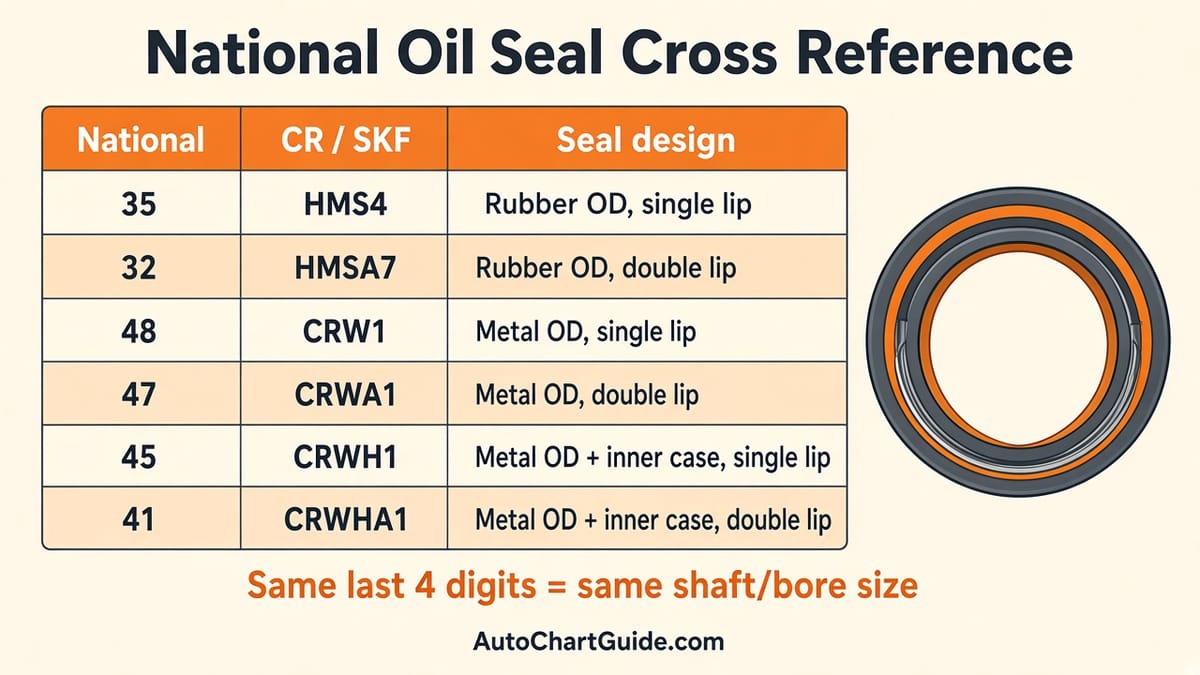
A National oil seal cross reference chart answers two questions: which Chicago Rawhide (CR/SKF) or other-brand seal matches a National seal style, and how to read a National part number well enough to tell if two seals share the same size. The short version: National 35 = CR/SKF HMS4, 32 = HMSA7, 48 = CRW1, 47 = CRWA1, 45 = CRWH1 and 41 = CRWHA1. In a six-digit National general-purpose number, the first two digits usually give the seal type and the last four point to a shaft-and-bore size. The style crosswalk below comes from published interchange sheets by GBSA and Daemar, which agree on the National-to-CR pairs. The part-number rules and size examples come from Timken's own National Industrial Seals catalog. National is a Timken brand.
Quick answer: National to CR/SKF style chart
| National style | CR/SKF style | Outer diameter (OD) | Lip | Spring |
|---|---|---|---|---|
| 35 | HMS4 | Rubber covered | Single | Garter spring |
| 32 | HMSA7 | Rubber covered | Double (main lip + dust lip) | Garter spring |
| 48 | CRW1 | Metal, ground | Single | Garter spring |
| 47 | CRWA1 | Metal, ground | Double | Garter spring |
| 45 | CRWH1 | Metal with inner case | Single | Garter spring |
| 41 | CRWHA1 | Metal with inner case | Double | Garter spring |
Both interchange sheets we used (GBSA's oil seal style cross reference and Daemar's National and SKF/CR interchange) list exactly these six pairs. GBSA also lists National 44 in its metal-OD, single-lip, springless column. Timken's catalog puts type 44 among its springless designs for grease retention and slow-speed use.
National style vs other brands
GBSA's sheet goes beyond CR/SKF. Here are the same seal designs under other common brands' style codes, so you can cross a National style to a NOK, Freudenberg (Simrit), Garlock or Dichtomatik equivalent.
| Design | National | CR/SKF | NOK | Freudenberg (Simriz) | Garlock | Dichtomatik | Goetze |
|---|---|---|---|---|---|---|---|
| Rubber OD, single lip, spring | 35 | HMS4 | SC | BA | 92 | WA | 827N |
| Rubber OD, double lip, spring | 32 | HMSA7 | TC | BASL | 94 | WAS | 827S |
| Metal OD, single lip, spring | 48 | CRW1 | SB | B1 | 76 | WB | 822N |
| Metal OD, double lip, spring | 47 | CRWA1 | TB | B1SL | 78 | WBS | 822S |
| Metal OD, single lip, no spring | 44 | - | VB | B1OF | 71 | WBO | - |
| Metal OD + inner case, single lip | 45 | CRWH1 | A2 | B2 | - | WC | 824N |
| Metal OD + inner case, double lip | 41 | CRWHA1 | TA2 | B2SL | - | WCS | 824S |
A style code says nothing about size. A National 47 and a CR CRWA1 are the same design. To get the same seal you still need the same shaft diameter, bore diameter and width, plus a compatible lip material.
How to read a National oil seal part number
Timken's National Industrial Seals catalog describes three numbering systems:
- General-purpose seals: five or six digits. "The first one or two digits usually signify seal type or construction. The last four digits refer to a specific assigned shaft and bore size combination but do not indicate seal size." Size codes are assigned in order as new shaft/bore combinations are created, so 0972 is a lookup key, not a measurement.
- Four-digit numbers are used for some seals and seal kits with mainly automotive uses. They are assigned in sequence and have no relation to size.
- Reserved blocks cover special groups: 370000A wheel-end seals, 380000A PTFE wheel-end seals, 39000-39999 PTFE seals, 200000-200500 triple-lip designs, 201000-205999 wheel seals, 220000-230000 automotive metric seals, 410000-499999 plain round seals (as printed in the catalog), 710000-799999 miscellaneous round applications, 99000 Redi-Sleeves and J/JV/JX wear sleeves.
Letter suffixes usually indicate the lip compound. For example, a V-type suffix on many brands means a fluoroelastomer lip. Timken's catalog notes that if a prefix or suffix is not in the manual, you should contact a Timken representative.
Worked example: the 0972 size family
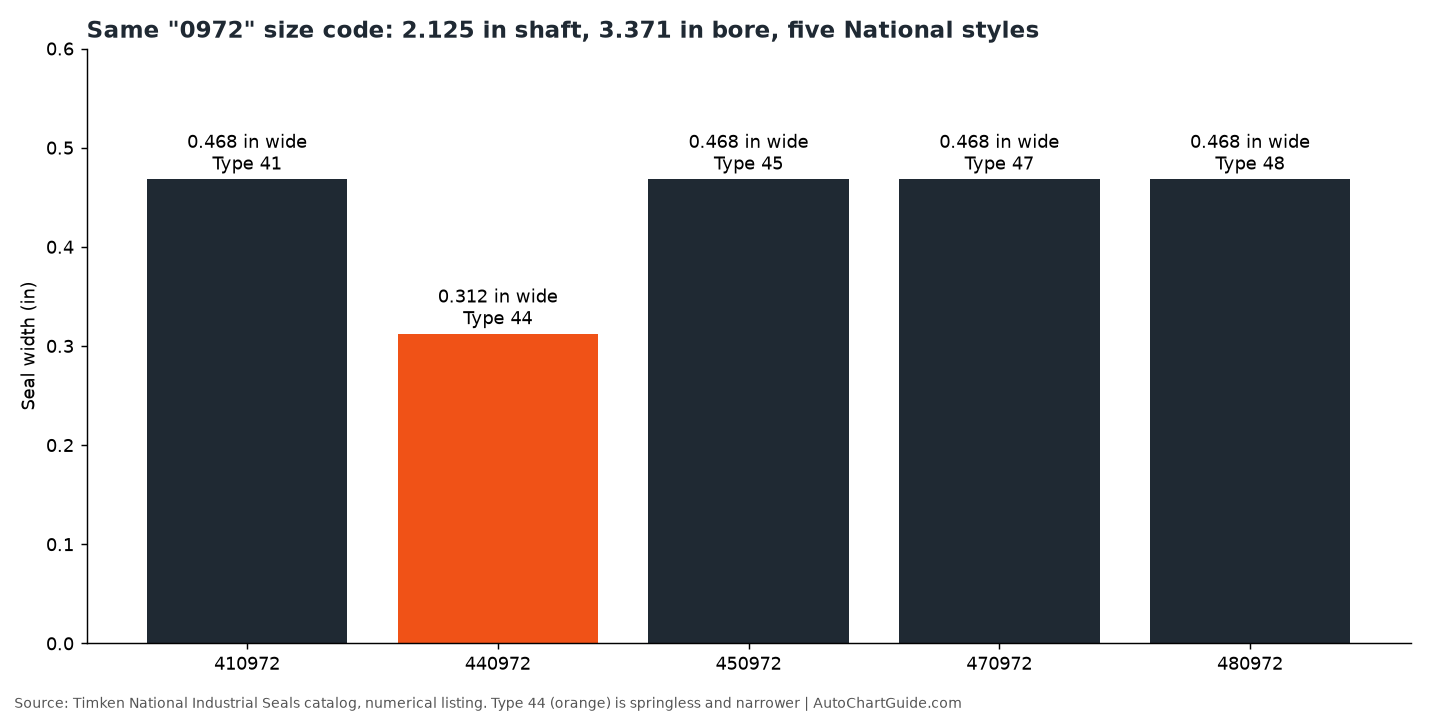
In Timken's numerical listing, five National part numbers end in 0972. Four of them have the same dimensions: 2.125 in shaft, 3.371 in housing bore, 3.376 in seal OD and 0.468 in width. The fifth, the springless type 44, is narrower:
| National part | Type | Shaft (in) | Housing bore (in) | Seal OD (in) | Width (in) | CR/SKF style |
|---|---|---|---|---|---|---|
| 410972 | 41 | 2.125 | 3.371 | 3.376 | 0.468 | CRWHA1 |
| 440972 | 44 | 2.125 | 3.371 | 3.376 | 0.312 | - |
| 450972 | 45 | 2.125 | 3.371 | 3.376 | 0.468 | CRWH1 |
| 470972 | 47 | 2.125 | 3.371 | 3.376 | 0.468 | CRWA1 |
| 480972 | 48 | 2.125 | 3.371 | 3.376 | 0.468 | CRW1 |
This is the catalog's warning in practice: seals with different first digits but the same last four "may" interchange, but only "based on whether alternative seal designs would meet the requirements of the specific application." A 440972 is 0.156 in narrower than a 470972 and has no spring. It is not a drop-in replacement for a spring-loaded double-lip seal in an oil-bath gearbox.
Second example: 0385
Timken lists 310385 (type 31) and 340385 (type 34) as 0.375 in shaft, 0.750 in housing bore and 0.250 in width. The seal ODs differ, though: 0.754 in for the 31 and 0.756 in for the 34. A few thousandths changes the press fit, so check OD as well as shaft and bore when you substitute.
Daemar's National interchange encodes size directly in its own part numbers, which makes a handy check. It maps National 310385, 340385 and 350385 to Daemar S03707525AO / AO / A, i.e. 0.375 x 0.750 x 0.250 in. The profile letters (AO vs A) show that a different lip design sits behind the same size.
How to cross a competitor part number to National
If you have an OEM or competitor number rather than a National one, use Timken's tools:
- Timken Seal Interchange Guide. A printed index of other manufacturers' numbers with the matching Timken/National number, sorted number-first, then alphabetically. For example, it lists NOK UF0496E and Cummins S16134 both crossing to National 340385, and Ford E3HZ4573C crossing to 415164N.
- Timken Seal Selection Tool. The online tool has a "Competitor Interchange" search: choose the brand, enter the part number and it returns Timken equivalents. It also searches by size and supports wildcard part searches (at least three characters before the *).
- Catalog interchange section. The National industrial catalog has its own interchange guide with manufacturer abbreviations, an alphabetical listing and a numerical listing.
Treat a cross reference as a starting point. Interchange books map to the nearest equivalent in that maker's line, which may differ in lip count, material or width. Confirm the size and design before you order. If the machine maker supplies the seal, its part number is still the best reference. Our guide on when to call the dealer for a part number covers when that is worth doing.
Step-by-step: finding a replacement for a National seal
- Read the old seal. National numbers are usually stamped or printed on the case face. Write down any prefix and suffix too.
- Split the number. For a six-digit general-purpose number, the first two digits are the type and the last four are the size code.
- Look it up in the numerical listing to get shaft, housing bore, seal OD and width.
- Translate the type to the other brand's style with the chart above (for example 47 to CRWA1).
- Search that brand by size and style. Use the brand's own catalog or tool, not a generic marketplace listing.
- Match the lip material to the fluid and temperature, for example nitrile for general oil and fluoroelastomer for heat.
- Check the shaft. If the old lip wore a groove, a new seal will leak. Fit a wear sleeve (Timken's Redi-Sleeve range is in the 99000 block) or move the lip position.
Choosing between the styles
Rubber OD (35 / 32)
A rubber-covered OD tolerates housing bores that are slightly rough or expand with heat, and it seals better in soft-alloy housings. Daemar's notes say the elastomer outer covering tolerates thermal expansion and bore roughness and prevents fretting corrosion. It is the usual pick for aluminum housings and seals that get replaced often.
Metal OD (48 / 47)
A metal OD is easier to press in straight but needs a closer-tolerance bore to seal on the outside diameter. It is common in cast-iron and steel housings and makes up the bulk of general industrial seals.
Metal OD with inner case (45 / 41)
An inner reinforcing case stiffens the seal. Daemar recommends it for rougher conditions and larger sizes, and it is less sensitive to installation damage. Timken's listing has more type 45, 47, 48 and 41 parts than any other style.
Single vs double lip
The second lip on 32, 47 and 41 seals is a dust or exclusion lip facing outward. It keeps dirt and water away from the main lip. Use a double lip where the seal faces outside contamination, such as wheel ends, farm machinery and pumps.
Springless (44 and others)
Without a garter spring, lip pressure is lower. Timken groups springless designs under grease retention and slow-speed applications, with lower surface-speed ratings than spring-loaded types. Don't substitute one into a high-speed oil application.
Installation and failure checks from the National catalog
Timken's catalog includes a full installation and troubleshooting section. The points that matter most when you fit a cross-referenced seal:
- Shaft finish: about 10-20 microinch for spring-loaded designs, and no lead marks, which pump oil past the lip.
- Shaft hardness: above Rockwell C-45 for the spring-loaded types in the design table.
- Chamfer the shaft to avoid cutting the lip, and protect keyways and splines with a sleeve during installation.
- Lip direction: the sealing lip usually faces toward the fluid being sealed.
- Pre-lube the lip with the fluid it will seal.
- Press squarely with a driver that bears on the case near the OD. A cocked seal leaks.
Most early leaks come from the shaft, the bore or the installation, not from the brand. Swapping 47 for CRWA1 won't fix a grooved shaft.
Common mistakes with oil seal cross references
- Matching style but not size. HMS4 is a design, not a part. Every size exists in that style.
- Assuming equal last four digits means identical seals. The 0972 family shows the width can change (0.312 vs 0.468 in), and the 0385 pair shows the OD can too.
- Ignoring material suffixes. A nitrile seal in a hot fluoroelastomer application hardens and cracks.
- Trusting a marketplace "fits" claim. Our guide to parts you should not interchange explains why fit claims need a primary source.
- Reading the exploded view wrong. On equipment diagrams the seal often hides behind the bearing callout. See how to read an exploded parts diagram.
Frequently asked questions
What is the CR/SKF equivalent of a National 47 seal?
A National 47 is a metal-OD, double-lip, spring-loaded seal, the same design as CR/SKF CRWA1. Match the shaft, bore and width separately.
What is the National equivalent of SKF HMS4?
National style 35, a rubber-covered OD, single-lip seal with a garter spring. HMSA7 (rubber OD, double lip) corresponds to National 32.
What do the digits in a National oil seal number mean?
In five- or six-digit general-purpose numbers, the first one or two digits usually give the seal type and the last four are an assigned shaft/bore size code. The code is a lookup key, not a measurement.
Are National seals with the same last four digits interchangeable?
Sometimes. Timken says they may interchange if the alternative design meets the application. In the catalog, 440972 is 0.312 in wide while 410972, 450972, 470972 and 480972 are 0.468 in, so check every dimension.
Who makes National oil seals?
National is a Timken brand. Timken publishes the National Industrial Seals catalog, a Seal Interchange Guide and an online Seal Selection Tool with competitor interchange search.
How do I cross an OEM seal number to National?
Look it up in Timken's Seal Interchange Guide, or use the Competitor Interchange search in the Timken Seal Selection Tool. Then confirm the size and style in the numerical listing.
What does the letter at the end of a National seal number mean?
Letter suffixes usually indicate the lip compound. If a suffix is not in the catalog, Timken advises contacting a representative.
Is National 45 the same as CRWH1?
Yes, by design. Both are metal-OD seals with an inner reinforcing case and a single spring-loaded lip. The double-lip version is National 41 / CR CRWHA1.