Car Battery Group Size Chart 2026: Complete BCI Guide
Car battery group size chart from BCI data: max dimensions, terminals and CCA ranges for 90 groups, plus H6/LN3 and JIS cross references.

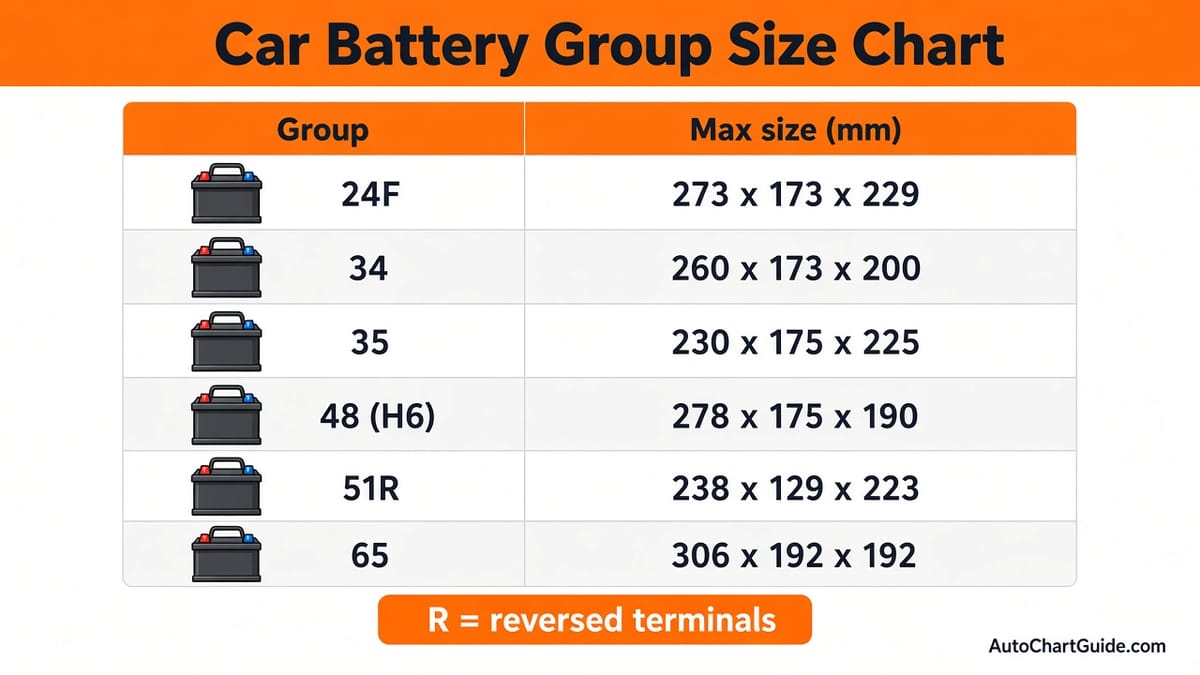
Short answer: a car battery group size chart tells you the largest case a battery in each Battery Council International (BCI) group can have, plus where its terminals sit. The groups you meet most in parts stores range from the compact 151R at 188 x 125 x 225 mm to the long group 49 (H8) at 353 x 175 x 190 mm. A group 24F is 273 x 173 x 229 mm, a 35 is 230 x 175 x 225 mm, a 48 (H6) is 278 x 175 x 190 mm and a 65 is 306 x 192 x 192 mm. Match the group your vehicle calls for, including any R or F suffix, and then check cold cranking amps separately.
Every dimension, terminal type and cold cranking range below comes from BCI's own document, BCI Group Numbers, Dimensional Specifications and Ratings, downloaded and read on 2026-10-26, and from BCI's group sizes page, read the same day. The DIN, EN and JIS cross references are BCI's "best fit estimate" tables from the same PDF. This chart describes the standard. It does not tell you which group your car uses; that comes from your owner's manual, the label on the battery that came with the car, or a retailer's application lookup.
What a battery group size actually fixes
BCI's group sizes page says batteries "are classified into numbered group sizes according to their voltage, maximum overall dimensions, terminal arrangement, and special features that may affect battery fit." It adds that batteries within a group "must be the same physical size (i.e., within 2mm)". That is the whole point of the number. A group is a promise about the box and the posts, so that a battery from any brand drops into the same tray, clears the same hood and lines up with the same cables.
The dimensions in the chart are maximums. BCI heads the columns "Maximum Overall Dimensions", which means a real battery in that group can be a little smaller but should not be bigger. The length is the long side, the width is the short side, and the height is measured to the top of the terminals. For one group, the footnote matters: BCI notes that the group 75 height "includes batteries with raised quarter cover design" and that a flat-top version is about 10 mm (3/8 inch) lower.
What the group does not fix is performance. The cold cranking figures in BCI's table sit under a heading that says "O.E. Performance Ranges (for Reference Only)". A group 24 shows a range from 200 to 1000 cold cranking amps, which tells you the case has been filled with very different batteries over the years. Our guide to CCA, reserve capacity and amp-hour ratings explains how to read those numbers once you have the right size.
Car battery group size chart: popular groups at a glance
The table below pulls out seventeen groups that cover the main case families: the narrow Japanese-style 51 and 151R cases, the classic American top-post 24, 25, 34 and 35 family, the European-style 47, 48, 49 and 94R cases with hold-down ledges, the wide 65, the side-terminal 75 and 78, and the 121R, 124R and 140R cases. All figures are BCI maximums.
| Group | Max L x W x H (mm) | Max L x W x H (in) | Terminals | Reference CCA range | Note |
|---|---|---|---|---|---|
| 151R | 188 x 125 x 225 | 7 7/16 x 4 15/16 x 8 7/8 | SAE top post | 340-370 | |
| 51R | 238 x 129 x 223 | 9 3/8 x 5 1/16 x 8 3/4 | SAE top post, EN/JIS post | 295-500 | JIS B24L family |
| 26 | 208 x 173 x 197 | 8 3/16 x 6 13/16 x 7 3/4 | SAE top post, EN/JIS post | 245-800 | |
| 25 | 230 x 175 x 225 | 9 1/16 x 6 15/16 x 8 7/8 | SAE top post, EN/JIS post | 260-660 | Same case as 35, posts reversed |
| 35 | 230 x 175 x 225 | 9 1/16 x 6 15/16 x 8 7/8 | SAE top post, EN/JIS post | 300-640 | JIS D23L family |
| 47 | 242 x 175 x 190 | 9 9/16 x 6 15/16 x 7 1/2 | SAE top post, DIN post, F | 290-680 | DIN H5 / EN LN2 |
| 24F | 273 x 173 x 229 | 10 3/4 x 6 13/16 x 9 | SAE top post, EN/JIS post | 250-900 | Longer than 24, figure 11F |
| 34 | 260 x 173 x 200 | 10 1/4 x 6 13/16 x 7 7/8 | SAE top post | 235-1000 | |
| 48 | 278 x 175 x 190 | 11 x 6 15/16 x 7 1/2 | SAE top post, DIN post, EN/JIS post | 315-850 | DIN H6 / EN LN3 |
| 94R | 315 x 175 x 190 | 12 7/16 x 6 15/16 x 7 1/2 | DIN post, EN/JIS post | 440-900 | DIN H7 / EN LN4 |
| 65 | 306 x 192 x 192 | 12 1/16 x 7 9/16 x 7 9/16 | SAE top post | 540-880 | Widest of this list |
| 49 | 353 x 175 x 190 | 13 15/16 x 6 15/16 x 7 1/2 | SAE top post, DIN post, EN/JIS post | 470-950 | DIN H8 / EN LN5 |
| 75 | 230 x 180 x 186 | 9 1/16 x 7 1/16 x 7 5/16 | Side | 425-690 | Side terminal |
| 78 | 260 x 180 x 186 | 10 1/4 x 7 1/16 x 7 5/16 | Side | 465-875 | Side terminal |
| 121R | 208 x 177 x 215 | 8 1/4 x 7 x 8 1/2 | SAE top post | 410-600 | |
| 124R | 262 x 177 x 218 | 10 3/8 x 7 x 8 5/8 | SAE top post | 500-740 | |
| 140R | 207 x 175 x 190 | 8 1/8 x 6 15/16 x 7 1/2 | SAE top post | 285-570 | DIN H4 / EN LN1 |
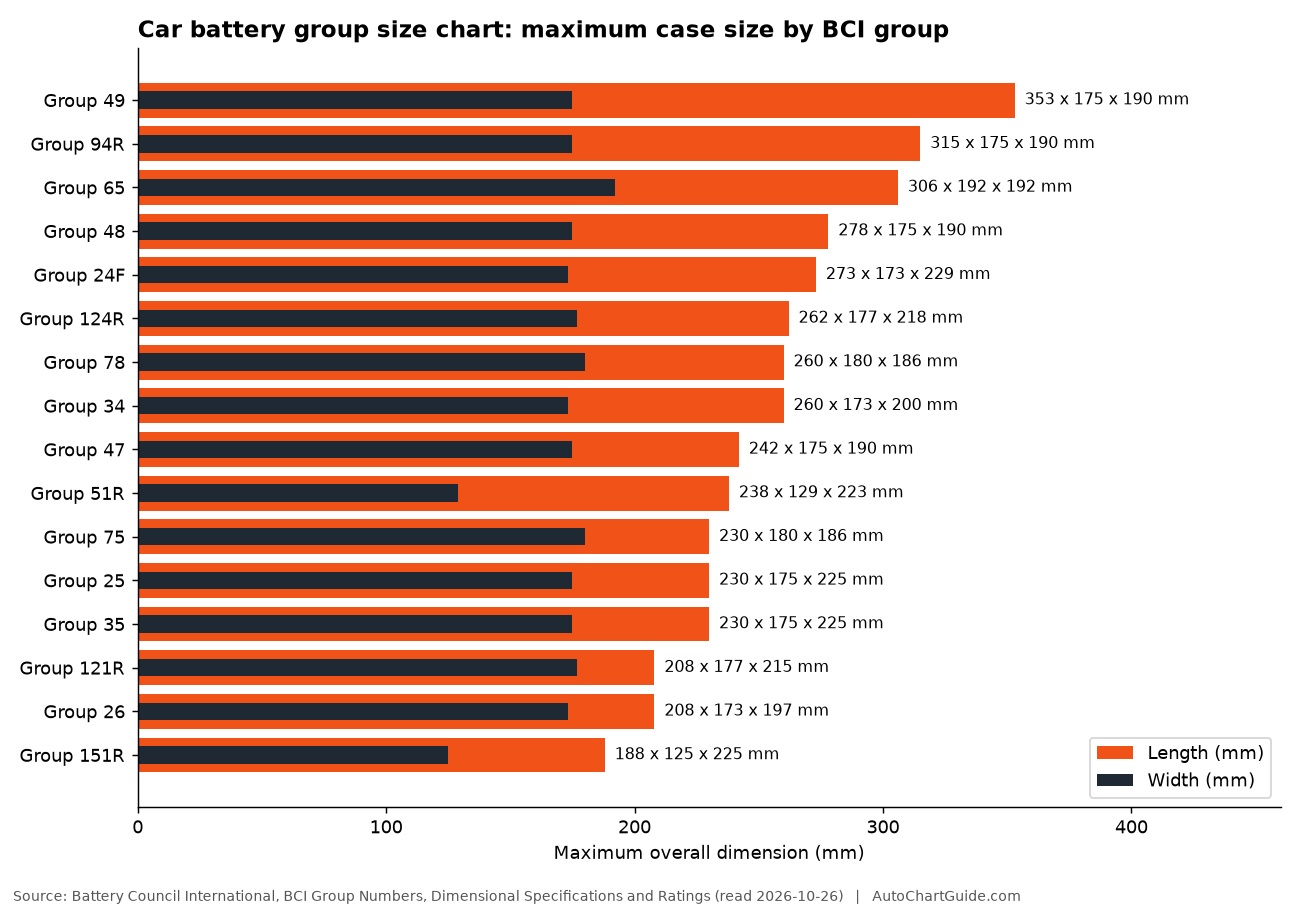
Two things stand out when you line them up. First, many groups share a width. Groups 24, 24F, 27, 34 and 26 are all 173 mm wide, and the European-style 47, 48, 49 and 94R are all 175 mm wide, so the tray width rarely tells you much. Length and height do the sorting. Second, a group 25 and a group 35 have exactly the same case dimensions, 230 x 175 x 225 mm. The difference is the assembly figure: 25 is figure 10 and 35 is figure 11, which puts the posts in the opposite positions. That is why the number has to match, not just the size.
Full BCI chart: passenger car and light commercial 12-volt groups
This is every 12-volt passenger car and light commercial group in BCI's dimensional table, 90 in all. Inches are BCI's own conversions, not rounded by us. The terminal column uses BCI codes: A is an SAE top post, A1 a DIN post, A2 an EN/JIS post, S a side terminal, F a special type BCI shows for group 47, and Aux an auxiliary terminal used on small accessory batteries. Where BCI prints "---" for amp-hours, it has no reference range for that group.
| Group | Max L x W x H (mm) | Max L x W x H (in) | Terminals | Reference CCA | BCI figure | Reference Ah |
|---|---|---|---|---|---|---|
| 21 | 208 x 173 x 222 | 8 3/16 x 6 13/16 x 8 3/4 | SAE top post, EN/JIS post | 305-420 | 10 | --- |
| 21R | 208 x 173 x 222 | 8 3/16 x 6 13/16 x 8 3/4 | SAE top post, EN/JIS post | 310-490 | 11 | --- |
| 22F | 241 x 175 x 211 | 9 1/2 x 6 15/16 x 8 5/16 | SAE top post | 220-500 | 11F | --- |
| 22HF | 241 x 175 x 229 | 9 1/2 x 6 15/16 x 9 | SAE top post | 290 | 11F | --- |
| 22NF | 240 x 140 x 227 | 9 7/16 x 5 1/2 x 8 15/16 | SAE top post, EN/JIS post | 165-550 | 11F | --- |
| 24 | 260 x 173 x 225 | 10 1/4 x 6 13/16 x 8 7/8 | SAE top post, EN/JIS post | 200-1000 | 10 | 70 |
| 24F | 273 x 173 x 229 | 10 3/4 x 6 13/16 x 9 | SAE top post, EN/JIS post | 250-900 | 11F | 65-70 |
| 24H | 260 x 173 x 238 | 10 1/4 x 6 13/16 x 9 3/8 | SAE top post | 315-410 | 10 | --- |
| 24R | 260 x 173 x 229 | 10 1/4 x 6 13/16 x 9 | SAE top post, EN/JIS post | 585 | 11 | --- |
| 24T | 260 x 173 x 248 | 10 1/4 x 6 13/16 x 9 3/4 | SAE top post | 370-900 | 10 | --- |
| 25 | 230 x 175 x 225 | 9 1/16 x 6 15/16 x 8 7/8 | SAE top post, EN/JIS post | 260-660 | 10 | --- |
| 26 | 208 x 173 x 197 | 8 3/16 x 6 13/16 x 7 3/4 | SAE top post, EN/JIS post | 245-800 | 10 | --- |
| 26R | 208 x 173 x 197 | 8 3/16 x 6 13/16 x 7 3/4 | SAE top post | 235-675 | 11 | --- |
| 27 | 306 x 173 x 225 | 12 1/16 x 6 13/16 x 8 7/8 | SAE top post, EN/JIS post | 240-810 | 10 | --- |
| 27F | 318 x 173 x 227 | 12 1/2 x 6 13/16 x 8 15/16 | SAE top post, EN/JIS post | 315-780 | 11F | 80 |
| 27H | 298 x 173 x 235 | 11 3/4 x 6 13/16 x 9 1/4 | SAE top post | 420-440 | 10 | --- |
| 27R | 306 x 173 x 225 | 12 1/16 x 6 13/16 x 8 7/8 | SAE top post, EN/JIS post | 270-700 | 11 | --- |
| 29NF | 330 x 140 x 227 | 13 x 5 1/2 x 8 15/16 | SAE top post | 280-430 | 11F | --- |
| 33 | 338 x 173 x 238 | 13 5/16 x 6 13/16 x 9 3/8 | SAE top post | 1050 | 11F | --- |
| 34 | 260 x 173 x 200 | 10 1/4 x 6 13/16 x 7 7/8 | SAE top post | 235-1000 | 10 | 70 |
| 34R | 260 x 173 x 200 | 10 1/4 x 6 13/16 x 7 7/8 | SAE top post | 450-850 | 11 | 100 |
| 35 | 230 x 175 x 225 | 9 1/16 x 6 15/16 x 8 7/8 | SAE top post, EN/JIS post | 300-640 | 11 | 48-113 |
| 36R | 263 x 183 x 206 | 10 3/8 x 7 3/16 x 8 1/8 | SAE top post | 540-650 | 19 | --- |
| 40R | 278 x 175 x 175 | 11 x 6 15/16 x 6 15/16 | SAE top post, DIN post | 550-650 | 15 | --- |
| 41 | 293 x 175 x 175 | 11 9/16 x 6 15/16 x 6 15/16 | SAE top post, DIN post | 300-720 | 15 | --- |
| 42 | 242 x 175 x 175 | 9 9/16 x 6 15/16 x 6 15/16 | SAE top post, DIN post | 210-500 | 15 | --- |
| 43 | 334 x 175 x 205 | 13 1/8 x 6 15/16 x 8 1/16 | SAE top post, DIN post | 495 | 15 | --- |
| 45 | 240 x 140 x 227 | 9 7/16 x 5 1/2 x 8 15/16 | SAE top post, EN/JIS post | 235-500 | 10F | --- |
| 46 | 273 x 173 x 229 | 10 3/4 x 6 13/16 x 9 | SAE top post, DIN post | 315-450 | 10F | --- |
| 47 | 242 x 175 x 190 | 9 9/16 x 6 15/16 x 7 1/2 | SAE top post, DIN post, F | 290-680 | 24 | 45-64 |
| 48 | 278 x 175 x 190 | 11 x 6 15/16 x 7 1/2 | SAE top post, DIN post, EN/JIS post | 315-850 | 24 | 60-80 |
| 49 | 353 x 175 x 190 | 13 15/16 x 6 15/16 x 7 1/2 | SAE top post, DIN post, EN/JIS post | 470-950 | 24 | 72-100 |
| 50 | 343 x 127 x 254 | 13 1/2 x 5 x 10 | SAE top post | 500-600 | 10 | --- |
| 51 | 238 x 129 x 223 | 9 3/8 x 5 1/16 x 8 3/4 | SAE top post, EN/JIS post | 270-500 | 10 | --- |
| 51R | 238 x 129 x 223 | 9 3/8 x 5 1/16 x 8 3/4 | SAE top post, EN/JIS post | 295-500 | 11 | --- |
| 52 | 186 x 147 x 210 | 7 5/16 x 5 13/16 x 8 1/4 | SAE top post | 405 | 10 | --- |
| 53 | 330 x 119 x 210 | 13 x 4 11/16 x 8 1/4 | SAE top post | 210-350 | 14 | --- |
| 54 | 186 x 154 x 212 | 7 5/16 x 6 1/16 x 8 3/8 | SAE top post | 305-330 | 19 | --- |
| 55 | 218 x 154 x 212 | 8 9/16 x 6 1/16 x 8 3/8 | SAE top post | 370-580 | 19 | --- |
| 56 | 254 x 154 x 212 | 10 x 6 1/16 x 8 3/8 | SAE top post | 350-550 | 19 | --- |
| 57 | 205 x 183 x 177 | 8 1/16 x 7 3/16 x 6 15/16 | SAE top post | 310 | 22 | --- |
| 58 | 255 x 183 x 177 | 10 1/16 x 7 3/16 x 6 15/16 | SAE top post | 245-550 | 26 | --- |
| 58R | 255 x 183 x 177 | 10 1/16 x 7 3/16 x 6 15/16 | SAE top post | 540-580 | 19 | --- |
| 59 | 255 x 193 x 196 | 10 1/16 x 7 11/16 x 7 3/4 | SAE top post | 540 | 21 | --- |
| 60 | 332 x 160 x 225 | 13 1/16 x 6 5/16 x 8 7/8 | SAE top post | 260-950 | 12 | --- |
| 61 | 192 x 162 x 225 | 7 9/16 x 6 3/8 x 8 7/8 | SAE top post | 310 | 20 | --- |
| 62 | 225 x 162 x 225 | 8 7/8 x 6 3/8 x 8 7/8 | SAE top post | 310-535 | 20 | --- |
| 63 | 258 x 162 x 225 | 10 3/16 x 6 3/8 x 8 7/8 | SAE top post | 450 | 20 | --- |
| 64 | 296 x 162 x 225 | 11 5/8 x 6 3/8 x 8 7/8 | SAE top post | 380-535 | 20 | --- |
| 65 | 306 x 192 x 192 | 12 1/16 x 7 9/16 x 7 9/16 | SAE top post | 540-880 | 21 | 70 |
| 66 | 306 x 192 x 194 | 12 1/16 x 7 9/16 x 7 11/16 | SAE top post | 650-750 | 13 | --- |
| 67R | 231 x 175 x 176 | 9 1/8 x 6 15/16 x 6 15/16 | SAE top post | 390 | 39 | --- |
| 70 | 208 x 180 x 186 | 8 3/16 x 7 1/16 x 7 5/16 | Side | 250-675 | 17 | --- |
| 71 | 208 x 179 x 216 | 8 3/16 x 7 1/16 x 8 1/2 | Side | 275-650 | 17 | --- |
| 72 | 230 x 179 x 210 | 9 1/16 x 7 1/16 x 8 1/4 | Side | 265-465 | 17 | --- |
| 73 | 230 x 179 x 216 | 9 1/16 x 7 1/16 x 8 1/2 | Side | 425-500 | 17 | --- |
| 74 | 260 x 184 x 222 | 10 1/4 x 7 1/4 x 8 3/4 | Side | 265-650 | 17 | --- |
| 75 | 230 x 180 x 186 | 9 1/16 x 7 1/16 x 7 5/16 | Side | 425-690 | 17 | --- |
| 76 | 334 x 179 x 216 | 13 1/8 x 7 1/16 x 8 1/2 | Side | 750-1075 | 17 | --- |
| 77 | 306 x 184 x 222 | 12 1/16 x 7 1/4 x 8 3/4 | SAE top post | 350-465 | 17 | --- |
| 78 | 260 x 180 x 186 | 10 1/4 x 7 1/16 x 7 5/16 | Side | 465-875 | 17 | 63 |
| 79 | 307 x 179 x 188 | 12 1/16 x 7 1/16 x 7 3/8 | Side | 800-840 | 35 | --- |
| 85 | 230 x 173 x 203 | 9 1/16 x 6 13/16 x 8 | SAE top post | 430-650 | 11 | --- |
| 86 | 230 x 173 x 203 | 9 1/16 x 6 13/16 x 8 | SAE top post | 430-640 | 10 | --- |
| 90 | 242 x 175 x 175 | 9 9/16 x 6 15/16 x 6 15/16 | DIN post, EN/JIS post | 450-600 | 24 | --- |
| 91 | 278 x 175 x 175 | 11 x 6 15/16 x 6 15/16 | DIN post, EN/JIS post | 590-700 | 24 | --- |
| 92 | 315 x 175 x 175 | 12 7/16 x 6 15/16 x 6 15/16 | DIN post, EN/JIS post | 575-720 | 24 | 80 |
| 93 | 353 x 175 x 175 | 13 15/16 x 6 15/16 x 6 15/16 | DIN post, EN/JIS post | 600-800 | 24 | 90 |
| 94R | 315 x 175 x 190 | 12 7/16 x 6 15/16 x 7 1/2 | DIN post, EN/JIS post | 440-900 | 24 | 61-100 |
| 95R | 394 x 175 x 190 | 15 9/16 x 6 15/16 x 7 1/2 | DIN post, EN/JIS post | 800-950 | 24 | 105-115 |
| 96R | 242 x 175 x 175 | 9 1/2 x 6 15/16 x 6 15/16 | SAE top post, DIN post | 400-590 | 15 | 60 |
| 97R | 252 x 175 x 190 | 9 15/16 x 6 15/16 x 7 1/2 | DIN post, EN/JIS post | 575 | 15 | --- |
| 98R | 283 x 175 x 190 | 11 1/8 x 6 15/16 x 7 1/2 | DIN post, EN/JIS post | 620-760 | 15 | --- |
| 99 | 207 x 175 x 175 | 8 1/8 x 6 15/16 x 6 15/16 | DIN post | 470 | 34 | --- |
| 99R | 207 x 175 x 175 | 8 1/8 x 6 15/16 x 6 15/16 | DIN post | 390-470 | 24 | 44 |
| 100 | 260 x 179 x 188 | 10 1/4 x 7 1/16 x 7 3/8 | Side | 770 | 35 | --- |
| 101 | 260 x 179 x 170 | 10 1/4 x 7 1/16 x 6 11/16 | Side | 540 | 17 | --- |
| 102R | 207 x 175 x 139 | 8 1/8 x 6 15/16 x 5 1/2 | SAE top post | --- | 24 | 35 |
| 121R | 208 x 177 x 215 | 8 1/4 x 7 x 8 1/2 | SAE top post | 410-600 | 11H | --- |
| 124 | 265 x 175 x 214 | 10 7/16 x 6 15/16 x 8 7/16 | SAE top post | 600 | 40 | --- |
| 124R | 262 x 177 x 218 | 10 3/8 x 7 x 8 5/8 | SAE top post | 500-740 | 11H | 68-80 |
| 140R | 207 x 175 x 190 | 8 1/8 x 6 15/16 x 7 1/2 | SAE top post | 285-570 | 24 | 44-51 |
| 148 | 278 x 175 x 190 | 11 x 6 15/16 x 7 1/2 | DIN post, EN/JIS post | 595-600 | 34 | 70 |
| 151R | 188 x 125 x 225 | 7 7/16 x 4 15/16 x 8 7/8 | SAE top post | 340-370 | 28 | --- |
| 152R | 260 x 173 x 225 | 10 1/4 x 6 7/8 x 8 7/8 | EN/JIS post | 605-780 | 28 | 70 |
| 153R | 175 x 175 x 190 | 6 15/16 x 6 15/16 x 7 1/2 | DIN post, EN/JIS post | 300-480 | 24 | 40 |
| 400 | 150 x 88 x 143 | 5 7/8 x 3 7/16 x 5 5/8 | Auxiliary | 200 | 41 | 12 |
| 401 | 150 x 88 x 130 | 5 7/8 x 3 7/16 x 5 1/8 | Auxiliary | 170-180 | 41 | 10 |
| 402R | 198 x 132 x 188 | 7 13/16 x 5 3/16 x 7 3/8 | SAE top post | --- | 28 | 30-33 |
| 403 | 150 x 87 x 145 | 5 7/8 x 3 7/16 x 5 11/16 | EN/JIS post | 200 | 42 | 14 |
How to read the suffix letters
The letters after a group number are where most wrong purchases happen, because two batteries with nearly the same number can be the same size but wired backwards for your car. BCI's figures show what each letter changes.
R: reversed terminals
An R group has the positive and negative posts in the opposite corners from the base group. BCI draws the base 24 as assembly figure 10 and the 24R as figure 11. On the dimensional table the case is the same footprint, 260 x 173 mm, although BCI lists the 24R at 229 mm high against 225 mm for the 24. The same pattern appears with 51 and 51R (both 238 x 129 x 223 mm) and with 26 and 26R. If you fit a 24 where a 24R belongs, the cables may not reach, or may reach only by stretching across the case, which is how terminals get shorted against metal.
F: a different layout, often longer
The F suffix does not mean "reversed" in a simple way. Groups like 22F, 24F, 27F and 29NF use assembly figure 11F, a different terminal layout. A 24F is also longer than a 24, at 273 mm against 260 mm. Treat F as its own group rather than a variant you can swap freely.
H, T and N: height and narrow cases
Within the 24 family, the letters track height. The 24 is 225 mm tall, the 24H is 238 mm and the 24T is 248 mm, with the same 260 x 173 mm footprint. A taller case can hit the hood or a strut brace even when the tray fits. An N in groups like 22NF and 29NF marks a narrower case, 140 mm wide instead of 173 to 175 mm.
Groups with no suffix that still mirror another
Not every reversed pair uses R. BCI's footnote says "148 is equivalent to a reversed termination 48 (H6)". On the DIN chart the 148 has its positive terminal on the left, while the 48 has it on the right. The 99 and 99R are another pair: same 207 x 175 x 175 mm case, positive terminal left on the 99 and right on the 99R.
European H and L codes and how they map to BCI groups
Many newer vehicles, especially European brands and a growing number of others, use batteries labeled with DIN codes like H6 or EN codes like LN3 rather than a BCI number. BCI's reference chart gives its best-fit match for each. These are the pairs from that chart, with BCI's dimensions:
| BCI group | DIN code | EN code | Max L x W x H (mm) | Hold-down | Lifting ledge | Positive terminal |
|---|---|---|---|---|---|---|
| 40R | T6 | LBN3 | 278 x 175 x 175 | B1 | No | Right |
| 42 | T5 | LBN2 | 242 x 175 x 175 | B4 | No | Right |
| 47 | H5 | LN2 | 242 x 175 x 190 | B3 | Yes | Right |
| 48 | H6 | LN3 | 278 x 175 x 190 | B3 | Yes | Right |
| 49 | H8 | LN5 | 353 x 175 x 190 | B3 | Yes | Right |
| 90 | T5 | LBN2 | 242 x 175 x 175 | B3 | Yes | Right |
| 91 | T6 | LBN3 | 278 x 175 x 175 | B3 | Yes | Right |
| 92 | T7 | LBN4 | 315 x 175 x 175 | B3 | Yes | Right |
| 93 | T8 | LBN5 | 353 x 175 x 175 | B3 | Yes | Right |
| 94R | H7 | LN4 | 315 x 175 x 190 | B3 | Yes | Right |
| 95R | H9 | LN6 | 394 x 175 x 190 | B3 | No | Right |
| 97R | H5 | LN2 | 252 x 175 x 190 | B4 | No | Right |
| 98R | H6 | LN3 | 283 x 175 x 190 | B4 | Yes | Right |
| 99 | T4 | LBN1 | 207 x 175 x 175 | B3 | Yes | Left |
| 99R | T4 | LBN1 | 207 x 175 x 175 | B3 | Yes | Right |
| 140R | H4 | LN1 | 207 x 175 x 190 | B3 | Yes | Right |
| 148 | H6 | LN3 | 278 x 175 x 190 | B3 | Yes | Left |
| 153R | H3 | LN0 | 175 x 175 x 190 | B3 | Yes | Right |
Two cautions come straight from BCI. The first is the disclaimer on the chart itself, which calls the matches a "best fit estimate" and says BCI "makes no promises or warranties regarding the accuracy" of the cross reference. The second shows up in the numbers. Both 47 and 97R are listed as H5 / LN2, but the 47 is 242 mm long and the 97R is 252 mm, and the 47 has a lifting ledge while the 97R does not. So an EN code tells you the family, and the BCI table tells you which physical case you are holding.
The hold-down ledge matters more on these cases than on American top-post batteries. BCI lists three common ledge types: B1, "10.5 mm high with 3 or 5 notches on sides only"; B3, "10.5 mm high on sides with 3 or 5 notches on sides and 3 notches on ends"; and B4, "19.0 mm high on sides only". A battery that is the right size but has a different ledge may not clamp properly in a tray that holds it by the base, and a loose battery is a vibration and short-circuit risk.
Japanese JIS codes: what the numbers mean
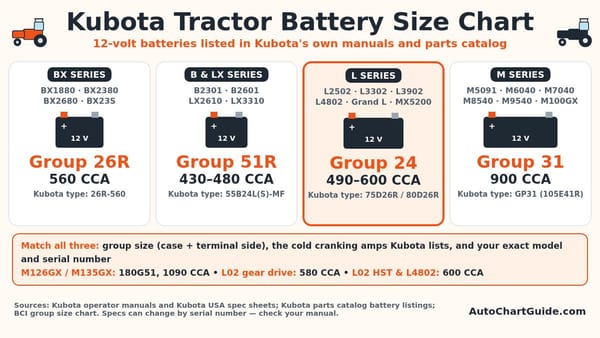
Many Asian-market vehicles leave the factory with a JIS-coded battery, such as 55D23L or 46B24R. BCI's JIS reference chart gives best-fit BCI groups for the common ones: 24 and 24R line up with the D26 family, 25 and 35 with the D23 family, 27 and 27R with D31, and 51 and 51R with B24. The chart itself shows how the codes behave. The two-digit number after the letter tracks case length in centimeters: D26 codes sit beside BCI's 260 mm group 24, D23 beside the 232 mm cases, D31 beside the 306 mm group 27, B24 beside the 238 mm group 51, and E41 beside 410 mm cases. The final letter follows terminal position, since BCI pairs group 24 with D26R codes and the reversed 24R with D26L codes. Read a JIS label that way and you can usually narrow it to one BCI family before you check exact dimensions. Our Kubota tractor battery size chart works through real examples, from the 55B24L in a B2601 to the GP31 (105E41R) in an M7040.
BCI flags a practical problem in its notes: for groups 51, 51R and 151R the "OEM post may be small diameter JIS size, connector change may be required." Some JIS batteries use thinner pencil posts, which BCI shows as terminal type A3. A replacement with standard SAE posts can be the right case and still need different clamps. BCI also notes that its group 29H "is 76 mm shorter in length than JIS Designated part", so a close match on paper is not always an exact one.
The JIS table also shows how far apart sources can be on small details. BCI's own JIS chart lists group 21 as 202 mm long, while its main dimensional table gives 208 mm. Both come from the same document. When a few millimeters decide whether a battery fits, measure your tray rather than trusting any single printed figure, including ours. Our article on why two websites give your car two different numbers covers why these gaps happen.
Side-terminal and dual-terminal groups
Several common American groups use side terminals, marked S in BCI's table: 70, 71, 72, 73, 74, 75, 76, 78, 79, 100 and 101. The bolts screw into threaded sockets on the side of the case rather than clamping onto a post. Group 77 is the exception in that run of numbers, with top posts. Group 78 is a frequent replacement size in this family, at 260 x 180 x 186 mm with a reference range of 465 to 875 cold cranking amps.
BCI's terminal chart also shows a type T threaded post and auxiliary terminals. Some aftermarket batteries carry both top posts and side terminals so one product can cover two applications. That is a retailer convenience, not a BCI group of its own. Before you buy one, make sure the unused terminals have their covers, because an exposed post near the hood can short against metal.
How to find the right group size for your car
BCI explains that it publishes a vehicle replacement database covering "over 160,000 vehicles from over 85 years". That database is sold, not free, which is why retailers and battery brands each run their own lookup tools based on it. For a do-it-yourself check, work through these steps in order.
- Read the label on the battery now in the car. The group number is usually printed on the top or side label, often as "Group 48" or "BCI 48", sometimes with the EN or DIN code beside it. If the battery is original, this is the best evidence you have.
- Check the owner's manual. Many manuals list the battery group, or at least its EN code and capacity, in the specifications or maintenance section. Our guide on where to find vehicle specs covers where else the number can hide.
- Measure the tray and the space. Take length, width and the height clearance under the hood, and compare them with the maximums in the chart above. Note which corner the positive terminal is in when you face the battery from the front of the car.
- Note the hold-down. Look at whether the battery is clamped at the top, by a bar across it, or at the base by a ledge. A base clamp needs a case with the matching ledge.
- Then compare ratings. Once the group matches, choose cold cranking amps at or above the original. Our article asking whether a higher CCA battery is better covers where extra capacity helps and where it does not.
Worked examples
A label reads "H6 / 48"
BCI's reference chart matches group 48 with DIN H6 and EN LN3. The case is 278 x 175 x 190 mm with a B3 hold-down ledge and the positive terminal on the right. If the store has only a group 148, do not take it: BCI says the 148 is a reversed-termination 48, so the posts would be on the wrong sides for your cables. If the store suggests a 98R, which BCI also lists as H6 / LN3, check its dimensions first. The 98R is 283 mm long, 5 mm longer than the 48, and uses a B4 ledge, so it may not sit in the same tray.
Choosing between a 24F and a 24
Say the old battery is a 24F and a group 24 is on sale. The 24 is 13 mm shorter and 4 mm lower, so it will physically fit in most 24F trays. But the 24F uses BCI's figure 11F layout and the 24 uses figure 10, so the terminals will not be where the cables expect them. A battery that fits the tray but not the cables is the wrong battery. Wait for the 24F.
Upgrading a 35 to a larger case
A group 35 is 230 x 175 x 225 mm. Some owners want more capacity and look at a 24F, 273 x 173 x 229 mm. That is 43 mm longer, which may or may not fit the tray, and the hold-down and cable routing were designed for the shorter case. If you want more capacity, look for a higher-rated battery in the same group first. BCI's reference range for group 35 already runs from 300 to 640 cold cranking amps.
AGM, EFB and flooded batteries in the same group
A group size says nothing about chemistry. A group 48 can be a conventional flooded battery, an enhanced flooded battery (EFB) or an absorbent glass mat (AGM) battery, all in the same case. Vehicles with stop-start systems often require AGM or EFB, and fitting a basic flooded battery of the right group can shorten its life or upset the charging system. Read our guide on replacing a flooded battery with AGM before you change type, and follow the owner's manual where it names one. Some vehicles also need the new battery registered to the charging system after replacement; the manual or a dealer can tell you if yours does.
Common mistakes when using a group size chart
- Dropping the suffix. 24 and 24F, 51 and 51R, and 48 and 148 are not interchangeable even though the numbers look alike.
- Treating the chart's CCA range as a spec. BCI labels those figures "for Reference Only". Your car's requirement comes from the original battery or the manual.
- Ignoring height. A battery that is the right length and width can still touch the hood or a brace if it is a T or H case.
- Assuming EN and DIN codes map one to one. BCI shows two different groups under the same H5 code. Check dimensions and the ledge.
- Forgetting the terminal style. JIS pencil posts, SAE posts and side terminals each need different clamps.
For the background on how the group system works, including the European and Japanese labels and the parts of fit people forget, see battery group size explained. Cold cranking amps are tested under the SAE method described in SAE J537, which is the rating BCI's table reports at 0°F (-18°C).
Frequently asked questions
What size is a group 24F battery?
BCI lists the maximum size of a group 24F battery as 273 x 173 x 229 mm (10 3/4 x 6 13/16 x 9 in), with top posts in its figure 11F layout. It is 13 mm longer than a plain group 24.
Is a group 48 the same as H6?
Yes, as a best fit. BCI's reference chart matches group 48 with DIN H6 and EN LN3, at a maximum of 278 x 175 x 190 mm with a B3 hold-down ledge. BCI also lists 98R and 148 under H6, but the 98R is longer and the 148 has reversed terminals.
What is the difference between group 24 and 24F?
The 24F is longer (273 mm against 260 mm) and slightly taller, and it uses a different terminal layout, BCI figure 11F instead of figure 10. They are not interchangeable even if the 24 fits the tray.
What does the R mean in a battery group size?
R means reversed terminals: the positive and negative posts are in the opposite corners from the base group. For example, BCI draws group 24 as figure 10 and 24R as figure 11, on the same 260 x 173 mm footprint.
Are group 25 and group 35 batteries the same size?
They have the same maximum case, 230 x 175 x 225 mm, in BCI's table. The posts are reversed: group 25 uses BCI figure 10 and group 35 uses figure 11, so one will not suit the other's cables.
Can I use a different group size battery in my car?
Only if it physically fits the tray and hold-down, clears the hood, has its terminals in the same positions and meets the original cold cranking rating. In practice, staying with the group your vehicle specifies is the safe choice.
Does a bigger group size mean a stronger battery?
Not necessarily. The group fixes case size and terminal layout. BCI's reference ranges show wide spreads within one group, such as 200 to 1000 cold cranking amps for group 24, so check the CCA rating on the label.
Where do I find my car's battery group size?
Look at the label on the current battery, the specifications section of the owner's manual, or a battery retailer's lookup tool. BCI's own vehicle replacement database is a paid publication that retailers use.
Sources
- Battery Council International, BCI Group Numbers, Dimensional Specifications and Ratings (PDF, uploaded October 2023), read 2026-10-26. Dimensions, terminal types, assembly figures, reference CCA and Ah ranges, footnotes, DIN/EN and JIS reference charts, hold-down types.
- Battery Council International, BCI Group Sizes, read 2026-10-26. Definition of a group size, 2 mm tolerance, replacement database coverage.
- SAE International, J537 Storage Batteries, standard listing, read 2026-10-26.